
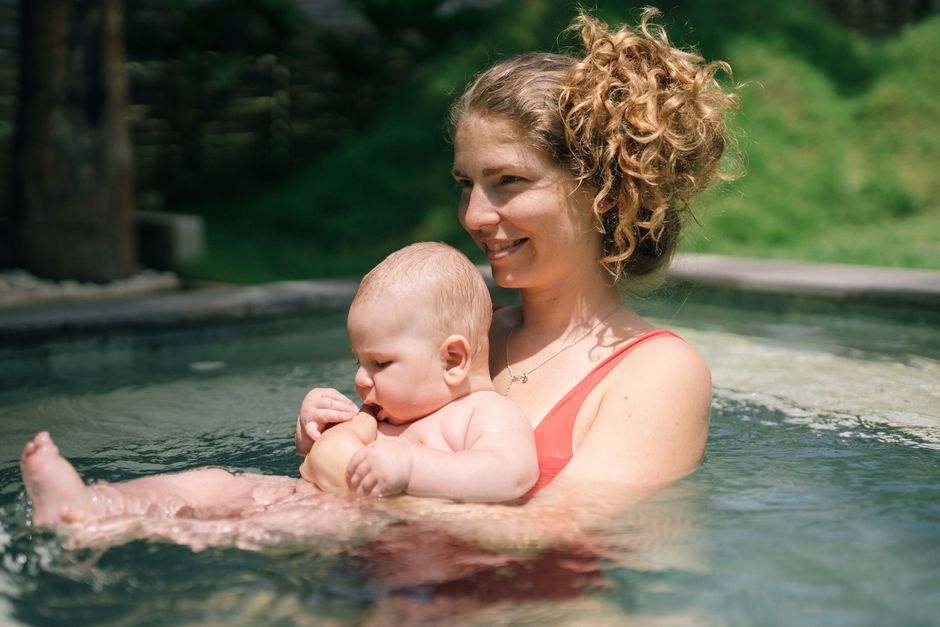
Most healthy infants can safely be in a pool before their first birthday, but the timing depends on two things: their health and the pool itself. The American Academy of Pediatrics does not set a minimum age for swimming in a pool. What matters is that the water is clean and the baby is physically ready. A baby who can hold their head up steadily and who has no active illness can generally go in a pool. The bigger risks are water temperature, water quality, and constant supervision — not age alone.
When Can An Infant Go In A Pool?
The American Academy of Pediatrics does not recommend a specific age for pool entry. It focuses instead on readiness and safety. That said, there is a practical age most pediatricians feel comfortable with.
Before 6 months, a baby’s immune system is still developing and their body cannot regulate temperature well. Many pediatricians suggest waiting until around 6 months, not because of a hard rule, but because younger babies get cold quickly and are harder to keep safe in water. Some babies go in pools earlier with a doctor’s okay — for example, in a warm, well-maintained pool with a parent holding them the entire time.
The real readiness signs are physical:
- Can the baby hold their head up without support?
- Does the baby stay alert and comfortable in the water?
- Can the baby stay warm — no shivering, no blue lips?
- Is the baby free of fever, diarrhea, or open skin wounds?
If a baby is sick, has diarrhea, or has broken skin, they should stay out of the water. Diarrhea in particular is a real concern: a baby with diarrhea can contaminate pool water and put other swimmers at risk. The CDC advises keeping anyone with diarrhea out of pools until it has fully resolved.
What Are the Real Risks of Pool Water for Babies?
The main health risks are water temperature and water quality. Both are manageable, but both matter more for babies than for adults.
Babies lose body heat faster than older children and adults. A baby who is cold can become fussy, lethargic, or stop responding normally. Most pools kept at comfortable adult temperatures — around 78 to 82°F — are too cool for a young baby to stay in for long. Warm-water pools (often kept near 85 to 90°F) are more comfortable for infants, but warmer water also allows bacteria to grow faster if the pool is not properly treated.
On water quality: chlorine kills most germs, but not all, and not instantly. Some germs — including Cryptosporidium, a parasite that causes diarrhea — can survive in properly chlorinated water for days. Babies put their hands and mouths everywhere, which raises their exposure. Public pools, splash pads, and crowded pools carry more risk than a well-kept private pool.
One more thing parents often miss: babies do not shiver well. A cold baby may not shake the way an older child would. Watch for pale or bluish lips, cool skin, and unusual drowsiness instead.
What Temperature Should the Pool Be for a Baby?
There is no official standard pool temperature for infants, but a few practical ranges help. Warm water is better for babies because it slows heat loss.
As a general guide:
- Water below about 85°F: keep sessions short, especially for babies under a year.
- Water around 85 to 90°F: comfortable for most infants, but bacteria grow faster, so pool treatment matters more.
- Water above about 95°F: too warm for active play and can cause overheating and dehydration.
These are practical ranges, not clinical rules. The best signal is your baby. If they are happy, alert, and warm to the touch, the water is likely fine. If they are shivering, fussy, or turning pale, get them out.





Does Pool Water Hurt a Baby’s Skin or Eyes?
Chlorine can irritate a baby’s sensitive skin and eyes. It does not usually cause lasting harm, but it can make a baby uncomfortable.
Common effects include dry or itchy skin, mild redness, and stinging eyes. Babies with eczema or very sensitive skin may react more. A quick rinse with plain water after swimming helps remove chlorine and pool chemicals from the skin. Patting dry rather than rubbing also helps.
Chlorine is not the only irritant. Some pools use other disinfectants or have unbalanced pH, which can make irritation worse. If a baby’s skin or eyes react strongly every time, it is worth asking the pool about its water chemistry. Persistent rashes after swimming should be checked by a doctor.
Is It Safe to Dunk a Baby Underwater?
No. You should not dunk a baby underwater, and you should not rely on infant swimming reflexes to keep them safe.
Young babies do have a reflex that makes them hold their breath and close their airway when water hits their face. This reflex is real, but it is unreliable and fades over time. It does not mean a baby can safely go underwater. Babies can and do swallow water, which can cause coughing, choking, or in rare cases a condition called hyponatremia — a dangerous drop in blood sodium from swallowing too much water. Hyponatremia from pool water is uncommon but serious, and it has been reported in young children after repeated water swallowing.
The safest approach is to keep a baby’s face out of the water unless they are actively being taught by a qualified instructor and you are following their guidance. Even then, never let go of the baby.
Do Swim Classes Make a Baby Safer Around Water?
Swim lessons can help a baby get comfortable with water, but they do not make a baby drown-proof. This is one of the most important facts about infant swimming.
The American Academy of Pediatrics supports swim lessons for children starting around age 1, and notes that some children may be ready earlier. But the evidence does not show that lessons for infants under 1 year meaningfully reduce drowning risk. A baby who has taken lessons still needs an adult within arm’s reach at all times.
Drowning is the leading cause of injury-related death in young children. For babies and toddlers, the most effective protection is constant, close supervision — not swimming skill. A parent should be within arm’s reach of a baby in the water, with no distractions. That means no phone, no conversation across the pool, and no relying on a lifeguard.
What Should Parents Do to Keep a Baby Safe in a Pool?
Supervision is the single most important safety measure. Everything else supports it.
Practical steps that matter:
- Keep a hand on the baby at all times. Use a flotation device only as a supplement, never as a substitute for your hands.
- Keep sessions short — especially in cooler water — and watch for signs of cold.
- Rinse the baby with plain water after swimming.
- Stay out of the pool if the baby is sick, has diarrhea, or has open skin wounds.
- Check the pool’s water quality if it is a public pool. Ask about recent testing and treatment.
- Never leave a baby alone near water, even for a moment — including buckets, bathtubs, and kiddie pools.
One clarification worth knowing: flotation aids like armbands and rings are not safety devices. They can slip, deflate, or tip a baby face-down. They give parents a false sense of security. The safest place for a baby in a pool is in an adult’s arms.
When Should You Talk to a Doctor First?
Talk to a pediatrician before pool time if the baby was born prematurely, has a weakened immune system, has a heart or lung condition, or has serious eczema or skin problems. These are situations where a doctor’s input genuinely matters.
Also check in if the baby has had a recent illness, especially diarrhea, or has an ear infection with a perforated eardrum. In those cases, pool water can get into places it should not.
For most healthy babies, no special clearance is needed. Use judgment, keep the baby warm, and stay close.
Frequently Asked Questions
Can a 3-month-old go in a pool?
Most pediatricians suggest waiting until around 6 months, mainly because younger babies get cold quickly and are harder to keep safe. Some babies can go in earlier with a doctor’s okay in a warm, clean pool.
Can babies get sick from pool water?
Yes. Babies can swallow water and pick up germs, including parasites like Cryptosporidium that survive chlorine. Public and crowded pools carry more risk than well-maintained private pools.
Do babies need to wear swim diapers?
Yes. Swim diapers help contain solid waste but do not stop liquid from leaking into the pool. A baby with diarrhea should stay out of the water entirely.
Is it safe to put a baby’s head underwater?
No. You should not dunk a baby underwater. The infant breath-hold reflex is unreliable, and swallowing pool water can cause choking or, rarely, a dangerous drop in blood sodium.
