
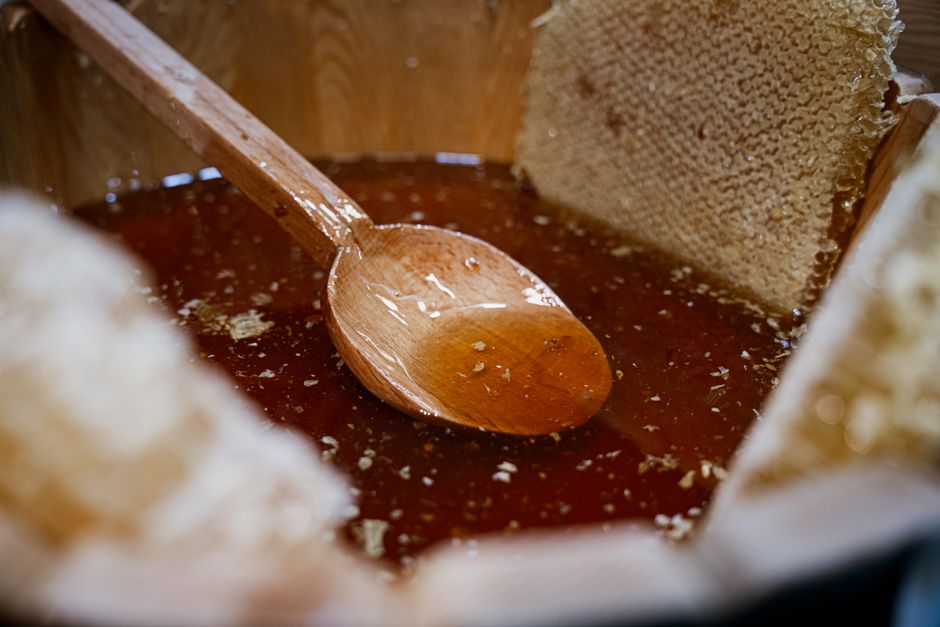
Molasses is a thick, dark syrup made from sugarcane or sugar beets. It is the byproduct left over after the sugar crystals are extracted from the plant juice. The syrup is boiled to concentrate it, and each boiling produces a different grade of molasses with its own color, flavor, and nutritional profile.
What Is Molasses Made From?
Molasses comes from the refining process of sugarcane or sugar beets. When the plant is crushed, it releases a sweet juice. That juice is boiled to form sugar crystals. The liquid left after the crystals are removed is molasses.
The process repeats several times. Each round of boiling and sugar extraction produces a darker, stronger-tasting molasses with less sugar remaining. The first boil gives light molasses. The second gives dark molasses. The third gives blackstrap molasses.
Sugarcane molasses is the type most people use in cooking and baking. Sugar beet molasses is also produced but has a different taste. It is mostly used in animal feed, fermentation, and industrial processing rather than in food for people.
How Is Molasses Made Step by Step?
The process starts with mature sugarcane stalks. The stalks are washed, crushed, and pressed to squeeze out the juice. The green juice contains about 70 to 75 percent water along with sucrose, glucose, fructose, and other plant compounds.
The juice is boiled in large evaporators to remove water. As the water leaves, the juice thickens and sugar crystals begin to form. The mixture is spun in a centrifuge to separate the sugar crystals from the remaining liquid. That liquid is the first molasses.
The first molasses still contains a significant amount of sugar. It can be boiled again to extract more sugar crystals. This second boil produces darker molasses with a more bitter flavor. A third boil yields blackstrap molasses, which has the least sugar and the strongest taste.
What Are the Different Types of Molasses?
Molasses is sold in several grades. The grade depends on how many times the syrup was boiled and how much sugar was removed.
- Light molasses comes from the first boiling. It is the sweetest and lightest in color. It is often used in baking, especially in gingerbread and cookies.
- Dark molasses comes from the second boiling. It is less sweet, thicker, and has a more pronounced flavor. It works well in baked beans and barbecue sauces.
- Blackstrap molasses comes from the third boiling. It is the most concentrated, darkest, and least sweet. It has a bitter edge and is often sold as a dietary supplement.
- Unsulphured molasses has no sulfur dioxide added. Sulfur is sometimes used in young sugarcane processing to help extract juice. Most grocery store molasses is unsulphured.
- Sulfured molasses is treated with sulfur dioxide gas. This type is mostly used commercially and has a slightly chemical aftertaste.





Does Molasses Have Nutritional Value?
Molasses is not a major source of calories, but it does contain minerals that white sugar lacks. Because molasses is a concentrated plant extract, it retains some of the minerals naturally present in sugarcane.
Blackstrap molasses is the most mineral-dense grade. It contains notable amounts of calcium, magnesium, potassium, and iron. Light molasses contains smaller amounts because more sugar remains in the syrup.
These mineral levels are real but modest. A tablespoon of blackstrap molasses provides a small fraction of your daily needs for these minerals. It is not a substitute for a balanced diet or for taking supplements when a doctor has recommended them.
Molasses is still sugar. It raises blood glucose like other sweeteners. The glycemic response varies by grade, but all molasses should be treated as a sweetener, not a health food.
Is Molasses Healthier Than Sugar?
Molasses has more minerals than refined white sugar. That is true. But the difference is small in practical terms. You would need to eat large amounts of molasses to get meaningful mineral intake, and that would mean consuming a lot of sugar at the same time.
Some studies suggest that molasses contains antioxidants. These are plant compounds that can neutralize free radicals in the body. Darker molasses generally has more antioxidant activity than lighter molasses. Blackstrap has the highest levels.
No clinical evidence currently confirms that eating molasses improves health outcomes or prevents disease. The antioxidant content is measurable in a lab, but whether it translates to real health benefits in humans is not established.
For most people, molasses is best understood as a flavorful alternative to refined sugar. It is not a medicine. It is not a superfood. It is a sugar product with a more complex taste and a slightly better mineral profile.
What Is the Difference Between Molasses and Other Sweeteners?
Molasses is often confused with other dark syrups. They look similar but come from different sources and have different properties.
Molasses comes from sugarcane or sugar beets. Corn syrup comes from corn starch and is mostly glucose. Maple syrup comes from the sap of maple trees. Honey is produced by bees from flower nectar. Golden syrup is a refined sugar syrup made by partially inverting sugar.
Each sweetener has a different flavor profile and behaves differently in recipes. Molasses has a distinctive earthy, slightly bitter taste that is hard to replicate with other sweeteners.
Is Molasses Safe for Everyone?
Molasses is generally safe for most people when eaten in normal food amounts. It is a common ingredient in baked goods, sauces, and marinades. No established safety concerns exist for typical dietary use.
People with diabetes need to account for molasses as a carbohydrate source. It contains sugar and will affect blood glucose levels. The exact effect depends on the grade and the amount consumed.
Molasses is not recommended for infants under 12 months old. This is the same precaution that applies to honey. Infant botulism is a risk associated with honey, and some clinicians extend the caution to other syrups, though the evidence for molasses specifically is limited.
People with sulfite sensitivity should check labels. Some molasses products contain sulfites from the processing method. Unsulphured varieties are available and avoid this issue.
How Should Molasses Be Stored?
Molasses does not spoil quickly because it is high in sugar, which acts as a preservative. An unopened jar can last for years in a cool, dry place.
Once opened, molasses should be stored in an airtight container at room temperature. It does not need refrigeration. Refrigeration can make it thicker and harder to pour.
Over time, molasses may develop mold on the surface if moisture gets in. If you see mold, discard the entire jar. Do not scrape off the mold and use the rest.
Frequently Asked Questions
Is molasses the same as blackstrap molasses?
No. Blackstrap is the darkest, most concentrated grade from the third boiling. Regular molasses is lighter, sweeter, and comes from earlier boilings.
Can molasses go bad?
Molasses can last for years if stored properly. If mold develops or the smell changes, discard it.
Is molasses vegan?
Yes. Molasses comes entirely from plants and no animal products are used in its production.
Does molasses contain gluten?
No. Molasses is naturally gluten-free. It is safe for people with celiac disease unless cross-contamination occurs during processing.
