
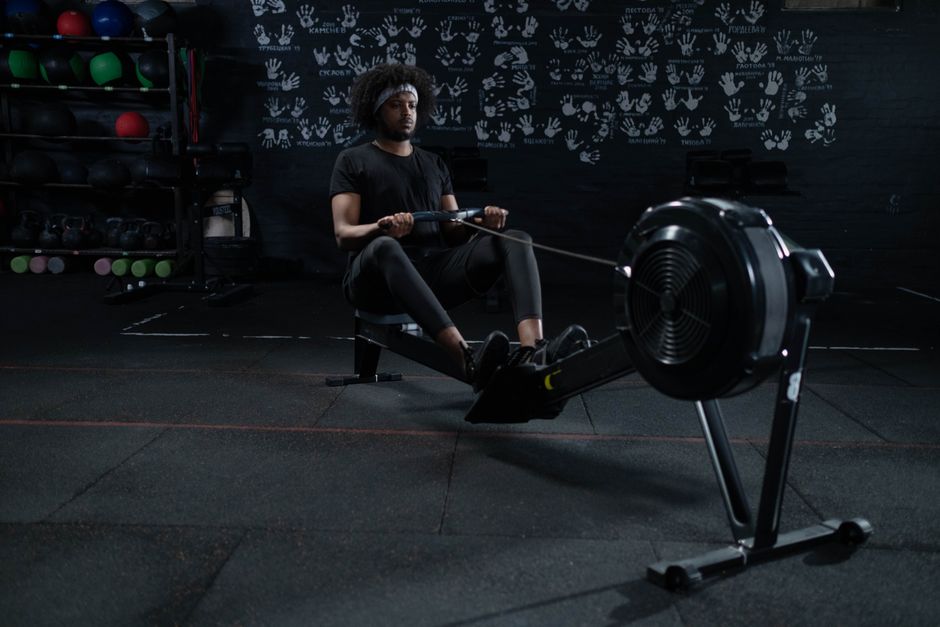
Rowing machines work about 85% of your body’s muscles in a single, coordinated movement. The primary muscles are your legs (quadriceps, hamstrings, glutes), back (latissimus dorsi, rhomboids, trapezius), and arms (biceps, triceps, forearms). Your core muscles (abdominals and obliques) stabilize your entire body throughout the stroke. Unlike most gym machines that isolate one area, a rowing machine demands a full-body sequence: legs drive first, then the back and arms pull, and the core holds everything together.
What Muscles Do Rowing Machines Work in Each Phase of the Stroke?
The rowing stroke has four distinct phases, and each engages different muscle groups. Understanding the phases helps you feel which muscles should be working when.
The Catch is the starting position. Your knees are bent, shins vertical, and arms extended forward. Your hamstrings and glutes are stretched and loaded. Your upper back muscles (rhomboids) are slightly engaged to keep your shoulders relaxed, not hunched.
The Drive is where the power happens. Your quadriceps and glutes push your legs down first. This is the strongest part of the stroke — about 60% of the power comes from your legs. As your legs straighten, your core braces and your back muscles (latissimus dorsi, trapezius) begin pulling the handle toward your lower ribs. Your biceps and forearms finish the pull.
The Finish is the end of the drive. Your legs are straight, your back is slightly leaned back (about 11 o’clock position), and the handle is at your lower ribs. Your triceps engage slightly to keep the handle stable. Your abdominals and obliques are fully contracted to support the lean.
The Recovery is the return to the catch. Your arms extend first, then your body swings forward over your hips, then your knees bend. Your hamstrings and glutes control the slide back. Your core stays engaged to prevent rounding your lower back.
Which Muscle Groups Get the Most Work?
Research published in the Journal of Strength and Conditioning Research measured muscle activation during rowing. The quadriceps showed the highest electrical activity of any muscle group during the drive phase. The gluteus maximus and hamstrings were close behind.
The latissimus dorsi (your “lats”) is the primary pulling muscle. These are the large wing-shaped muscles under your armpits that give a V-shaped back. The trapezius (upper and middle back) and rhomboids (between your shoulder blades) activate strongly as you pull the handle toward your body.
Your core muscles — rectus abdominis (six-pack area), obliques (side abs), and erector spinae (lower back) — work as stabilizers throughout. They do not move the handle directly, but they transfer force between your legs and upper body. Without a strong core, your lower back takes the load and you risk injury.
Your arm muscles get moderate work. Biceps pull the handle in. Triceps stabilize at the finish. Forearm muscles grip the handle. Rowing is not an arm-dominant exercise, so do not expect big arm growth from it alone.
Does a Rowing Machine Build Muscle or Just Burn Calories?
It does both, but not equally. Rowing is primarily a cardiovascular exercise that builds muscular endurance. The American Council on Exercise reports that rowing can burn 400 to 800 calories per hour depending on intensity and body weight.
For muscle growth (hypertrophy), rowing is less effective than traditional weightlifting. The resistance comes from either air, water, or magnets — not heavy plates. You can increase the damper setting or row harder, but the load is limited by how fast you pull. You cannot progressively overload a rowing machine the same way you can add weight to a barbell.
That said, rowing does build noticeable muscle in your back, glutes, and legs if you are new to exercise. Beginners often see definition in their lats and hamstrings within weeks. Experienced lifters will maintain muscle but likely not add size.
One non-obvious fact: rowing strengthens your hip flexors and psoas muscles more than many other cardio machines. These muscles are often tight from sitting all day. Rowing lengthens and strengthens them through the full range of motion at the catch.


How Does Rowing Compare to Other Cardio Machines for Muscle Engagement?
Here is a direct comparison of muscle activation across common gym machines. The percentages are estimates based on electromyography (EMG) studies of muscle activity.
| Machine | Primary Muscles | Secondary Muscles | Core Activation |
|---|---|---|---|
| Rowing Machine | Quads, glutes, lats, hamstrings | Biceps, triceps, traps, rhomboids | High — full stabilization required |
| Stationary Bike | Quads, hamstrings, glutes | Calves | Low — back support reduces core demand |
| Treadmill | Quads, hamstrings, glutes, calves | Hip flexors | Moderate — depends on incline and speed |
| Elliptical | Quads, glutes, hamstrings | Triceps, chest (if using arms) | Low — handles provide upper body support |
| Stair Climber | Glutes, quads, hamstrings, calves | Hip flexors | Moderate — balance required |
The key difference is upper body engagement. Only rowing and some ellipticals with moving handles work the back and arms significantly. Rowing also demands more core stability than any other machine because your pelvis is not fixed to a seat back.
What Are Common Mistakes That Reduce Muscle Activation?
The most common mistake is pulling with the arms too early. Many people yank the handle with their biceps before their legs have finished driving. This shifts the work from the large leg and back muscles to the smaller arm muscles. You tire faster and get less total body benefit.
Another mistake is rounding the lower back at the catch. When you lean forward to grab the handle, your lower back should stay flat or slightly arched. A rounded back puts the erector spinae in a weak position and increases disc pressure. The American Physical Therapy Association warns that this is the most common cause of rowing-related low back pain.
Gripping the handle too tightly is also common. A death grip activates your forearm flexors and biceps unnecessarily. It also leads to forearm fatigue and elbow tendinitis over time. Hold the handle loosely enough that someone could pull it from your hand with moderate effort.
Rushing the recovery phase is a third mistake. The recovery is not rest — it is an active part of the stroke where your hamstrings and glutes control the slide. If you let the seat slam back to the catch, you lose tension in your legs and miss the eccentric (lengthening) work that builds muscle.
Can Rowing Alone Give You a Full-Body Workout?
Rowing alone provides a solid full-body workout for general fitness. It meets the American Heart Association’s guidelines for cardiorespiratory fitness: 150 minutes of moderate-intensity or 75 minutes of vigorous-intensity aerobic activity per week.
For muscle strength, rowing alone is not enough if your goal is significant hypertrophy or maximal strength. The resistance is limited by your pull speed, and there is no way to isolate individual muscle groups. You will not build a big chest, shoulders, or triceps from rowing because those muscles are not primary movers in the stroke.
For most people, rowing combined with two days of resistance training per week is ideal. Add push exercises like push-ups or bench press, overhead pressing, and direct ab work. This covers the muscles rowing misses — chest, front delts, and triceps.
Some people report that rowing alone improved their posture significantly. The reason is that rowing strengthens the posterior chain (back, glutes, hamstrings) which counteracts the forward-shoulder, forward-head posture common from desk work. Research in the International Journal of Sports Physical Therapy found that rowers had better scapular stability and less forward shoulder posture than non-rowers.
Frequently Asked Questions
Does rowing build arm muscle?
Rowing works your biceps and forearms but not enough for significant arm growth. Your arms are the last link in the chain and get moderate activation compared to legs and back.
Is rowing good for belly fat?
Rowing burns calories and can help reduce overall body fat including belly fat. No exercise spot-reduces fat, but rowing is effective for total body calorie burn.
Can rowing hurt your lower back?
Rowing can cause lower back pain if your form is poor, especially if you round your back at the catch. Proper technique with a flat back and engaged core prevents most issues.
How many minutes should I row per day?
Twenty to thirty minutes of steady rowing is a good starting point for most people. Beginners can start with 10 to 15 minutes and increase gradually as endurance improves.
