
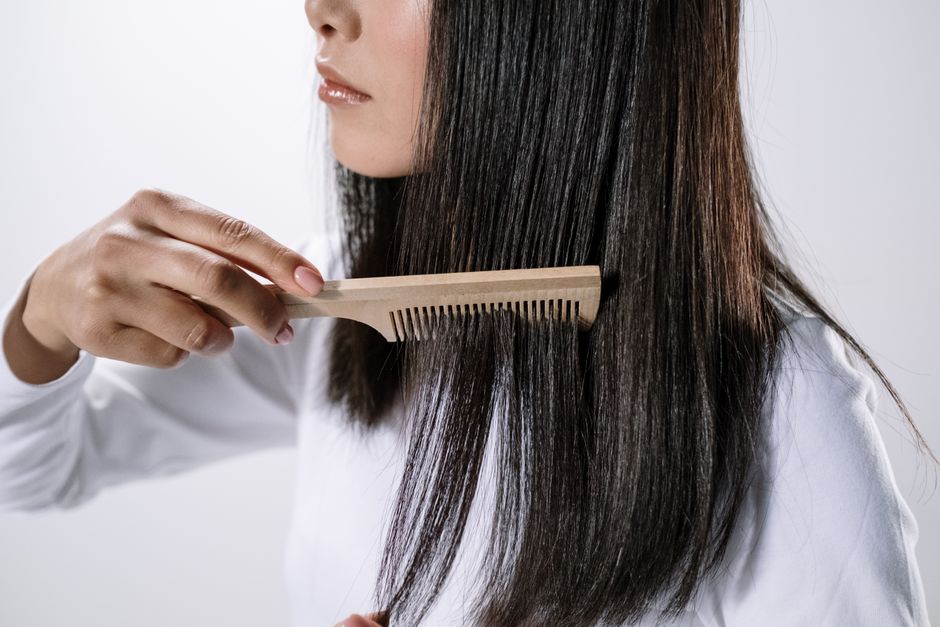
Hair shape comes down to biology you were born with. Your genes decide the shape of the hair follicle — the tiny pocket in your skin where each hair grows — and that follicle shape decides whether your hair comes out straight, wavy, curly, or coiled. Straight hair grows from round follicles, while curly hair grows from oval or flattened ones.
That is the short answer. The longer answer involves how tightly those follicle cells are packed, how the hair fiber itself is built, and why two siblings with the same parents can end up with completely different hair. None of it is random. All of it traces back to instructions written into your DNA before you were born.
What Makes Your Hair Straight Genes And Follicles?
Two things working together: the physical shape of your follicle and the genetic code that built it that way. The follicle is not a passive tube. It is a living structure with a specific cross-sectional shape, and that shape physically determines how the hair fiber emerges.
A round follicle produces a hair that grows out round in cross-section. Round hair tends to hang straight. An oval follicle produces a hair with an oval cross-section, which tends to bend and wave. A flattened, kidney-shaped follicle produces a ribbon-like hair that twists and curls. The flatter the follicle, the tighter the curl.
This is anatomy, not opinion. Dermatology textbooks describe these follicle shapes as the structural basis of hair curvature. What varies between people is the genetic instructions that determine which shape their follicles develop.
Follicle shape is set before you are born. You are born with all the hair follicles you will ever have — roughly five million across the body, with about 100,000 on the scalp. No new follicles form after birth. So the shape of your hair is essentially locked in from early development.
How Do Genes Control Hair Curvature?
Hair curvature is polygenic, meaning many genes contribute rather than one master switch. There is no single “straight hair gene.” Instead, dozens of genetic variants each nudge the follicle toward one shape or another, and the combination produces your result.
Several genes have been linked to hair texture in genetic studies. One of the most studied is TCHH, which appears to influence hair shaft shape. Variants in and around this gene have been associated with straight hair in multiple populations. Another gene, EDAR, has been linked to hair thickness and straightness, particularly in East Asian populations. KRT genes, which code for the keratin proteins that build hair, also play a role in how the fiber is structured.
Here is the part that surprises people. The genes involved in hair shape are not the same as the genes involved in hair color. Hair color comes largely from melanin production, governed by a different set of genes such as MC1R. That is why you can inherit your father’s dark hair color and your mother’s curl pattern independently. The two traits are genetically separate.
Because so many genes are involved, hair shape is a spectrum. It is not a simple switch between straight and curly. Two people can both carry “curly” variants and end up with very different curl patterns depending on how the other genes combine.
Why Do Two Siblings Have Different Hair?
Each parent passes on one version of each gene to a child. Which version gets passed is random. So siblings inherit different combinations of the same parental gene pool.
If hair shape were controlled by a single gene with two versions, siblings would match more often. Because it is polygenic, the number of possible combinations is enormous. Two children can share 50 percent of their DNA and still land on completely different hair textures. This is normal inheritance, not a fluke.
Recessive and dominant patterns do exist for some hair traits, but hair texture does not follow a clean dominant-recessive rule the way eye color is sometimes taught. Real-world hair genetics is messier, and predictions based on simple models are unreliable.
This is also why a straight-haired couple can have a curly-haired child, or the reverse. If both parents carry hidden variants for a different texture, those variants can combine in the child.



Can Hair Texture Change Over Time?
Yes, and it happens more often than people expect. Hair that is straight in childhood can become wavy or curly after puberty. Hair can also change during pregnancy, after menopause, or with certain medical conditions and medications.
The follicle shape itself does not usually change. What changes is the hormonal environment and the condition of the hair fiber. Hormones such as androgens can affect the hair growth cycle and the size of the follicle over time. Thyroid disorders can alter hair texture and cause it to become dry, coarse, or brittle. Some medications, including certain chemotherapy drugs, can cause hair to grow back with a different texture.
Age also plays a role. As people get older, hair often thins and the growth cycle shortens. The remaining hair can appear different in texture and volume, though the underlying follicle shape is largely the same.
So “permanent” hair texture is not quite accurate. It is stable for most people most of the time, but hormones and health status can shift it.
What About Hair Treatments and Straightening?
No topical product changes your follicle shape or your genes. Shampoos, conditioners, and serums can smooth the surface of the hair fiber temporarily, but they do not alter the structure underneath. Once you wash it out, the hair reverts.
Chemical straightening and relaxers work differently. They break the chemical bonds inside the hair fiber itself and reform them in a straighter configuration. This is a real structural change to the hair — but only to the hair that has already grown. New hair emerging from the follicle comes out in its original shape. That is why treatments need repeating as new growth appears.
Heat styling works by temporarily breaking hydrogen bonds in the hair when it is wet and reforming them as it dries in a new shape. This is also temporary. Water can reverse it.
It is worth being honest about safety here. Chemical relaxers contain strong alkaline agents. Some research has raised concerns about long-term use and health risks, and the evidence on this is still developing. Anyone considering frequent chemical straightening should discuss it with a dermatologist rather than relying on marketing claims.
Does Hair Shape Differ Across Populations?
Yes, and the differences trace back to genetic history and migration. Populations that evolved in different regions carry different frequencies of the gene variants that shape hair follicles.
Straight hair is more common in populations with East Asian and Indigenous American ancestry. Tightly coiled hair is more common in populations with sub-Saharan African ancestry. Wavy and curly hair is widespread across European, Middle Eastern, and South Asian populations.
These are broad patterns, not rules. Within any population, there is wide variation. A person’s individual hair texture depends on their specific combination of genes, not their group membership.
Can You Predict a Baby’s Hair Type?
Not reliably. Because hair shape is polygenic and involves many variants, there is no simple test that predicts a child’s hair texture with accuracy.
Direct-to-consumer genetic tests sometimes offer hair trait predictions. These are based on statistical associations in study populations, not on a complete understanding of every gene involved. They can give a rough probability, but they cannot tell you with certainty what a child’s hair will look like. Many genes that influence hair shape have not been fully identified.
If you want to know what a baby’s hair will be like, waiting is more accurate than testing. Hair texture often becomes clearer as a child grows, and it can keep changing through adolescence.
Frequently Asked Questions
Is straight hair dominant or recessive?
Hair texture does not follow a simple dominant-recessive pattern. It is controlled by many genes, so inheritance is more complex than a single dominant or recessive trait.
Can straight hair become curly naturally?
Yes, hair texture can change with hormonal shifts such as puberty, pregnancy, or menopause, and with certain medical conditions or medications. The follicle shape itself usually stays the same.
Does cutting hair make it grow back thicker or curlier?
No. Cutting hair does not change the follicle, so it grows back with the same texture and thickness as before. The blunt cut end can make hair feel coarser temporarily.
Can a DNA test tell me my hair type?
Not with certainty. Consumer genetic tests give rough probabilities based on known gene variants, but many genes affecting hair shape are not fully understood.
