
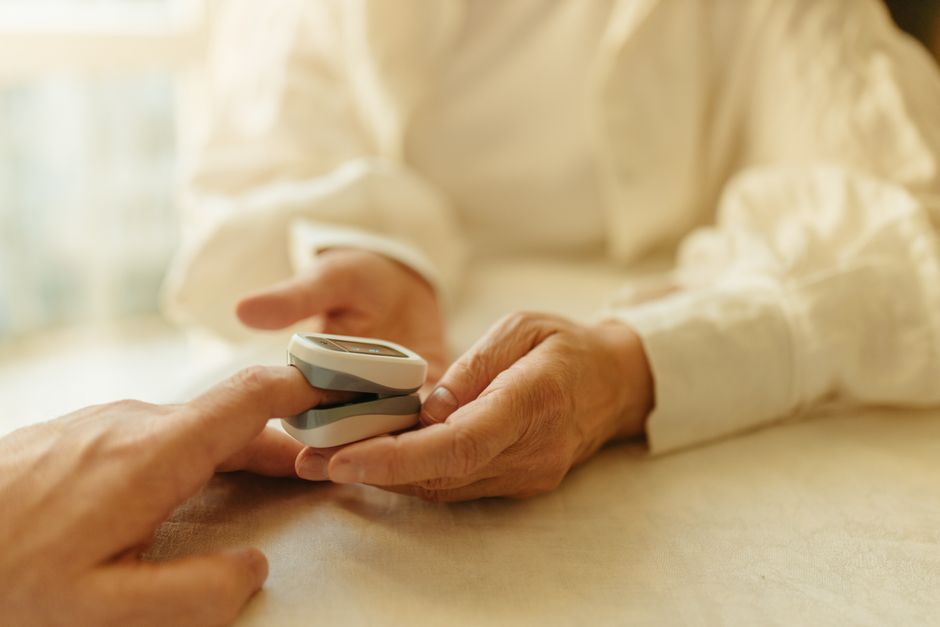
Your blood oxygen level is one of the clearest signals your body gives about how well your lungs and heart are working. For most healthy adults at sea level, normal oxygen saturation is 95% to 100%, measured by a pulse oximeter clipped to your finger. A reading of 90% or below is considered low and generally requires medical attention.
What Is Normal Oxygenation Levels?
Oxygen saturation, often written as SpO2, is the percentage of your red blood cells that are carrying oxygen. A healthy adult breathing normal room air typically sits between 95% and 100%.
That number comes from a small device called a pulse oximeter. It shines light through your finger or earlobe and estimates how much oxygen is bound to hemoglobin, the protein in red blood cells that carries oxygen. It is not a direct measurement, but for most people it tracks closely with the more invasive arterial blood gas test used in hospitals.
Arterial blood gas testing measures oxygen partial pressure, or PaO2, directly from an artery. A normal PaO2 is generally between 75 and 100 millimeters of mercury (mmHg) in a healthy adult breathing room air. The two numbers, SpO2 and PaO2, describe the same basic thing through different methods.
Several things can shift your reading without meaning anything is wrong. Cold hands, dark nail polish, poor circulation, and movement can all throw off a finger reading. If a number looks off, it is worth repeating the measurement before drawing conclusions.
What Do the Different Oxygen Saturation Ranges Mean?
Ranges help organize what a reading might indicate, but they are not a diagnosis on their own. A single number rarely tells the whole story.
| SpO2 Range | General Meaning |
|---|---|
| 95% to 100% | Normal for most healthy adults at sea level |
| 91% to 94% | Below normal; worth monitoring and discussing with a clinician |
| 90% or below | Low oxygen; generally requires medical evaluation |
| 88% or below | Significantly low; often prompts supplemental oxygen in clinical settings |
These cutoffs are general guides, not fixed rules. Someone with chronic lung disease may live comfortably at a lower baseline than a healthy person, and a clinician who knows that person’s history will interpret the number differently. This is one reason home readings should never replace a medical assessment.
Altitude changes the picture too. At high elevations, the air holds less oxygen, so a lower saturation can be normal for that environment. The body adapts over time, but the adaptation takes days to weeks, not hours.
What Causes Low Oxygen Levels?
Low oxygen, called hypoxemia, happens when the lungs cannot move enough oxygen into the blood, when the blood cannot carry it well, or when the heart cannot deliver it efficiently. The cause shapes both the symptoms and the treatment.
Common causes include:
- Lung conditions such as pneumonia, chronic obstructive pulmonary disease (COPD), asthma, and pulmonary fibrosis
- Heart conditions that affect blood flow through the lungs
- Anemia, where too few red blood cells or too little hemoglobin limits oxygen transport
- Sleep apnea, which interrupts breathing during sleep
- High altitude, where the air pressure and oxygen content are lower
- Medications that slow breathing, particularly opioids
Some causes develop slowly and quietly. Chronic lung disease can lower oxygen over months while a person adjusts and notices little. Other causes, like a sudden clot in the lung, can drop oxygen within minutes and produce obvious distress.
The speed matters as much as the number. A slow decline that the body has partly compensated for is a different situation from a sudden drop in a previously healthy person.





What Are the Symptoms of Low Oxygen?
Shortness of breath is the most common symptom, especially during activity that used to feel easy. Other signs include a racing heart, confusion or trouble concentrating, headache, and a bluish tint to the lips or fingertips in severe cases.
Mildly low oxygen sometimes causes no obvious symptoms at all. A person can feel fine and still have a reading in the low 90s. This is why pulse oximeters became popular for home monitoring, though a normal-feeling body is not proof that oxygen is normal.
When oxygen drops further, the brain and heart are affected first because they use the most oxygen. Confusion, fainting, and chest pain are warning signs that need urgent attention. A bluish color in the lips, face, or nail beds, called cyanosis, indicates a serious shortage and is a medical emergency.
Symptoms alone are an unreliable guide. Some people with genuinely low oxygen feel surprisingly well, and some people with normal oxygen feel short of breath for other reasons, such as anxiety or deconditioning. The measurement and the symptoms together give a fuller picture.
How Is Oxygen Saturation Measured?
Pulse oximetry is the most common method. A device clips onto a fingertip and gives a reading within seconds. It is painless, inexpensive, and widely used in clinics, hospitals, and homes.
Accuracy depends on conditions. Nail polish, especially dark colors, can interfere with the light signal. Cold fingers reduce blood flow and can lower the reading. Motion, weak pulse, and poor probe placement all add error. When a reading seems wrong, warming the hand and trying a different finger often helps.
Arterial blood gas testing is more accurate and gives additional information, including PaO2 and carbon dioxide levels. It requires drawing blood from an artery, usually in the wrist, so it is used mainly in hospitals when precise data is needed.
Consumer smartwatches and phone apps now offer oxygen readings. Their accuracy varies, and they are not held to the same standards as medical-grade oximeters. They can be useful for spotting trends, but they should not be trusted for medical decisions.
When Should You Be Concerned About Your Oxygen Level?
A reading of 90% or below is the general threshold for seeking medical care. If you have symptoms like shortness of breath, chest pain, confusion, or bluish lips along with a low reading, treat it as urgent.
For readings between 91% and 94%, the right step depends on context. If you feel well and the reading is a one-time event, repeating the measurement after warming your hands is reasonable. If it stays low, or if you have an underlying lung or heart condition, contact a clinician.
Do not rely on a home oximeter to rule out serious illness. A normal reading does not guarantee that everything is fine, and a low reading does not always mean an emergency. The device is a tool, and its output needs interpretation alongside how you feel and your medical history.
Anyone with a chronic lung condition should discuss with their clinician what reading should prompt action. Personal thresholds vary, and blanket numbers do not fit every situation.
Can You Improve Your Oxygen Levels?
For healthy people, oxygen levels are regulated automatically and do not need improvement. The body adjusts breathing rate and depth to keep saturation in a normal range without conscious effort.
When oxygen is genuinely low, the treatment depends on the cause. Supplemental oxygen helps some people with chronic lung disease. Breathing exercises and pursed-lip breathing can help some people with COPD manage breathlessness, though the evidence for improving oxygen saturation itself is limited. Treating the underlying condition, such as an infection or a blocked airway, is usually the real solution.
There is no evidence that over-the-counter oxygen cans, oxygen bars, or “oxygenated” water raise blood oxygen in healthy people. Blood oxygen is tightly controlled by physiology, and breathing extra oxygen when you do not need it does not push saturation above normal. These products are marketing, not medicine.
If you are concerned about your oxygen levels, the useful step is a conversation with a clinician who can look at your history, your symptoms, and your measurements together. A number on a screen is a starting point, not an answer.
Frequently Asked Questions
What is a normal oxygen level by age?
Normal oxygen saturation is generally 95% to 100% for healthy adults regardless of age, though older adults may sit slightly lower within that range. Persistent readings below 95% should be discussed with a clinician.
Is 92% oxygen level dangerous?
A reading of 92% is below the normal range and worth evaluating, but whether it is dangerous depends on your health history and symptoms. If it persists or comes with shortness of breath, seek medical advice.
What oxygen level is too low?
A reading of 90% or below is generally considered too low and warrants medical attention. Readings of 88% or below often prompt supplemental oxygen in clinical settings.
Can anxiety cause low oxygen readings?
Anxiety can cause rapid breathing and a feeling of breathlessness, but it does not usually lower true oxygen saturation. If a low reading appears during anxiety, repeat the measurement and have it checked if it stays low.
