
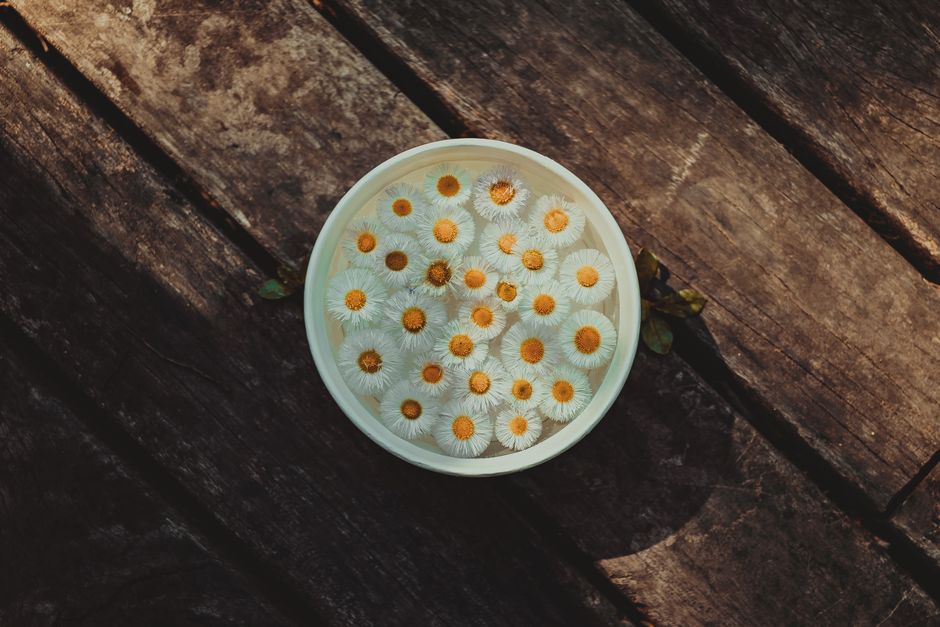
Daisy water is a floral water made by distilling daisy flowers, usually Bellis perennis, the common lawn daisy. It has a long history in European folk medicine as a gentle skin tonic. Today you will find it in toners, facial mists, and creams, often described as soothing and brightening. The honest picture is more modest than the marketing suggests.
Daisy water is a dilute, water-based liquid that carries small amounts of compounds from the daisy plant. These include flavonoids and other plant chemicals that show antioxidant and mild anti-inflammatory activity in laboratory studies. Whether those effects translate into visible skin benefits when applied in a typical cosmetic product is far less clear. No large human trial has confirmed that daisy water brightens skin, fades dark spots, or reduces wrinkles. What follows is what the evidence actually supports, and what it does not.
What Is Daisy Water And How Does It Work For Skin?
Daisy water is the watery portion collected when daisy flowers are steam-distilled. It is not an oil. It is mostly water with trace amounts of water-soluble plant compounds, including flavonoids such as apigenin and luteolin, along with small quantities of plant acids and other aromatic molecules.
The idea behind its use is simple. Those compounds act as antioxidants in lab settings, meaning they can neutralize free radicals — unstable molecules that contribute to skin aging and inflammation. Some laboratory studies also show mild anti-inflammatory activity. That is the mechanism people point to.
The gap is between the lab dish and your face. A study showing that a plant extract quenches free radicals in a petri dish does not prove it does the same thing on living skin, at the concentration in a bottle of toner, or that it produces any visible change. Biological plausibility is not the same as demonstrated benefit.
One practical point that gets overlooked: daisy water is typically 95 percent or more water. The active plant compounds are present in very small amounts. That does not make it useless, but it does mean the effect, if any, is likely mild and gradual rather than dramatic.
What Is The Difference Between Daisy Water And Daisy Extract?
Daisy water and daisy extract are not the same thing, and the difference matters for judging any product.
- Daisy water (hydrosol or floral water): A dilute byproduct of distillation. Mostly water, low concentration of plant compounds. Used as a base or mist.
- Daisy extract: A concentrated preparation made by soaking daisy material in a solvent such as water, alcohol, or glycol. Contains a much higher concentration of the plant’s compounds. Used as an active ingredient.
When a product label lists daisy extract high in the ingredient list, that signals a higher concentration than a product that only uses daisy water. When daisy water appears near the end of a list — or the label simply says “daisy water” with no extract — the amount of active plant material is likely small.
This is not a trick specific to daisy. It applies across botanical skincare. Floral waters are pleasant and can be hydrating, but they are not the same as concentrated extracts, and marketing rarely makes the distinction clear.
What Does The Evidence Actually Show For Skin?
Here the honest answer is that the evidence is thin, and much of it comes from laboratory work rather than studies in people.
Laboratory research on daisy extracts has found antioxidant and anti-inflammatory activity in cell and test-tube models. Some of this work points to compounds that could, in theory, influence pigmentation or calm irritation. That is where the trail largely ends for strong evidence.
What is missing is the kind of research that would let anyone make a confident claim about skin results in real use:
- No large, controlled human trials showing that daisy water lightens dark spots or evens skin tone.
- No strong evidence that it reduces wrinkles or firmness changes.
- No established data on how much of the plant’s compounds actually penetrate intact skin from a typical product.
So when a label or an influencer says daisy water “brightens” or “renews” skin, understand that this is a claim built on mechanism and tradition, not on demonstrated outcomes. It may be a fine, gentle, hydrating product. It is not a proven treatment for any skin condition.





Is Daisy Water Good For Sensitive Or Irritated Skin?
Daisy water is often marketed for sensitive skin because it is mild and water-based. That reputation is reasonable in the sense that most floral waters are gentle and unlikely to sting. But “gentle” and “treats sensitivity” are different claims.
There is no solid clinical evidence that daisy water reduces redness, calms rosacea, or treats eczema or dermatitis. If you have a diagnosed skin condition, a floral water is not a treatment for it. Established care for these conditions involves approaches your clinician recommends, not botanical mists.
There is also a real, if uncommon, risk that gets ignored in the marketing: plants can cause allergic contact dermatitis. Daisy belongs to the aster family, which includes ragweed, chrysanthemums, and marigolds. People allergic to those plants can react to related botanicals. If you are sensitive to those, patch test any daisy product on a small area first and stop if you notice redness, itching, or swelling.
One clarification worth making: a product being “natural” or “plant-based” says nothing about whether it will irritate your skin. Some of the most irritating ingredients in cosmetics are plant-derived. Natural and gentle are not the same word.
How Do You Use Daisy Water In A Skincare Routine?
If you want to try it, the sensible approach is to treat it as a light, optional step rather than a core treatment. There are no clinical guidelines for how to use daisy water, so anything below is general cosmetic practice, not medical advice.
Common ways it appears in routines:
- As a toner or mist after cleansing, before moisturizer.
- As a refreshing mist during the day.
- As a base ingredient in a cream or serum, where it is one of many components.
A few practical notes. Patch test first, especially if you have known plant allergies. Keep expectations modest — think hydration and a pleasant sensory step, not a transformation. And do not let a floral water replace the steps with real evidence behind them, such as daily sunscreen, which remains the single most effective thing most people can do to slow visible skin aging.
How Does Daisy Water Compare To Other Skincare Ingredients?
Daisy water sits in a different category from ingredients with strong human evidence. The table below is a general orientation, not a ranking of products.
| Ingredient | Type | Strength of evidence for skin benefit |
|---|---|---|
| Daisy water | Floral water | Limited; mostly laboratory and traditional use |
| Daisy extract | Concentrated botanical | Limited; some lab data, little human trial data |
| Sunscreen (broad-spectrum) | Protective | Strong; well established for preventing UV damage |
| Retinoids | Active treatment | Strong; well studied for aging and acne |
| Vitamin C | Antioxidant | Moderate; studied for pigmentation and antioxidant effects |
| Niacinamide | Active | Moderate; studied for barrier and tone |
The takeaway is not that daisy water is bad. It is that it belongs in the “nice to have” column, while sunscreen and proven actives belong in the “does the work” column. If a product markets daisy water as a substitute for those, that is a marketing claim, not an evidence-based one.
Does Daisy Water Have Any Proven Skin Benefits At All?
It can hydrate, because it is mostly water, and any water applied to skin provides temporary moisture. That is a real but minor benefit, and plain water does the same thing.
Beyond hydration, the proven benefits are close to none in human studies. The antioxidant and anti-inflammatory findings come from laboratory work on extracts, often at concentrations higher than you would find in a floral water. Extrapolating those results to a bottle of daisy water mist is a leap the evidence does not support.
None of this means you should avoid it. If you enjoy how it feels and it does not irritate your skin, using it is reasonable. Just do not expect it to do the heavy lifting. The ingredients with real evidence behind them are the ones worth your attention and your budget.
Frequently Asked Questions
Is daisy water the same as daisy extract?
No. Daisy water is a dilute hydrosol that is mostly water, while daisy extract is a concentrated preparation with far more of the plant’s compounds. The two are not interchangeable in terms of potency.
Can daisy water lighten dark spots or brighten skin?
No clinical evidence currently confirms that daisy water lightens dark spots or brightens skin. Claims about these effects rest on laboratory findings and tradition, not on human trials.
Is daisy water safe for sensitive skin?
It is generally mild, but plants in the daisy family can trigger allergic reactions in some people. Patch test first if you have known plant allergies, and stop if you notice redness or itching.
Can daisy water replace sunscreen or anti-aging products?
No. Daisy water has little supporting evidence for skin benefits beyond temporary hydration, while sunscreen and proven actives like retinoids have strong evidence behind them.
