
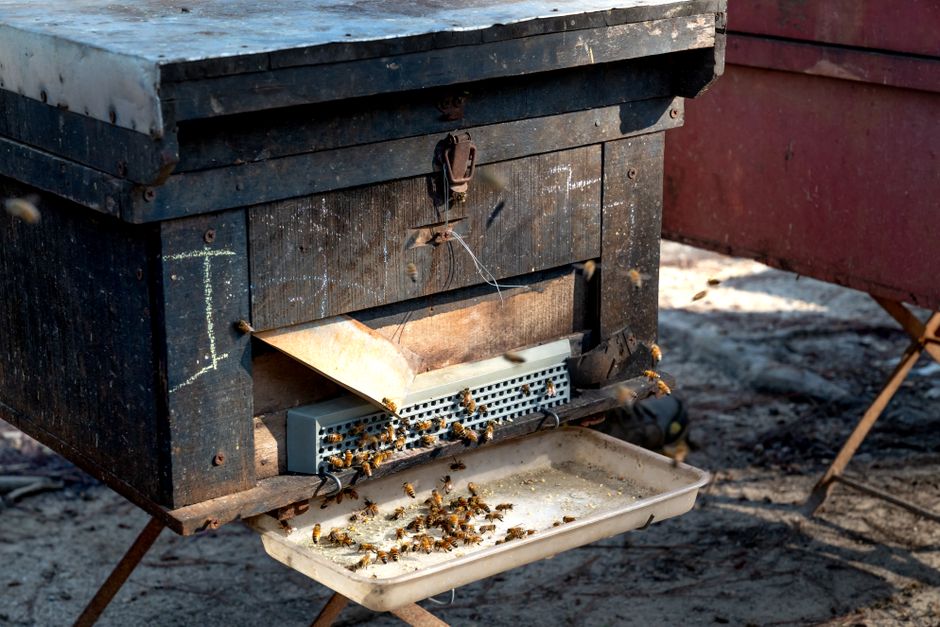
Bee propolis is a sticky, resinous material that honeybees make by mixing their own saliva and wax with substances they collect from tree buds, sap flows, and other plant sources. The bees use it as a kind of natural caulk — to seal cracks in the hive, smooth out internal surfaces, and reinforce the thin walls of the honeycomb. Humans have used it for centuries in traditional medicine, and today it shows up in throat sprays, toothpaste, capsules, and skin creams.
What makes propolis interesting to researchers is its chemistry. It contains flavonoids, phenolic acids, and other plant compounds, and it does show antimicrobial and anti-inflammatory activity in laboratory studies. Whether those effects translate into meaningful human health benefits is a separate question — and the evidence there is much thinner than the marketing suggests.
What Is Bee Propolis Made Of?
Propolis is not one fixed substance. Its composition depends entirely on what plants the bees can reach.
Bees in a temperate forest collect resins from poplar, birch, and conifer trees. Bees in a tropical region collect from completely different plants. The result is that propolis from Brazil, Europe, and China can have noticeably different chemical profiles. Even hives a few miles apart may produce propolis with different compound ratios.
That variability matters for two reasons. First, it makes propolis hard to study in a standardized way — a trial using one batch of propolis is not necessarily testing the same thing as a trial using another. Second, it means product labels rarely tell you much about what is actually inside a given bottle.
Generally speaking, raw propolis contains:
- Plant resins and gums (the largest fraction)
- Beeswax
- Essential oils and volatile compounds
- Pollen
- Flavonoids and phenolic acids — the compounds most studied for biological activity
The flavonoid content is what most research focuses on. Compounds like galangin, quercetin, and caffeic acid phenethyl ester (CAPE) have been examined in laboratory settings. That laboratory activity is real. What it means for a person taking a propolis capsule is a different matter.
What Does Bee Propolis Do in the Hive?
Inside the hive, propolis is structural and defensive. Bees apply it to seal gaps smaller than a bee can pass through, which limits drafts and keeps out intruders.
They also use it to embalm intruders. If a mouse or large insect gets inside and is killed by the bees but is too heavy to remove, the bees coat the carcass in propolis. This prevents decomposition from fouling the hive. It is a remarkable behavior and one of the clearest demonstrations that propolis has antimicrobial properties in a real biological setting.
Some research suggests propolis may also play a role in the hive’s immune dynamics — bees living in hives with more propolis appear to have different immune gene expression than bees in hives with less. That finding is interesting but does not directly tell us anything about human health.
What Is Bee Propolis Used For?
The most common human uses are for sore throats, mouth and gum irritation, minor wounds, and skin conditions. It also appears in some cold and flu products, usually combined with honey, echinacea, or vitamin C.
There is a real basis for some of these uses. Propolis has been used in oral care for decades, and some research supports its presence in mouth rinses and toothpaste for reducing plaque and gum inflammation. The evidence is not overwhelming, but it is more substantial than for most other proposed uses.
For sore throats and colds, the picture is weaker. Some small trials have looked at propolis throat sprays and lozenges, and some have reported symptom relief. But these trials tend to be small, and results have not been consistent across studies. A reasonable summary is that there may be a modest effect, but the evidence is not strong enough to call it established.
For wounds and skin infections, most of the supporting evidence comes from laboratory studies and animal models, not from controlled human trials. That does not mean it does not work — it means we do not have good human data.





Does Bee Propolis Have Proven Health Benefits?
This is where honest reporting requires separating what has been shown from what has been assumed.
In laboratory dishes, propolis extracts kill or inhibit a range of bacteria, fungi, and viruses. These findings are consistent and have been replicated many times. But laboratory results frequently do not carry over into the human body, where compounds are broken down, diluted, and metabolized before they reach the site of infection.
In humans, the strongest evidence is for oral health applications. Beyond that:
- Wound healing: Some small human studies suggest faster healing with propolis ointments. The studies are limited and often of modest quality.
- Sore throat and cold symptoms: Mixed results. Some trials show benefit, others do not.
- Blood sugar and cholesterol: A few small trials have reported improvements in people with type 2 diabetes. These are preliminary and should not be treated as established.
- Cancer: Laboratory studies have examined propolis compounds against cancer cells. This is early-stage research and does not support any claim that propolis treats or prevents cancer in people.
One point worth making clearly: a substance having antimicrobial activity in a petri dish is not the same as a substance treating an infection in a person. That gap is where most supplement marketing lives.
Is Bee Propolis Safe?
For most adults, propolis taken by mouth in typical supplement amounts is generally tolerated without serious problems. Reported side effects are usually minor — mouth irritation, stomach upset, or a mild rash.
The main concern is allergy. Propolis is a bee product, and people allergic to bee stings, honey, or other bee-derived products may react to it. Reactions have included contact dermatitis from skin products and, in rare cases, more serious allergic responses. If you have a known bee product allergy, propolis is not something to experiment with.
Propolis can also interact with blood-thinning medications. Some compounds in propolis have mild antiplatelet effects, and combining them with drugs like warfarin or aspirin could theoretically increase bleeding risk. This is based on limited data, but it is a reasonable caution for anyone on anticoagulant therapy.
There are no established dosing guidelines for propolis in pregnant women, breastfeeding women, infants, or children. No clinical guidelines currently exist for these groups. That is not a statement that it is dangerous — it is a statement that the safety data simply has not been collected.
How Do You Choose a Propolis Product?
This is harder than it should be, because propolis is not standardized.
Two bottles labeled “propolis extract” can contain very different amounts of active compounds, depending on the source plants, the extraction method, and the concentration. Some products list a flavonoid content; many do not. Some are standardized to a specific compound; most are not.
What you can reasonably do:
- Look for a stated flavonoid or phenolic content, if the manufacturer provides one
- Prefer products from manufacturers who disclose the geographic source of the propolis
- Be skeptical of products making specific disease claims — those claims are not supported by human evidence
- Check with a pharmacist or doctor if you take any medication, especially blood thinners
Propolis is not a regulated drug. In the US, it is sold as a dietary supplement, which means it does not go through the same pre-market safety and effectiveness review that medications do. That is a structural fact about the category, not a comment on any specific brand.
What Is the Bottom Line on Bee Propolis?
Propolis is a genuine biological material with real antimicrobial properties in the laboratory. Bees use it for good reason, and it has a long history of traditional use in oral care and wound treatment.
But the gap between laboratory activity and demonstrated human benefit is wide, and most propolis products are sold on claims that outrun the evidence. The strongest human data supports oral health uses. For colds, sore throats, blood sugar, and skin conditions, the evidence is either mixed or preliminary.
If you are considering propolis, it is reasonable to think of it as a supplement with modest and uneven supporting evidence — not a treatment. Anyone with a bee product allergy or taking blood-thinning medication should talk to a clinician before using it.
Frequently Asked Questions
What is bee propolis good for?
The best-supported use is oral health, including mouth rinses and toothpastes for plaque and gum inflammation. Evidence for sore throats, colds, and skin conditions is weaker and less consistent.
Is bee propolis safe to take every day?
Most healthy adults tolerate oral propolis without serious issues, though minor stomach upset or mouth irritation can occur. Anyone with a bee product allergy or taking blood thinners should check with a doctor first.
Can bee propolis cure a sore throat or cold?
No, propolis is not a cure for colds or sore throats, and trial results have been mixed. Some small studies suggest mild symptom relief, but the evidence is not strong enough to call it an established treatment.
Is bee propolis the same as honey?
No, propolis and honey are different bee products with different compositions. Honey is made from flower nectar, while propolis is made from tree resins and plant gums collected by bees.
