
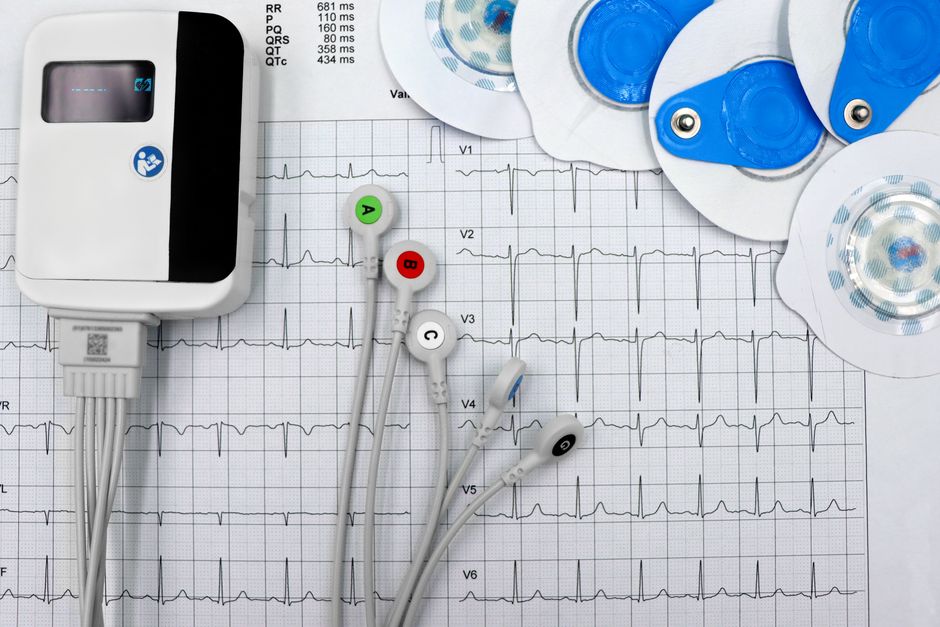
An extended Holter monitor is a portable device that records your heart’s electrical activity continuously for up to 14 days or longer. Unlike a standard Holter monitor that typically records for 24 to 48 hours, the extended version captures heart rhythms over a longer period. This makes it useful for detecting heart rhythm problems that happen infrequently or unpredictably. The device attaches to your chest with small electrodes and stores every heartbeat for your doctor to analyze later.
What Is An Extended Holter Monitor And How Does It Work Exactly?
An extended Holter monitor is a small, battery-powered device about the size of a deck of cards. You wear it under your clothes while going about your normal daily activities. The monitor connects to three to five sticky patches called electrodes that attach to your chest.
The electrodes detect your heart’s electrical signals. The monitor records every single heartbeat for the entire wearing period — usually 7 to 14 days. Some newer models can record for up to 30 days. The device stores the data on internal memory or transmits it wirelessly to a cloud-based system.
Unlike an event monitor that only records when you push a button, an extended Holter captures everything continuously. This is the key difference. It does not rely on you feeling symptoms and pressing a button. It simply records all the time.
After you return the monitor, a technician uses specialized software to analyze the recording. They look for abnormal rhythms, pauses in heartbeat, or unusually fast or slow rates. Your cardiologist then reviews the report and discusses findings with you.
Who Needs an Extended Holter Monitor?
Doctors typically recommend an extended Holter monitor when someone has symptoms that might come from an irregular heartbeat but standard tests were normal. Common symptoms include unexplained fainting, dizziness, palpitations, or a feeling that your heart is skipping beats.
The American Heart Association reports that about 2.7 million Americans have atrial fibrillation, a common irregular heart rhythm. Many people with atrial fibrillation do not feel symptoms all the time. An extended monitor can catch these silent episodes that a 24-hour recording would miss.
People who have already been diagnosed with a heart rhythm problem may also use an extended monitor to see if treatment is working. For example, after starting medication or having a procedure like ablation, your doctor may want to know if the abnormal rhythms have stopped.
Some people get an extended Holter monitor after a stroke to check for hidden atrial fibrillation. Research published in the journal Stroke found that extended monitoring detected previously unknown atrial fibrillation in about 16% of stroke patients. This is important because atrial fibrillation increases stroke risk and often requires blood thinner medication.
How Is It Different From a Standard Holter or Event Monitor?
The table below shows the main differences between the three types of heart rhythm monitors doctors commonly use.
| Feature | Standard Holter Monitor | Extended Holter Monitor | Event Monitor |
|---|---|---|---|
| Recording duration | 24 to 48 hours | 7 to 30 days | 30 days or longer |
| Records continuously | Yes | Yes | No — records only when activated or triggered |
| Requires symptom button | No | No — but you can mark symptoms in a diary | Yes — you press a button when you feel symptoms |
| Best for | Daily symptoms | Weekly or unpredictable symptoms | Rare symptoms that occur less than once a week |
| Data storage | On-device memory | On-device or cloud-based | Usually cloud-based |
The extended Holter fills a gap. It is longer than a standard Holter but still records continuously, unlike an event monitor. This matters because some abnormal heart rhythms happen every few days, not every day. A 24-hour monitor can miss them entirely.





What Does the Research Show About Extended Holter Monitors?
Multiple studies have compared extended monitoring to shorter recordings. The evidence consistently shows that longer monitoring finds more abnormal rhythms. A study published in the Journal of the American College of Cardiology found that extending monitoring from 24 hours to 7 days increased detection of atrial fibrillation by more than 200%.
Another study in Circulation looked at patients with unexplained fainting. Researchers found that 7-day Holter monitoring detected a possible cause in 27% of patients, compared to just 5% with 24-hour monitoring. That is a large difference.
The Centers for Medicare and Medicaid Services recognizes the value of extended monitoring. They cover 14-day Holter monitoring for certain conditions like suspected arrhythmia after a stroke. This coverage decision was based on clinical evidence showing that longer monitoring improves detection rates.
Some people claim that extended monitors are always better than shorter ones. That is not entirely accurate. For symptoms that happen every day, a 24-hour monitor is often sufficient. The extended version is most valuable when symptoms are unpredictable or when you have had a negative 24-hour test but still have symptoms.
What Are the Practical Steps for Wearing an Extended Holter Monitor?
Your doctor or a technician will place the electrodes on your chest. The skin is cleaned first to help the patches stick well. Men may need chest hair shaved in small spots for good contact. The patches connect to wires that plug into the monitor.
You wear the monitor continuously for the prescribed time — usually 7 to 14 days. You can put it in a pocket, clip it to a belt, or wear it on a strap around your neck. The device is waterproof for daily activities like hand washing and showering, but you typically cannot swim or take baths while wearing it.
- Keep a diary of your symptoms — write down the date, time, and what you were doing when you felt anything unusual
- Continue your normal daily activities — exercise, work, and sleep as usual
- Avoid magnets, metal detectors, and high-voltage areas that can interfere with the recording
- Do not get the monitor wet beyond light splashes — check with your provider about showering instructions
- Press the event button if your monitor has one — this marks the recording for your doctor to review
Most people adjust to wearing the monitor within a day or two. The main complaints are skin irritation from the adhesive patches and difficulty sleeping with the device. If the patches start to peel, you can use medical tape to secure them. Call your doctor’s office if any patch falls off completely.
What Are the Limitations and Common Misconceptions?
Extended Holter monitors are not perfect. They can miss abnormal rhythms that happen less than once every two weeks. For very rare symptoms, a different device called an implantable loop recorder may be a better option. This device is placed under the skin and can monitor for years.
A common misconception is that the monitor records only when you feel symptoms. That is wrong. It records every heartbeat, all the time. The symptom diary is just a tool to help your doctor correlate what you felt with what the monitor recorded.
Another misconception is that a normal result means your heart is fine. It does not. It means no abnormal rhythm was recorded during the wearing period. If your symptoms did not happen during that time, the test is not conclusive. Your doctor may recommend a longer monitoring period or a different type of monitor.
Some people worry the monitor will shock them or interfere with their heart. It will not. The monitor only records — it does not deliver any electricity. It is completely passive. The electrodes just pick up the natural electrical signals your heart produces.
There is no clinical evidence that extended Holter monitors cause any harm. The main risk is skin irritation from the adhesive patches. This is usually mild and goes away after the monitor is removed. If you have a known allergy to medical adhesives, tell your doctor before the test.
Frequently Asked Questions
How long do you wear an extended Holter monitor?
Most people wear it for 7 to 14 days. Some newer devices can record for up to 30 days depending on your doctor’s recommendation.
Can you shower with an extended Holter monitor?
You can shower but you must keep the monitor and electrodes dry. Some monitors are water-resistant for brief exposure but you should check with your provider for specific instructions.
Does an extended Holter monitor hurt?
No. The monitor itself does not hurt. You may feel mild skin irritation from the adhesive patches, but the device does not deliver any sensation or electricity.
What happens if a symptom happens but you forget to press the button?
The monitor still records your heart rhythm continuously. The symptom marker just helps your doctor find that part of the recording. The data is still captured and can be reviewed.
