
A muscle knot feels like a hard, tender spot deep in your muscle tissue. You press on it and it hurts, sometimes sending pain to another area of your body. The medical term is myofascial trigger point. These spots are common, and most people will deal with at least one at some point in their lives. Understanding what they actually are — and what they are not — can change how you treat them.
What Is A Knot In A Muscle? The Basics
A muscle knot is a small, hyperirritable spot within a taut band of skeletal muscle. The muscle fibers in that specific area contract and do not fully release. This creates a palpable nodule that feels different from the surrounding healthy tissue.
These contracted fibers compress local blood vessels. Reduced blood flow means less oxygen reaches the area. Waste products like lactic acid build up. The combination of sustained contraction, reduced circulation, and chemical irritation sensitizes the nerve endings in that spot. That is why the area feels tender and achy.
Knots are not scar tissue, and they are not actually a “knot” in the way a tangled rope is a knot. They are a neurological and muscular event. The muscle fibers are stuck in a contracted state because of a signaling problem, not because the tissue is physically twisted or bound up.
What Causes Muscle Knots to Form?
Several factors can create the conditions for a trigger point to develop. The most common trigger is repetitive overuse. Performing the same motion for hours — typing, lifting, swinging a racket — fatigues specific muscle fibers. When those fibers fatigue, they may fail to relax properly.
Poor posture is another frequent contributor. Sitting with your shoulders rounded forward for hours shortens the chest muscles and overstretches the upper back muscles. Both states create strain that can lead to knot formation. The same applies to holding your neck in a forward position while looking at a screen.
Direct injury can also cause knots. A fall, a car accident, or a sudden awkward movement can damage muscle fibers. The body responds by protecting the area with muscle tension, and that protective tension can become a chronic knot.
Stress plays a role too. Emotional stress causes your body to hold tension, often in the shoulders, neck, and jaw. Chronic stress keeps those muscles in a state of low-level contraction. Over time, that sustained tension can develop into trigger points.
Other contributing factors include sleep problems, vitamin deficiencies, and lack of physical activity. These factors do not directly cause knots, but they reduce the body’s ability to recover from muscle strain.
What Do Muscle Knots Feel Like?
The sensation varies from person to person. Some people describe a deep, dull ache. Others feel a sharp pain when pressing directly on the spot. The area may feel tight or stiff, and range of motion in the surrounding joint may be limited.
Trigger points often cause referred pain. This means the pain is felt in a different location than the knot itself. A knot in the upper trapezius muscle, for example, commonly refers pain up the side of the neck and into the temple. A knot in the gluteal muscles can refer pain down the back of the leg, mimicking sciatica.
This referred pain pattern is why muscle knots are frequently misidentified. People may treat the location where they feel pain rather than the location where the knot actually exists. A skilled therapist can identify the true source of the pain by palpating the muscle tissue.
Knots can also cause symptoms beyond local pain. Some people experience headaches from knots in the neck and shoulder muscles. Others report dizziness, ringing in the ears, or tingling in the hands. These symptoms occur because the knot irritates nearby nerves or alters muscle function.





How Are Muscle Knots Diagnosed?
There is no imaging test — no X-ray, MRI, or ultrasound — that reliably confirms a muscle knot. Diagnosis is primarily clinical. A healthcare provider or therapist will feel the muscle tissue with their hands, a process called palpation.
During palpation, they look for a taut band of muscle fibers. Within that band, they seek a specific tender nodule. Pressing on that nodule should reproduce the patient’s pain, either locally or in the referred pattern. This finding, called a spot tenderness, is a key diagnostic feature.
Because the diagnosis depends on the examiner’s skill, different practitioners may identify different trigger points in the same patient. This is a limitation of the current diagnostic approach. There is no objective standard for confirming a muscle knot exists.
It is also important to rule out other conditions. Muscle knots can feel similar to muscle strains, tendonitis, bursitis, or even nerve entrapment. A doctor may order imaging to exclude these other possibilities, particularly if the pain is severe, persistent, or accompanied by other symptoms like weakness or numbness.
What Treatments Actually Work?
Several treatment approaches have evidence supporting their use. The quality of that evidence varies, and not every treatment works for every person.
Massage therapy is the most common approach. Various techniques — deep tissue massage, trigger point massage, myofascial release — aim to manually release the contracted fibers. Research suggests massage can reduce pain and improve function in the short term. The effects may not be permanent, and repeat sessions are often needed.
Stretching is another foundational treatment. Gentle, sustained stretching of the affected muscle can help reset the muscle spindle’s sensitivity and encourage the fibers to lengthen. Stretching is most effective when combined with other treatments rather than used alone.
Heat therapy can help in the acute phase. Applying a warm compress or taking a warm shower increases blood flow to the area and may help relax the muscle. Heat is a supportive measure, not a cure.
Dry needling is performed by trained physical therapists and involves inserting thin needles directly into the trigger point. The goal is to elicit a local twitch response, which appears to interrupt the abnormal contraction cycle. Some clinical trials show dry needling provides short-term pain relief, though long-term superiority over other methods is not firmly established.
Injections are another option. A physician may inject a local anesthetic, like lidocaine, directly into the trigger point. This can provide rapid relief by blocking nerve signals and allowing the muscle to relax. The evidence for injection therapy is mixed, but many patients report significant benefit.
Over-the-counter pain relievers like ibuprofen or acetaminophen can reduce pain but do not address the underlying muscle contraction. They are reasonable for short-term symptom management but are not a long-term solution.
There is a common misconception that “no pain, no gain” applies to treating knots. This is not accurate. Aggressive, painful treatment can cause the muscle to guard further, worsening the problem. Effective treatment is usually firm but should not cause intense pain.
What Can You Do at Home Right Now?
Self-treatment can be effective for mild knots. The principle is to apply sustained, moderate pressure to the knot to encourage the muscle fibers to release.
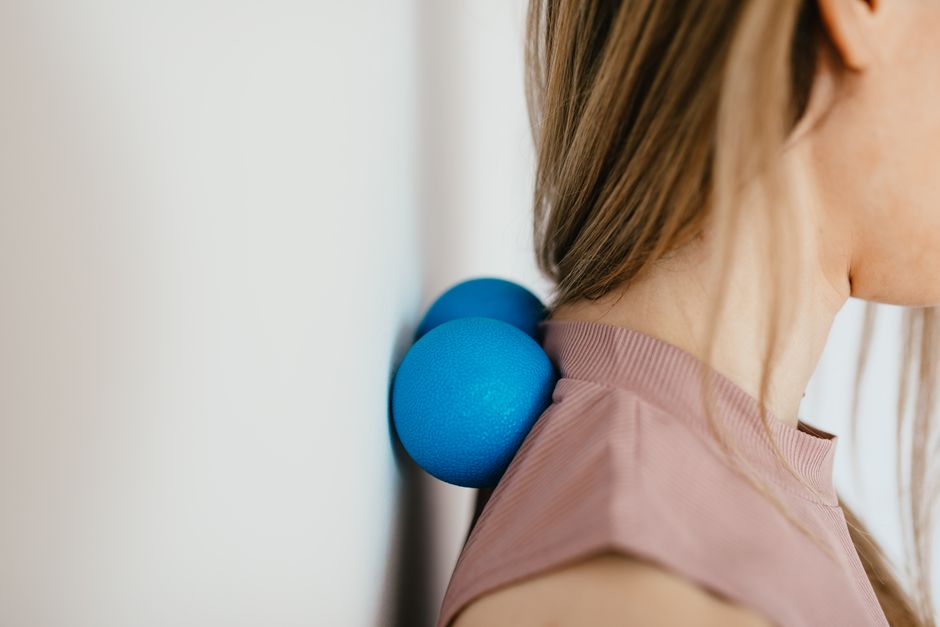
A massage ball or tennis ball placed between your body and a wall or the floor can target knots in the back, glutes, and shoulders. Position the ball on the knot and apply your body weight. Hold the pressure for 30 to 60 seconds. You should feel discomfort, not sharp pain. Breathe deeply and try to relax the muscle while pressure is applied.
Foam rollers work on a broader area. Rolling slowly over the muscle can help release tension, though a foam roller is less precise than a ball for targeting a specific knot.
Self-massage with your hands works for accessible areas like the neck, forearms, and calves. Use your fingertips or thumb to apply pressure directly to the knot. Move in small circular motions or hold steady pressure.
After releasing the pressure, gently stretch the muscle. This combination — pressure followed by stretching — appears more effective than either alone.
Hydration matters. Muscle tissue is about 75 percent water. Dehydration impairs muscle function and recovery. Drinking adequate water throughout the day supports normal muscle physiology, though it will not immediately resolve an existing knot.
How Do You Prevent Muscle Knots From Returning?
Prevention requires addressing the underlying causes. If your knots are related to posture, changing your workstation setup is essential. Your monitor should be at eye level. Your elbows should rest at a 90-degree angle. Your feet should be flat on the floor. These adjustments reduce the sustained strain that creates knots.
Regular movement breaks interrupt prolonged static postures. Standing, stretching, and walking for a few minutes each hour prevents muscles from becoming locked in one position.
Strength training helps build muscle resilience. Stronger muscles can handle more load before fatiguing. Focus on balanced strength — the chest and the upper back, the abdominals and the lower back — to avoid creating imbalances that lead to knots.
Stress management is a legitimate prevention strategy. Practices like deep breathing, meditation, or simply taking time to relax reduce the chronic muscle tension associated with stress. This is not speculation; the physiological link between stress and muscle tension is well established.
Sleep quality also matters. Muscles repair and recover during deep sleep. Poor sleep impairs this recovery process, making muscles more vulnerable to developing knots.
When Should You See a Doctor?
Most muscle knots are not dangerous and respond to self-care. But some situations warrant professional evaluation.
See a doctor if the pain is severe, lasts more than a few weeks despite self-treatment, or interferes with daily activities. Also seek medical advice if you have numbness, tingling, or weakness in the affected limb, as these symptoms may indicate nerve involvement rather than a simple muscle knot.
Seek immediate medical care if muscle pain is accompanied by chest pain, difficulty breathing, dizziness, or fever. These symptoms could indicate a more serious condition like a blood clot, heart problem, or infection. Do not assume muscle pain is benign when these red flags are present.
Keep in mind that not every tender spot is a muscle knot. Lumps, bumps, or areas of swelling that persist or grow should be evaluated by a healthcare professional. A muscle knot should feel like part of the muscle tissue, not like a foreign mass.
Frequently Asked Questions
Can a muscle knot be permanent?
Muscle knots can persist for months or years if untreated, but they are not typically permanent. With appropriate treatment — massage, stretching, or professional therapy — most knots can be resolved, though they may recur if the underlying cause remains.
Is it better to use heat or ice on a muscle knot?
Heat is generally more helpful for muscle knots because it increases blood flow and promotes muscle relaxation. Ice is better suited for acute injuries with inflammation, not for chronic muscle tension.
Can a muscle knot cause nerve pain?
Yes. A knot can compress or irritate nearby nerves, causing tingling, numbness, or radiating pain. This is why a knot in the neck or shoulder can produce symptoms in the arm or hand.
Does a muscle knot mean I need surgery?
No. Muscle knots are almost never treated with surgery. Conservative treatments like physical therapy, massage, and stretching are effective for the vast majority of cases.
