
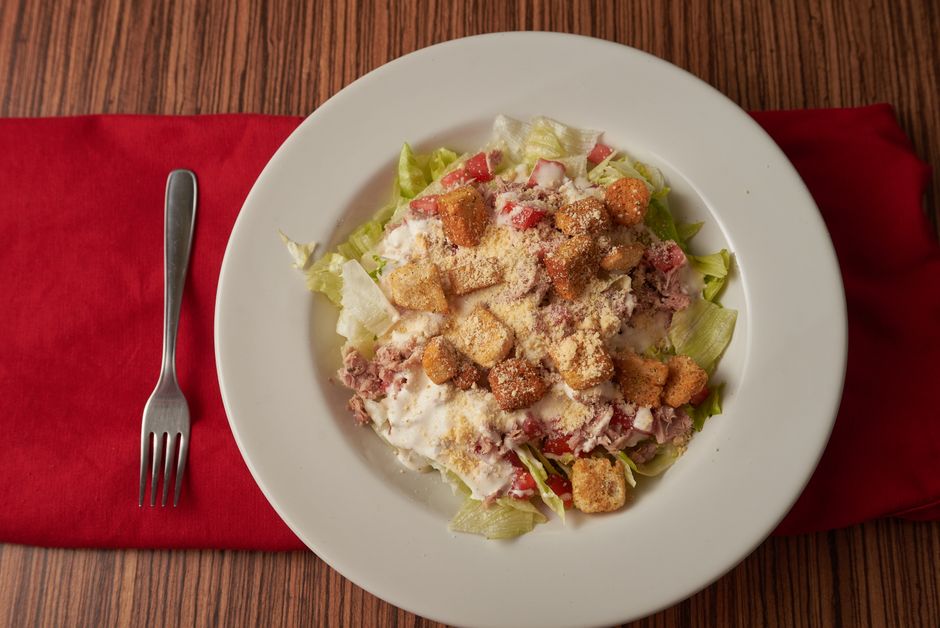
A Caesar salad is a salad made with romaine lettuce, garlic croutons, Parmesan cheese, and a dressing of egg, lemon juice, Worcestershire sauce, olive oil, and anchovies. It is assembled tableside in the classic preparation, but most versions are pre-mixed in the kitchen. The defining feature is the creamy, savory dressing that clings to every leaf of lettuce.
Where Did the Caesar Salad Come From?
The Caesar salad was invented in Tijuana, Mexico, in 1924. An Italian-born restaurateur named Caesar Cardini created it at his restaurant on July 4th weekend when the kitchen was running low on ingredients. He combined what he had on hand to make a quick dish for a crowd.
The story is well documented in culinary history. Cardini’s daughter, Rosa, recounted the origin in interviews and in her own cookbook. The original recipe did not include anchovies as a visible ingredient. The salty, fishy flavor came from Worcestershire sauce, which is made with anchovies.
The salad became famous across the border in California and spread across the United States over the following decades. It remains one of the most popular salads in American restaurants today.
What Is in a Classic Caesar Salad Dressing?
The classic dressing is an emulsion. That means it is a mixture of ingredients that normally separate, held together by a stabilizer. In this case, the egg yolk is the stabilizer that binds the oil and lemon juice together.
The traditional ingredients are:
- Egg yolk or a whole raw egg
- Lemon juice
- Olive oil
- Worcestershire sauce
- Anchovy fillets
- Garlic
- Dijon mustard
- Salt and black pepper
Some recipes skip the anchovy fillets entirely and rely on Worcestershire sauce for that flavor. Others add more anchovy for a stronger taste. The mustard is not in the original recipe but is common in modern versions because it helps keep the emulsion stable.
The texture should be thick enough to coat a spoon but thin enough to toss easily through the lettuce. The flavor is savory, tangy, and slightly salty with a clear garlic note.
Is Raw Egg in Caesar Dressing Safe?
Traditional Caesar dressing uses raw egg. Raw eggs carry a small risk of Salmonella infection. The risk is higher for young children, pregnant women, older adults, and people with weakened immune systems.
Commercial Caesar dressings sold in grocery stores are made with pasteurized eggs or cooked egg products. Pasteurization kills harmful bacteria while keeping the creamy texture. Most restaurant versions use pasteurized eggs as a standard safety practice.
If you make dressing at home, you can use pasteurized eggs from the refrigerated section of the grocery store. They are labeled as pasteurized and perform the same way as raw eggs in the dressing. You can also use a lightly cooked egg yolk, which reduces the risk while keeping the emulsion stable.
No clinical guidelines recommend eating raw eggs from unverified sources. If you are in a high-risk group, choose a dressing made with pasteurized eggs or use a bottled version.





Why Are Anchovies in the Dressing?
Anchovies add umami, the savory fifth taste that makes food deeply satisfying. They do not make the salad taste fishy when used in the right amount. They add depth and saltiness that balances the sharp lemon and garlic.
Umami is a recognized basic taste alongside sweet, sour, salty, and bitter. It comes from glutamate, an amino acid naturally present in anchovies, Parmesan cheese, and Worcestershire sauce. The Caesar salad is a layered umami dish because it combines several glutamate-rich ingredients.
People who dislike anchovies often enjoy Caesar dressing without realizing it contains them. The anchovy flavor blends into the dressing rather than standing out as a separate taste. If you are allergic to fish, you should avoid traditional Caesar dressing and ask about alternatives at restaurants.
What Is the Correct Way to Assemble a Caesar Salad?
The classic assembly starts with whole romaine leaves, not chopped lettuce. Cardini served the leaves whole so people could pick them up with their fingers. Modern versions often chop the romaine for easier eating.
The traditional tableside presentation involves several steps. The garlic is rubbed on the inside of a chilled wooden bowl. The romaine is added. The dressing is poured over the top. The salad is tossed with a fork and spoon to coat every leaf. Parmesan is shaved on top, and croutons are added last so they stay crisp.
There is no single correct way to assemble a Caesar salad at home. The important points are that the lettuce is dry, the dressing coats the leaves evenly, and the croutons stay crunchy. Wet lettuce dilutes the dressing and makes the salad watery.
Washing and drying the romaine thoroughly is the step most often skipped, and it makes the biggest difference in the final result. A salad spinner works best. Patting leaves dry with a towel is acceptable if you do not have a spinner.
Is a Caesar Salad Healthy?
A Caesar salad has a mixed nutritional profile. The romaine lettuce provides fiber, vitamin A, vitamin K, and folate. It is a genuinely nutritious base with few calories.
The dressing is where calories and fat add up. A typical two-tablespoon serving of Caesar dressing contains roughly 150 to 170 calories and 15 to 17 grams of fat. Restaurant servings are often larger than that. A full restaurant Caesar salad with dressing, croutons, and cheese can contain 400 to 600 calories before any protein is added.
Parmesan cheese adds calcium and protein but also sodium. Anchovies add protein and omega-3 fatty acids but also significant sodium. Croutons add refined carbohydrates and often extra oil.
None of these ingredients are harmful on their own. The salad becomes less healthy when portion sizes grow or when chicken, bacon, or extra cheese are added in large amounts. A side Caesar with light dressing is a reasonable choice. A large entree Caesar with grilled chicken is a filling meal but should not be treated as a low-calorie option.
Some research on salad consumption suggests that people who eat salads regularly tend to have higher intake of vegetables and certain vitamins. This is an association, not proof that Caesar salad specifically causes better health. The evidence does support eating vegetables in any form you enjoy, including romaine lettuce.
What Are Common Variations of the Caesar Salad?
Many restaurants and home cooks have adapted the original recipe. Grilled chicken Caesar is the most common version in the United States. It adds protein and turns the salad into a full meal.
Other variations include:
- Shrimp or salmon Caesar instead of chicken
- Kale substituted for romaine
- Bacon bits added for extra salt and smoke
- Avocado slices for creaminess
- Blackened or grilled romaine for a smoky flavor
- Vegan Caesar dressing made with cashews or tofu instead of egg and anchovies
Kale Caesar is popular because kale holds up to dressing better than romaine and does not wilt as quickly. The texture is chewier and the flavor is more bitter. Some people prefer this, and it is a reasonable swap nutritionally.
Vegan versions replace the egg with blended cashews or silken tofu and replace anchovies with capers or miso paste. These versions can taste quite similar to the original, though the texture is often thicker. No clinical evidence suggests these alternatives are either healthier or less healthy than the traditional version. They simply serve different dietary needs.
How Should You Store Leftover Caesar Salad?
Caesar salad does not store well once the dressing is on it. The lettuce wilts and the croutons become soggy within hours. If you have leftovers, they are best eaten the same day.
If you must store it, keep it in an airtight container in the refrigerator for no more than one day. The texture will change, and the salad will be noticeably softer. It is not unsafe to eat within that window if it was kept refrigerated, but the quality drops quickly.
Store the components separately if you want to prepare ahead. Keep the dressing, croutons, cheese, and washed romaine in separate containers. Combine them just before serving. This method keeps everything fresh for up to three days.
Frequently Asked Questions
Why is it called a Caesar salad if it has no Caesar dressing?
It is named after Caesar Cardini, the chef who invented it in 1924. The name refers to the creator, not the Roman emperor or the Caesar salad dressing sold in bottles.
Can you eat Caesar salad while pregnant?
Yes, if the dressing is made with pasteurized eggs or no raw egg at all. Ask the restaurant or check the label, and avoid dressings made with raw unpasteurized eggs during pregnancy.
Does Caesar salad contain raw fish?
Traditional Caesar dressing contains anchovies, which are fish, but they are not served raw as fillets. Anchovies are cured and salted, and in the dressing they are usually mashed or blended into the emulsion.
What is the best lettuce for a Caesar salad?
Romaine lettuce is the traditional and best choice. It has a sturdy texture that holds up to the dressing and provides the classic crunch that defines the salad.
