
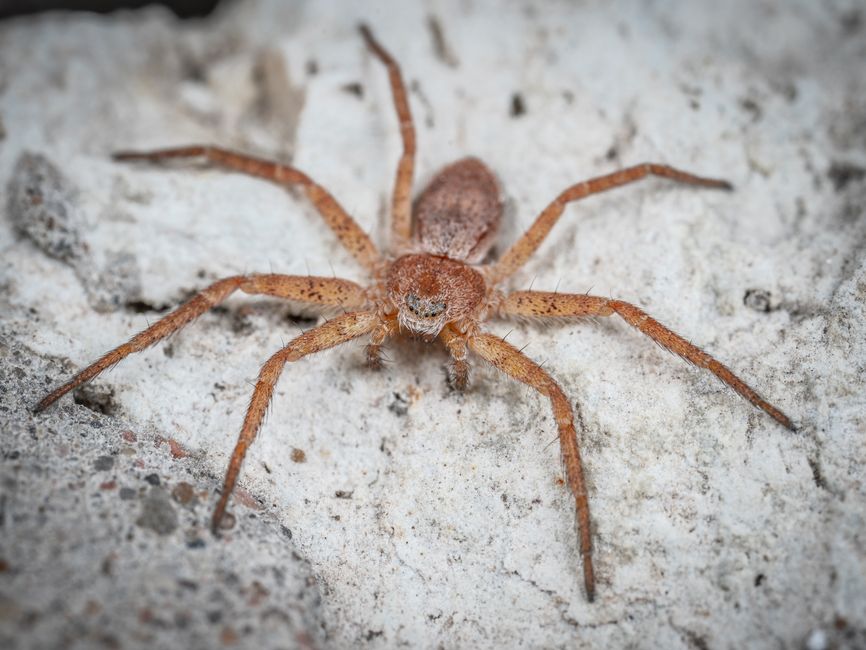
The brown recluse spider is one of the few spiders in North America whose bite can cause meaningful tissue damage in humans. It is a small, unassuming spider with a distinct violin-shaped marking on its back, which is why people also call it the “fiddleback” spider. Understanding what this spider looks like, where it lives, and what happens when it bites is the first step in separating real risk from unnecessary fear.
What Does a Brown Recluse Look Like?
The brown recluse is not a large spider. An adult is roughly the size of a US quarter when its legs are spread out. Its body is uniformly light to medium brown, and it has a distinctive dark, violin-shaped marking that starts near the eyes and extends backward toward the abdomen. The neck of the violin points toward the rear of the spider.
That marking is helpful, but it is not the most reliable identification feature. Many harmless spiders have similar markings. The most accurate way to identify a brown recluse is by looking at its eyes. Unlike most spiders that have eight eyes arranged in two rows, the brown recluse has six eyes arranged in three pairs, forming a semicircle. You likely will not get close enough to count eyes on a live spider. If you need certainty, a magnifying glass or a photograph enlarged on a phone screen can help.
Another clue is the spider’s behavior. Recluse spiders are reclusive by nature. They build irregular, messy webs in undisturbed areas and rarely leave them during daylight. If a spider is actively wandering across an open wall in the middle of the day, it is probably not a brown recluse.
Where Do Brown Recluse Spiders Live?
Brown recluse spiders have a specific geographic range in the United States. They are concentrated in the south-central Midwest, spanning states like Missouri, Kansas, Arkansas, Oklahoma, and eastern Texas. Their range extends eastward through Tennessee and parts of Kentucky and south into northern Louisiana and Mississippi. Isolated populations exist outside this core area, but they are uncommon.
If you live in the Pacific Northwest, the Northeast, or most of the Mountain West, the chance that a spider in your home is a brown recluse is very low. Many people report brown recluse bites in states outside the known range, but experts generally consider these reports unreliable. The spider’s range is well documented, and confirmed cases outside it are rare.
Inside homes, brown recluses prefer warm, dry, undisturbed spaces. Common hiding spots include closets, attics, basements, storage boxes, and the spaces behind furniture. They also live outdoors in some regions, under rocks, logs, and bark. They do not thrive in high-traffic areas of a home.
What Does a Brown Recluse Bite Look Like?
Most brown recluse bites are mild. Many people never feel the bite at the moment it happens, or they feel only a slight sting. In many cases, the bite heals on its own without any medical treatment and leaves no lasting mark.
When symptoms do develop, they typically appear within 2 to 8 hours. The bite area may become red, swollen, and tender. A small blister sometimes forms. In more serious cases, the tissue around the bite begins to die, a condition called necrosis. The center of the wound may turn dark blue or purple, then black, as the tissue breaks down. This process can take days to fully develop.
It is important to understand that severe necrosis is the exception, not the rule. Research consistently shows that only a small percentage of brown recluse bites cause significant tissue damage. Many bites that people attribute to brown recluses are actually caused by other things, including other spider species, bacterial infections, or skin conditions. A study published in the Journal of the American Board of Family Medicine noted that brown recluse bites are frequently overdiagnosed, and many “spider bites” are actually MRSA infections or other skin ulcers.




What Are the Symptoms of a Brown Recluse Bite?
Local symptoms vary widely. Some people experience only mild redness that fades within days. Others develop a painful, deep ulcer that takes weeks or months to heal.
Systemic symptoms are less common but can occur. These include fever, chills, nausea, joint pain, and a general feeling of being unwell. In rare cases, a condition called hemolysis can develop, where the spider’s venom destroys red blood cells. This can lead to anemia and, in very severe cases, kidney damage. Hemolysis is rare and typically occurs within the first 24 to 72 hours after a bite.
Children, older adults, and people with weakened immune systems are at higher risk for more severe reactions. But even in these groups, most bites remain mild.
How Is a Brown Recluse Bite Treated?
If you believe a brown recluse bit you, start with basic first aid. Wash the area gently with soap and water. Apply a cold compress to reduce pain and swelling. Keep the affected limb elevated when possible. Over-the-counter pain relievers like acetaminophen or ibuprofen can help with discomfort.
There is no antivenom approved for brown recluse bites in the United States. Treatment focuses on wound care and managing symptoms. For mild bites, keeping the area clean and covered is usually enough. For bites that develop necrosis, medical care is necessary. A doctor may need to clean the wound surgically, prescribe antibiotics if an infection develops, and monitor the healing process. Surgery is rarely needed immediately. Most doctors wait to see how the wound evolves before considering debridement, which is the removal of dead tissue.
Some clinicians recommend medications like dapsone or colchicine to reduce necrosis, but the evidence supporting these treatments is limited and mixed. No large clinical trials have confirmed their effectiveness. Do not attempt to treat a necrotic wound at home. Seek medical attention if the bite area becomes increasingly painful, develops a dark center, or if you experience fever, chills, or nausea.
How Can You Prevent Brown Recluse Bites?
Prevention focuses on reducing hiding places and being careful in areas where the spiders live. Shake out clothing, shoes, and towels before use if they have been stored in garages, basements, or closets. Wear gloves when moving boxes or firewood from storage areas. Seal cracks and gaps in walls, floors, and foundations to reduce entry points.
Insecticides can kill brown recluses on contact, but they do not eliminate the population. Sticky traps placed along baseboards and in corners can help you monitor for their presence. If you find a spider and are unsure of its identity, capture it in a clear container and contact a local extension service or pest control professional for identification.
It is worth noting that brown recluse spiders do not actively seek out humans. They bite in self-defense when pressed against skin, which often happens when a person rolls onto one in bed or puts on clothing that contains a spider. Taking simple precautions in storage areas significantly reduces the risk of an encounter.
When Should You See a Doctor?
Most brown recluse bites do not require a trip to the emergency room. However, you should seek medical attention if you develop severe pain at the bite site, if the area grows rapidly in size, or if you see a blister or dark discoloration forming within the first 24 hours. Fever, chills, joint pain, or dark urine are signs that the venom may be affecting your whole body, and these symptoms warrant prompt medical evaluation.
If you can safely capture the spider that bit you, bring it with you. A doctor or an entomologist can confirm the species, which helps guide treatment decisions. Many suspected spider bites turn out to be something else entirely, and accurate identification prevents unnecessary treatment.
Frequently Asked Questions
Can a brown recluse bite kill you?
Death from a brown recluse bite is extremely rare. Severe complications like hemolysis or kidney failure can occur but are uncommon and treatable with prompt medical care.
How long does a brown recluse bite take to heal?
Mild bites typically heal within 1 to 3 weeks. Bites that cause necrosis can take several months to fully heal and may leave a scar.
Do brown recluse spiders live in every state?
No. They are concentrated in the south-central Midwest, with established populations in roughly 15 to 16 states. Reports outside this range are rarely confirmed.
What should I do if I find a brown recluse in my house?
Do not panic. Capture it if you can, confirm its identity, and take steps to reduce hiding places. Sticky traps and sealing entry points help manage the population.
