

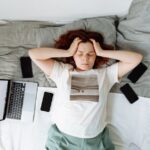
Nighttime is when the mind often gets loudest. You lie down, the lights go off, and suddenly worries surface that felt manageable during the day. Anxiety at night is common, and it is treatable. The most effective approach combines immediate calming techniques with consistent daytime habits that address the root causes of your anxious brain.
Why Does Anxiety Get Worse at Night?
Anxiety spikes at night for several biological and psychological reasons. When the sun goes down and your environment quiets, your brain has fewer external distractions to process. Your attention naturally turns inward, and that is when worry cycles can take hold.
Your body also has natural rhythms. Cortisol, the stress hormone, follows a daily pattern. For many people, cortisol levels rise in the early morning to help you wake up. But some people experience a secondary pattern where stress hormones remain elevated in the evening, making it hard to settle down.
Fatigue plays a major role too. After a long day, your mental resources are depleted. The same worry that you could dismiss at noon feels overwhelming at 10 p.m. because your brain does not have the energy to regulate emotions effectively. This is not a personal failure. It is a predictable biological response.
What Helps Anxiety At Night: Immediate Calming Strategies
When anxiety hits at night, you need tools that work within minutes. These strategies are supported by clinical evidence and can be done from your bed.
Slow your breathing. Rapid breathing feeds the anxiety cycle. Slow, deliberate breathing activates your parasympathetic nervous system, which is responsible for rest and digestion. Try this pattern: breathe in through your nose for four counts, hold for four counts, and exhale slowly through your mouth for six counts. Repeat for two to three minutes. The longer exhale is the key — it signals safety to your nervous system.
Use progressive muscle relaxation. Anxiety causes physical tension, and physical tension signals danger to your brain. Progressive muscle relaxation breaks this loop. Starting at your toes, tense each muscle group for five seconds, then release completely. Move upward: feet, calves, thighs, abdomen, hands, arms, shoulders, jaw, and face. By the time you reach your forehead, most people notice a measurable drop in tension.
Try the 5-4-3-2-1 grounding technique. This pulls your attention out of your head and into the present moment. Name five things you can see, four things you can touch, three things you can hear, two things you can smell, and one thing you can taste. It interrupts the worry loop by forcing your brain to process sensory information instead of anxious thoughts.
Get out of bed if you cannot sleep. If you have been lying awake for more than 20 minutes, your brain starts associating your bed with worry. This is called conditioned arousal. Get up, go to a dimly lit room, and do something quiet — reading a paper book, folding laundry, or sipping herbal tea. Return to bed only when you feel sleepy again. This is a core principle of cognitive behavioral therapy for insomnia, and it works for nighttime anxiety as well.
Daytime Habits That Reduce Nighttime Anxiety
What you do during the day directly affects how anxious you feel at night. These habits do not require willpower at midnight. They work in advance.
Move your body earlier in the day. Exercise is one of the most reliable anxiety reducers. Physical activity burns off stress hormones like adrenaline and increases endorphins. But timing matters. Vigorous exercise too close to bedtime raises your core temperature and heart rate, which can interfere with sleep. Aim to finish intense workouts at least three hours before bed. Gentle stretching or walking in the evening is fine.
Limit caffeine after noon. Caffeine blocks adenosine, a chemical that promotes sleep. It also mimics anxiety symptoms — racing heart, jitteriness, racing thoughts. Caffeine has a half-life of roughly five to six hours. That means a 2 p.m. coffee still has half its caffeine in your system at 8 p.m. If you are prone to nighttime anxiety, switching to decaf or herbal tea after lunch makes a real difference.
Schedule a worry time. Anxiety often spikes at night because you have not given your worries dedicated attention during the day. Set aside 15 minutes each afternoon. Write down every worry on paper. If a worry shows up at night, remind yourself it already has a time and place tomorrow. This technique, called stimulus control, comes from cognitive behavioral therapy. It contains worry instead of letting it flood your evenings.



How Your Sleep Environment Affects Anxiety
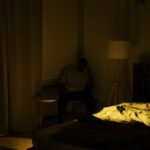
Your bedroom sends signals to your brain. If those signals say “alert,” anxiety will fight your attempts to sleep. If they say “safe and dark,” your brain can transition into rest mode more easily.
Keep your bedroom cool. Your body temperature needs to drop slightly to initiate and maintain sleep. Most sleep specialists recommend a room temperature between 60 and 67 degrees Fahrenheit. If your room is too warm, you may wake more often and feel more restless.
Block blue light before bed. The blue light from phones, tablets, and computers suppresses melatonin, the hormone that regulates sleep. It also keeps your brain in an alert, task-oriented state. Stop using screens 30 to 60 minutes before bed if possible. If you must use your phone, enable night mode and dim the brightness. But be honest with yourself — scrolling social media right before sleep often feeds anxiety rather than relieving it.
Use white noise or calming sounds. Silence can feel deafening when you are anxious. A fan, white noise machine, or nature sounds provide a gentle auditory anchor. They also mask sudden sounds — like traffic or a neighbor’s door — that can jerk you out of a light sleep.
When Anxiety At Night Is a Sign of Something Else
Sometimes nighttime anxiety is not just anxiety. It can be a symptom of an underlying condition that needs different treatment.
Sleep apnea causes breathing to stop and start during sleep. Many people with undiagnosed sleep apnea wake up feeling panicked, with a racing heart. They may not remember these episodes clearly, but they experience daytime fatigue and morning anxiety. If you snore loudly, wake gasping, or feel exhausted despite spending enough time in bed, talk to a doctor about a sleep study.
Nocturnal panic attacks are distinct from general nighttime anxiety. They wake you from sleep with intense fear, a pounding heart, sweating, and a sense of doom. These attacks usually peak within minutes. They are treatable — often with cognitive behavioral therapy and sometimes medication — but they deserve a professional evaluation rather than self-management alone.
Generalized anxiety disorder may also be the underlying cause. If your nighttime anxiety is part of a broader pattern of persistent worry that interferes with daily life, consider speaking with a mental health professional. Therapy, particularly cognitive behavioral therapy, has strong evidence for treating anxiety disorders. Medication is also available and effective for many people.
What Not to Do When You Feel Anxious at Night
Some common responses to nighttime anxiety make it worse. Knowing what to avoid is as important as knowing what to do.
Do not check the time repeatedly. Watching the clock feeds a cycle of frustration. Each glance tells your brain “I am still awake, and this is a problem.” This raises stress and makes sleep harder. Turn your clock away from your bed or remove it entirely.
Do not reach for alcohol. Alcohol is a depressant, so it may help you fall asleep faster. But as your body metabolizes it, sleep becomes fragmented. You may wake in the middle of the night feeling anxious, restless, and dehydrated. Alcohol also suppresses REM sleep, which your brain needs for emotional processing.
Do not try to force sleep. Sleep is not something you can command. Trying to force it creates performance anxiety that keeps you awake. Instead, shift your goal. Tell yourself: “I am resting my body even if I do not sleep.” This removes the pressure and often allows sleep to arrive naturally.
Frequently Asked Questions
What is the fastest way to calm anxiety at night?
Slow breathing with an extended exhale is the fastest reliable method. Breathe in for four counts and out for six counts for several minutes to activate your relaxation response.
Can magnesium help with nighttime anxiety?
Some research suggests magnesium may help with sleep quality and anxiety symptoms, but evidence is not conclusive. If you are considering a supplement, discuss it with your doctor first.
Why do I wake up at 3 a.m. with anxiety?
Waking between sleep cycles is normal, but anxiety can turn a brief awakening into a full worry episode. Blood sugar dips and natural cortisol rises in the early morning can also contribute.
Should I take melatonin for nighttime anxiety?
Melatonin can help you fall asleep faster, but it does not directly treat anxiety. It is generally safe for short-term use, but it is not a substitute for addressing the underlying causes of your anxiety.
