
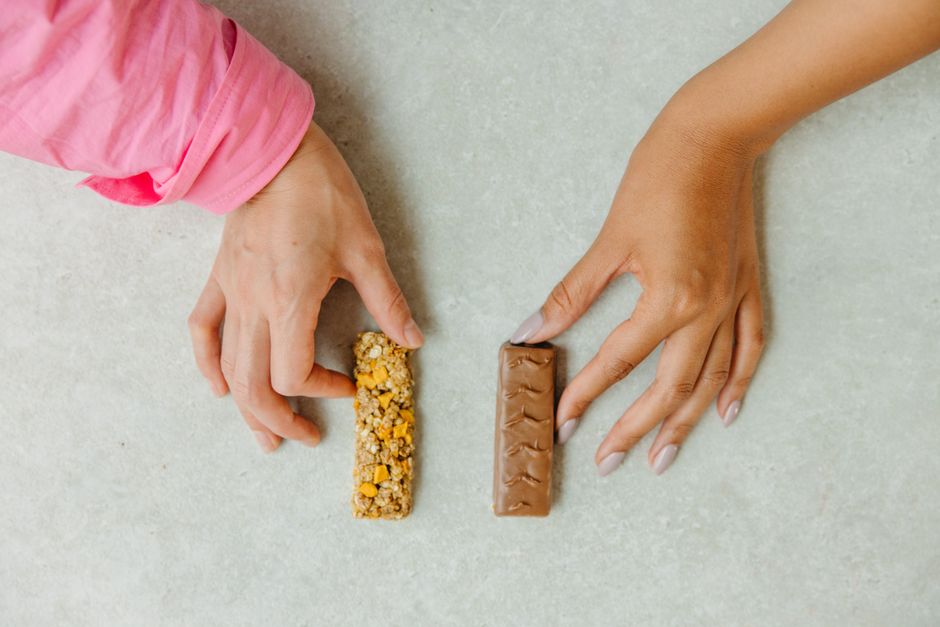
Foods that contain protein and carbohydrates with little to no fat include most beans and lentils, egg whites, plain nonfat yogurt, shrimp, white fish, and grains like rice and oats. Each of these delivers both macronutrients while keeping fat low, though the exact amounts vary widely from food to food.
That combination is not as common as it sounds. Fat is the most calorie-dense macronutrient, so foods that skip it tend to be either naturally lean animal proteins or plant foods built mostly from starch and water. Knowing which foods fit can help with meal planning, but it also matters to understand what you give up when a food has no fat at all.
What Has Protein And Carbs But No Fat?
The clearest examples come from two food groups: lean animal proteins and legumes.
- Egg whites — about 3.6 grams of protein and 0.2 grams of carbs per white, with essentially no fat
- Nonfat plain Greek yogurt — roughly 10 grams of protein and 4 grams of carbs per 100 grams, with fat near zero
- Shrimp — about 20 grams of protein per 100 grams, almost no carbs, and under 1 gram of fat
- Cod and other white fish — around 18 grams of protein per 100 grams with minimal fat
- Lentils — about 9 grams of protein and 20 grams of carbs per 100 grams cooked, with under 1 gram of fat
- Black beans and kidney beans — similar protein and carb profile to lentils, with very little fat
- Plain cooked rice — mostly carbs, a few grams of protein, and almost no fat
- Oats — about 5 grams of protein and 27 grams of carbs per 100 grams dry, with around 3 grams of fat
A note on that last entry: oats are not truly fat-free. They carry a small amount of naturally occurring fat. The same is true of most whole plant foods. “No fat” is usually a practical description, not a literal zero.
How Can A Food Have Protein And Carbs But No Fat?
Fat is not a required building block for every food. Plants store energy as starch and protein, and animals store some of it as lean muscle tissue. Neither process requires fat to be present in large amounts.
Egg whites are a good example. The yolk holds nearly all of the egg’s fat. The white is mostly water and protein, which is why it fits the pattern so cleanly.
Legumes work differently. They build protein and carbohydrate from the same plant tissue, so both nutrients come bundled together. The fat content stays low because the seed does not need much stored fat to germinate.
White fish and shellfish are lean because they build muscle without much fat storage. Their bodies use fat differently than land animals do.
Which Foods Have All Three Macronutrients?
Most whole foods contain some of all three macronutrients. The difference is proportion.
| Food | Protein | Carbs | Fat |
|---|---|---|---|
| Egg white (1 large) | 3.6 g | 0.2 g | ~0 g |
| Nonfat Greek yogurt (100 g) | 10 g | 4 g | ~0 g |
| Shrimp (100 g) | 20 g | 0 g | 0.5 g |
| Cod (100 g) | 18 g | 0 g | 0.7 g |
| Lentils, cooked (100 g) | 9 g | 20 g | 0.4 g |
| Whole egg (1 large) | 6 g | 0.6 g | 5 g |
| Chicken breast (100 g) | 31 g | 0 g | 3.6 g |
| Salmon (100 g) | 20 g | 0 g | 13 g |
The pattern is clear. The foods at the top of that table are the ones people mean when they ask this question. The ones at the bottom have fat, sometimes a lot of it.

Do You Need Fat In Your Diet?
Yes. Fat is an essential nutrient, and the human body cannot make two of the fatty acids it needs. Those must come from food.
Fat also helps the body absorb vitamins A, D, E, and K. Those vitamins are fat-soluble, which means they need dietary fat to be taken up properly. A meal built entirely from fat-free foods can reduce how well those vitamins are absorbed.
Fat provides energy, supports cell membranes, and helps regulate hormones. The general guidance from major health organizations is to get roughly 20 to 35 percent of daily calories from fat, with an emphasis on unsaturated sources like olive oil, nuts, seeds, and fish.
So a food being fat-free is not automatically better. It is one data point, not a verdict.
Are Fat-Free Foods Always Healthier?
No. Fat-free does not mean healthy, and it does not mean low in calories.
Many processed fat-free products replace fat with sugar, starch, or thickeners to keep the texture acceptable. Those ingredients add carbohydrates and calories. A fat-free cookie can carry as many calories as a regular one.
There is also a practical issue. Fat carries flavor and helps you feel full. Foods stripped of fat can be less satisfying, which some people find leads them to eat more later. The evidence on this is mixed, and individual responses vary.
Naturally fat-free foods like beans, egg whites, and plain yogurt are a different story from manufactured fat-free products. The first group is a whole food. The second is a formulation.
Who Might Focus On These Foods?
People watching their saturated fat intake often lean on this group. So do people managing calorie targets, since fat has more than twice the calories per gram of protein or carbohydrate.
Athletes sometimes use fat-free protein sources to hit protein targets without overshooting calories. That is a common practice, though it is not a requirement for performance.
Anyone following a low-fat eating pattern for medical reasons should work with a clinician or dietitian. The right mix depends on the person, their health history, and their goals. There is no single fat target that fits everyone.
What About Label Claims On Packaged Foods?
The word “fat-free” on a US label has a legal definition. A product can carry that claim only if it contains less than 0.5 grams of fat per serving.
That threshold matters. A food labeled fat-free can still contain a small amount of fat, and the serving size can be small enough to hide a meaningful total. Eating several servings changes the math.
“Low fat” is a separate claim with its own threshold, generally 3 grams or less per serving. These are regulated terms, not marketing language, though they say nothing about sugar, sodium, or overall nutritional quality.
Reading the Nutrition Facts panel tells you more than the front of the package. The label claim is a starting point, not the whole picture.
How Do These Foods Fit Into A Balanced Diet?
They fit well as building blocks. A meal of beans and rice, or egg whites with oats, delivers protein and carbs with almost no fat. Add a small amount of a fat source and you have all three macronutrients covered.
That is often the more useful approach than chasing a completely fat-free day. The body needs some fat, and the foods that provide it also tend to carry fat-soluble vitamins and essential fatty acids.
The practical takeaway is simple. Foods with protein and carbs but no fat exist, and they are easy to find. They are one part of a diet, not the whole thing.
Frequently Asked Questions
What food has protein and carbs but no fat?
Egg whites, nonfat plain Greek yogurt, shrimp, cod, lentils, and black beans all fit. Each delivers protein and carbohydrates with little to no fat.
Is it healthy to eat only fat-free foods?
No. Fat is an essential nutrient, and the body needs it to absorb vitamins A, D, E, and K and to obtain two fatty acids it cannot make on its own.
Do beans have protein and carbs without fat?
Yes. Cooked lentils and black beans provide roughly 9 grams of protein and 20 grams of carbs per 100 grams, with under 1 gram of fat.
Does fat-free mean low calorie?
Not always. Many fat-free packaged foods add sugar or starch to replace fat, which can bring calories back up to the same level as the regular version.
