
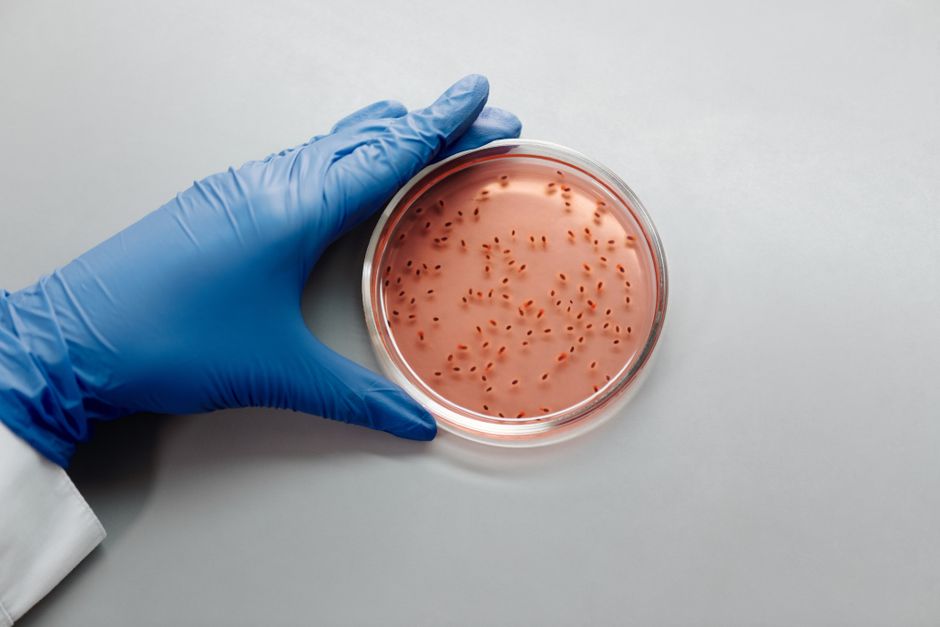
Salmonella is a group of bacteria that you cannot see with the naked eye. It does not have a color, shape, or texture that you can spot on food. You cannot smell it, taste it, or feel it. The only way to know if salmonella is present is through a laboratory test. So when people ask what salmonella looks like, the honest answer is that it looks like nothing at all on your food.
What Does Salmonella Look Like Under a Microscope?
Under a microscope, salmonella bacteria appear as rod-shaped cells. They are often described as looking like small capsules or pills. They are typically about 2 to 5 micrometers long, which is far smaller than the width of a human hair.
In a laboratory, scientists use special stains to make salmonella visible. The most common stain is called a Gram stain. Salmonella is a Gram-negative bacterium, which means it appears pink or red under this stain. This is a standard laboratory finding and is part of how scientists identify the bacteria.
Salmonella also has flagella, which are long, whip-like tails. These tails help the bacteria move. Under a high-powered microscope, you might see the bacteria swimming or darting around. But this level of detail requires specialized equipment and training.
What Does Salmonella Look Like on Food?
Salmonella does not change the appearance of food. Raw chicken with salmonella looks exactly like raw chicken without it. The same is true for eggs, beef, pork, and produce. There is no visual cue that tells you contamination is present.
This is why food safety guidelines focus on temperature and handling rather than appearance. Cooking food to a safe internal temperature kills salmonella. For poultry, that temperature is 165°F. For ground meats, it is 160°F. For whole cuts of beef, pork, and lamb, it is 145°F with a three-minute rest time.
Some people believe that a slimy texture or a bad smell means food is unsafe. These signs can indicate spoilage, but they do not indicate salmonella. Fresh-looking food can still carry the bacteria. The reverse is also true — food that looks and smells odd may not contain salmonella at all.
What Does Salmonella Look Like in Stool?
Salmonella infection can cause diarrhea, but the bacteria itself is not visible in stool. The diarrhea may be loose, watery, or even bloody. Blood in the stool can happen because salmonella can damage the lining of the intestines.
You cannot diagnose a salmonella infection by looking at stool. The symptoms overlap with many other infections, including other bacteria and viruses. A stool culture is the standard test. A laboratory takes a sample and tries to grow the bacteria. If salmonella grows, the diagnosis is confirmed.
If you have bloody diarrhea, a high fever, or signs of dehydration, seek medical care. These symptoms require professional evaluation. Do not try to determine the cause on your own.




What Are the Symptoms of a Salmonella Infection?
Symptoms usually start 6 hours to 6 days after exposure. The most common symptoms are diarrhea, fever, and stomach cramps. Nausea and vomiting can also occur.
Most people recover without treatment within 4 to 7 days. The main risk is dehydration from fluid loss. Drinking fluids is the most important part of home care. Oral rehydration solutions are often recommended because they replace both water and electrolytes.
Antibiotics are not routinely prescribed for healthy people with mild illness. They are sometimes used for severe cases, for infants, for older adults, or for people with weakened immune systems. Using antibiotics unnecessarily can contribute to antibiotic resistance, so doctors are careful about when they prescribe them.
Some people develop a complication called reactive arthritis after a salmonella infection. This can cause joint pain, eye irritation, and painful urination. It can last for months or even longer. This is not common, but it is a known risk.
How Does Salmonella Spread?
Salmonella lives in the intestines of animals and humans. It is shed in feces. The most common route of infection is through contaminated food.
Common sources include raw or undercooked poultry, eggs, meat, and unpasteurized milk. Produce can also become contaminated if it is washed with contaminated water or handled by someone with the bacteria on their hands. Recent outbreaks have been linked to raw flour, peanut butter, and even cantaloupe.
Cross-contamination is a major factor in home kitchens. This happens when juices from raw meat touch ready-to-eat foods, cutting boards, or utensils. Washing your hands after handling raw meat is essential. Using separate cutting boards for raw meat and produce is a practical way to reduce risk.
Pet reptiles and amphibians are another source. Turtles, lizards, and frogs can carry salmonella on their skin. Children are especially at risk because they may touch the animal and then put their hands in their mouths. The CDC has advised that households with children under 5 should not keep reptiles as pets.
How Can You Prevent a Salmonella Infection?
Prevention comes down to four basic practices: clean, separate, cook, and chill.
- Clean: Wash your hands with soap and water before and after handling food. Wash cutting boards, counters, and utensils with hot, soapy water.
- Separate: Keep raw meat, poultry, and seafood away from other foods. Use separate cutting boards and plates for raw and cooked foods.
- Cook: Use a food thermometer to check that food reaches a safe internal temperature. Do not rely on color or texture.
- Chill: Refrigerate leftovers within 2 hours. Keep your refrigerator at or below 40°F.
Do not wash raw poultry or meat before cooking. Washing can splash bacteria around your kitchen. Cooking to the proper temperature is what kills the bacteria.
Eggs should be cooked until both the white and yolk are firm. Avoid foods that contain raw or lightly cooked eggs, such as homemade mayonnaise or certain dessert recipes. Pasteurized eggs are a safer option for these uses.
When eating out, order foods cooked well-done. This is especially important for ground meat, which can have bacteria mixed throughout rather than just on the surface.
When Should You See a Doctor?
Most salmonella infections resolve on their own. But some situations require medical attention.
Seek care if you have a fever above 102°F, if diarrhea lasts more than 3 days without improvement, or if you see blood in your stool. Prolonged vomiting that prevents you from keeping fluids down is also a reason to seek care. Signs of dehydration include dry mouth, decreased urination, and dizziness when standing.
Infants, older adults, and people with weakened immune systems are at higher risk for severe illness. If someone in these groups has symptoms, contact a healthcare provider early rather than waiting.
Salmonella is one of the most common causes of foodborne illness in the United States. The CDC estimates it causes about 1.35 million infections each year. Most people recover fully. But the infection can be serious, and in rare cases it can be life-threatening.
Frequently Asked Questions
Can you tell if food has salmonella by looking at it?
No. Salmonella does not change the color, smell, taste, or texture of food.
What color is salmonella bacteria?
When stained in a laboratory using a Gram stain, salmonella appears pink or red because it is a Gram-negative bacterium.
How long after eating contaminated food do symptoms appear?
Symptoms usually start 6 hours to 6 days after exposure, with most people becoming ill within 12 to 72 hours.
Does cooking kill salmonella?
Yes. Cooking food to the proper internal temperature — 165°F for poultry and 160°F for ground meats — kills salmonella.
