
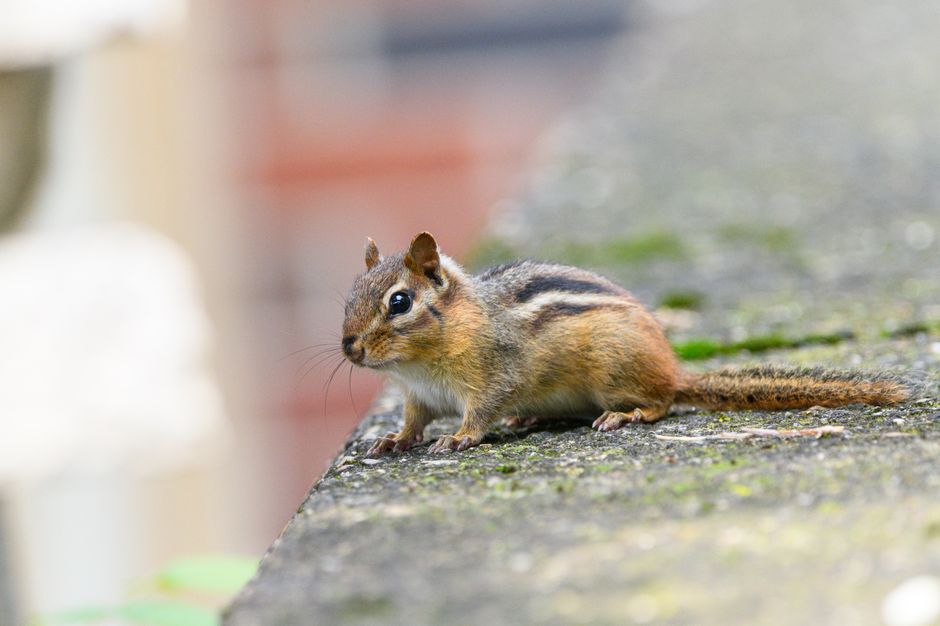
Chipmunk droppings look like small, dark, oval pellets, roughly the size of a grain of rice. They are usually dark brown to nearly black, slightly curved or tapered at the ends, and measure about 3 to 6 millimeters long. They often sit scattered rather than piled, and they look similar enough to mouse droppings that the two are frequently confused.
If you have found tiny dark pellets in a garage, shed, attic, or garden bed and you are trying to figure out what left them, the shape, size, and placement all matter. This guide explains what chipmunk droppings actually look like, how they differ from the droppings of other small animals, and what to do about them.
What Does Chipmunk Droppings Look Like?
Chipmunk droppings are small, dark, and roughly oval or slightly elongated. Most are between 3 and 6 millimeters long — smaller than a pencil eraser and comparable to a grain of long rice.
Fresh droppings tend to be dark brown or black and may look slightly shiny. As they dry, they become duller and lighter, sometimes turning grayish-brown. Because chipmunks eat a mix of seeds, nuts, berries, insects, and fungi, the color and texture can shift with their diet. You may occasionally see tiny visible fragments of seed hull or insect shell in the droppings.
One detail that helps: chipmunk droppings usually do not have the pointed, pinched-off tips that mouse droppings often show. They tend to look more rounded or blunt at the ends. This is not a perfect rule, but it is a useful starting point.
How Big Are Chipmunk Droppings Compared to Other Animal Droppings?
Size is one of the most useful ways to narrow down what you are looking at. Chipmunk droppings fall into the small-pellet category, but they are not identical to every other small pellet you might find.
| Animal | Typical dropping size | Shape |
|---|---|---|
| Chipmunk | About 3–6 mm long | Oval, blunt ends, slightly curved |
| House mouse | About 3–6 mm long | Pointed or tapered ends |
| Rat | About 12–20 mm long | Larger, capsule-shaped |
| Squirrel | About 8–12 mm long | Larger, rounded, often lighter |
You can see the problem: chipmunk and mouse droppings overlap closely in size. That is why size alone is not enough. Shape, location, and the surrounding evidence usually matter more.
Rat droppings are noticeably bigger and have a more uniform capsule shape. Squirrel droppings are larger still and often look more like small rounded plugs. If the pellets you found are clearly bigger than a grain of rice, you are probably looking at something other than a chipmunk.
How Can You Tell Chipmunk Droppings From Mouse Droppings?
This is the single most common mix-up, and it is understandable. Chipmunk and mouse droppings are close in size and both are dark and pellet-shaped. The differences are subtle but real.
Mouse droppings tend to have pointed or tapered ends, giving them a slightly spindle-like look. Chipmunk droppings are more likely to look blunt or rounded at both ends. Mouse droppings are also often found in greater numbers and in more concentrated trails along walls, inside cabinets, or near food sources.
Chipmunk droppings are more likely to appear outdoors or in transition spaces — along a stone wall, near a woodpile, on a porch, in a garage, or in a garden bed. Chipmunks are active during the day, while mice are mostly nocturnal. If you are seeing the animal itself scampering around in daylight with stripes down its back, that is strong evidence.
Here is a point worth clarifying, because it comes up often: you generally cannot identify the species from a single dropping with certainty. Wildlife professionals use a combination of size, shape, location, and other signs. If identification truly matters — for example, in a food storage area — assume it could be a rodent and act accordingly.





Where Are You Most Likely to Find Chipmunk Droppings?
Location is often more telling than appearance. Chipmunks are ground-dwelling rodents that dig burrows and stay close to cover.
You are most likely to find their droppings:
- Along the edges of stone walls, foundations, and retaining walls
- Near woodpiles, brush piles, and dense ground cover
- Around the base of bird feeders, where spilled seed collects
- In garages, sheds, and crawl spaces, especially near stored seed or pet food
- On porches, steps, and patios where they pause to feed
- In garden beds and mulch, often near burrow entrances
Chipmunk burrows usually have a small, clean entrance hole about the size of a golf ball, often with a small mound of excavated soil nearby. If you find droppings plus a burrow entrance plus scattered seed hulls, you have a fairly strong picture.
Indoors, chipmunks are less common than mice, but they do enter garages, basements, and outbuildings. Finding droppings inside a living space is more often a mouse or rat situation, though chipmunks are not impossible.
Do Chipmunk Droppings Carry Disease?
Yes, rodent droppings can carry disease-causing organisms, and chipmunk droppings should be treated with the same caution as any wild rodent waste. This is not a reason to panic, but it is a reason to handle cleanup carefully.
Rodent droppings can transmit bacteria such as Salmonella and Leptospira, and they can carry parasites. Hantavirus is a serious concern with some rodent species, particularly deer mice in certain regions of North America. The evidence linking chipmunks specifically to hantavirus transmission to humans is limited compared to deer mice, but the general principle holds: dried rodent droppings and the dust around them should not be disturbed carelessly.
The main route of concern is breathing in dust from dried droppings or contaminated nesting material, or transferring contamination to your mouth via your hands. This is why dry sweeping or vacuuming rodent droppings is discouraged — it can launch contaminated dust into the air.
If you have symptoms like fever, muscle aches, or breathing trouble after known rodent exposure, contact a healthcare provider and mention the exposure. This is general information, not a diagnosis, and any medical concern should be evaluated by a clinician.
How Should You Clean Up Chipmunk Droppings Safely?
Cleaning up rodent droppings safely comes down to avoiding dust and avoiding contact. Public health guidance on rodent cleanup is fairly consistent on the core steps.
General approach:
- Open windows and doors to ventilate the area before you start
- Put on disposable gloves, and consider a mask if the area is dusty or enclosed
- Do not dry sweep or vacuum the droppings
- Spray the droppings and surrounding area with a disinfectant or a diluted bleach solution until they are thoroughly wet
- Let it sit for several minutes, then wipe up with paper towels
- Dispose of everything in a sealed bag, then wash your hands thoroughly
- Clean any surfaces that may have been contaminated
For bleach dilution and contact time, follow the label directions on the product you use, since concentrations vary. If you are dealing with a large or long-standing infestation, or contamination inside HVAC systems or insulation, a professional remediation service may be the safer choice.
After cleanup, the bigger question is prevention. Sealing entry points, storing bird seed and pet food in sealed containers, and reducing dense ground cover near your foundation all make your property less attractive to chipmunks.
Can You Prevent Chipmunks From Leaving Droppings Around Your Home?
Prevention is mostly about removing food and shelter. Chipmunks are drawn to easy calories and safe cover, so reducing both makes your space less appealing.
Practical steps include:
- Store bird seed, grass seed, and pet food in sealed metal or heavy plastic containers
- Clean up spilled seed under feeders regularly, or use feeders designed to reduce spillage
- Keep woodpiles and brush away from the foundation of your home
- Seal gaps around foundations, vents, and outbuildings where practical
- Trim dense ground cover and shrubs back from the base of the house
Exclusion is generally more effective and longer-lasting than trying to remove chipmunks one at a time. Trapping and relocation are sometimes used, but they come with legal and practical considerations that vary by state, and relocation is not always humane or effective. If you have a significant infestation, a licensed wildlife control professional is a reasonable route.
Frequently Asked Questions
What do chipmunk droppings look like?
They are small, dark, oval pellets about 3 to 6 millimeters long, usually dark brown to black with blunt or rounded ends. They often look similar to mouse droppings but tend to be less pointed.
Are chipmunk droppings dangerous to humans?
They can carry bacteria and parasites, so they should be handled with care and never disturbed by dry sweeping. The specific risk from chipmunks is lower than from some other rodents, but standard rodent-cleanup precautions still apply.
How do I tell chipmunk droppings from mouse droppings?
Mouse droppings usually have pointed or tapered ends, while chipmunk droppings tend to be blunter and more rounded. Location helps too, since chipmunks are active by day and often found outdoors near burrows and cover.
Should I worry if I find droppings in my house?
Finding rodent droppings indoors is worth taking seriously, since it usually means an animal has gotten inside. Clean the area safely, look for entry points, and consider professional help if the problem is ongoing.
