
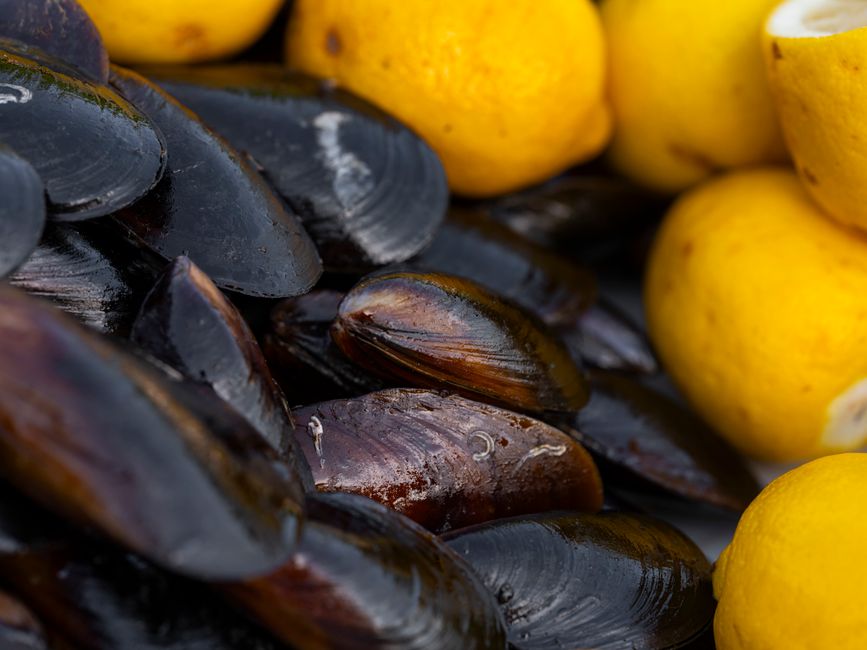
Mussels are filter feeders. They eat tiny particles floating in the water around them. This includes microscopic algae, bacteria, and organic debris. They do not hunt or chew their food like animals with mouths and teeth.
How Do Mussels Eat Without a Mouth?
Mussels have a different body plan than most animals you think of. They live attached to rocks, docks, or the ocean floor. They do not move around to find food. Instead, they pull water into their shell through a tube called an incurrent siphon. Inside the shell, the water passes over their gills. The gills are not just for breathing. They are covered in tiny hair-like structures called cilia. These cilia beat constantly, creating a current that moves water through the mussel. Sticky mucus on the gills traps the small food particles. Then the cilia move the food particles toward the mouth. It is a continuous process. The United States Geological Survey notes that a single adult mussel can filter up to 15 gallons of water per day. That is a lot of tiny meals.
What Exactly Is in a Mussel’s Diet?
The specific food a mussel eats depends entirely on what is floating in its local water. There is no single menu. But researchers have identified the main categories. The primary food source is phytoplankton. These are microscopic plants that drift in sunlit water. Diatoms are a common type of phytoplankton that mussels eat. Zooplankton, which are tiny animals, are also on the menu but in smaller amounts. Mussels also consume bacteria and detritus, which is dead organic matter like broken-down plant material. A study published in Limnology and Oceanography found that mussels can digest bacteria efficiently, getting a meaningful amount of energy from them. This ability to eat bacteria is important because it means they can survive in murky water where phytoplankton is scarce. They are not picky. They eat whatever organic particles are small enough to trap.
Do Freshwater Mussels Eat the Same Things as Saltwater Mussels?
The basic feeding mechanism is identical. Both freshwater and saltwater mussels are filter feeders. They both use siphons and gills to capture particles. But the specific food available is different in each environment. Freshwater mussels live in rivers, lakes, and streams. Their diet leans more heavily on bacteria and detritus because phytoplankton is often less abundant in freshwater systems. Saltwater mussels, like the blue mussels you see on restaurant menus, live in the ocean. They have a more consistent supply of phytoplankton because ocean water is usually richer in these microscopic plants. The National Oceanic and Atmospheric Administration reports that saltwater mussels in coastal areas can filter enormous volumes of water, which helps keep the water clear. One difference worth noting is that freshwater mussels are often more sensitive to water quality. If the water is too polluted or has too much sediment, it can clog their gills and starve them. Saltwater mussels are generally more tolerant of turbid, or cloudy, water.




What Do Mussels Eat in an Aquarium or Farm Setting?
If you keep mussels in an aquarium, you cannot just drop fish food flakes in the tank. They will not eat them. Mussels need particles suspended in the water column. In a home aquarium, you can feed them live phytoplankton cultures. These are sold online or at specialty pet stores. You add a small amount directly to the water. The mussel filters it out. The challenge is keeping the water clean. If you add too much phytoplankton, it can rot and spike ammonia levels, which can kill the mussel. Many aquarists find that a well-established tank with live rock and fish already has enough natural food particles to sustain a small mussel. On mussel farms, the process is simpler. Farmers grow mussels on ropes or in mesh bags in open water. The mussels feed naturally on whatever is in the ocean. There is no supplemental feeding. The farmers rely on the natural productivity of the water. This is why mussel farming is considered one of the most environmentally friendly types of aquaculture. The mussels clean the water as they grow, and they do not compete for wild fish stocks for food.
Can Mussels Eat Anything Other Than Plankton?
This is where things get interesting. Mussels are non-selective filter feeders. They take in whatever is small enough to pass through their siphon. That includes things that are not food. In polluted waters, mussels can ingest microplastics. These are tiny plastic fragments from bags, bottles, and synthetic clothing. Research published in Environmental Science & Technology has found microplastics in the tissues of mussels from oceans around the world. Mussels also absorb heavy metals like lead and mercury from the water. They concentrate these toxins in their bodies over time. This is why health agencies advise caution about eating wild mussels from unknown sources. The mussels themselves do not get sick from these pollutants. But the contaminants build up in their flesh. For the mussel, the water is a soup. It filters the soup. Good particles become food. Bad particles become stored toxins. This is also why mussels are used as indicator species. Scientists test mussel tissue to measure pollution levels in a body of water. If the mussels are healthy, the water is likely clean. If they are full of toxins, the water has a problem.
| Environment | Primary Food Source | Key Challenge |
|---|---|---|
| Open Ocean | Phytoplankton, zooplankton | Predation, storms |
| Freshwater River | Bacteria, detritus, some phytoplankton | Sediment clogging gills |
| Mussel Farm | Natural plankton in water column | Algal blooms (red tide) |
| Home Aquarium | Live phytoplankton culture | Water quality management |
What Happens If a Mussel Cannot Find Food?
Mussels are surprisingly tough. They can survive long periods without food. When food is scarce, they slow their metabolism down. They close their shells tightly to conserve energy. This is called a resting state. They can stay like this for weeks. Mussels in intertidal zones, where the tide goes in and out, are used to this. They close up when the tide leaves them exposed to air. They open again when the water returns. But there is a limit. If the water is chronically low in food, the mussel will weaken. It may stop growing. Its shell may become thin and brittle. Eventually, it will starve. This is rare in natural environments because plankton populations fluctuate with the seasons. But it can happen in areas with severe pollution or after a large algal bloom dies off and decomposes, which consumes oxygen in the water. The mussel cannot filter enough food to offset the energy it spends pumping water.
Common Misconceptions About What Mussels Eat
One of the most persistent myths is that mussels eat fish waste or fish poop. This is not accurate. Mussels do eat bacteria and detritus, which are components of waste. But they do not actively seek out feces. They simply filter whatever is in the water. If fish waste breaks down into small enough particles, a mussel might trap and eat some of it. But it is not a primary food source. Another misconception is that you can keep a mussel alive in a tank by feeding it crushed fish flakes. Fish flakes are too large and sink to the bottom. Mussels cannot pick food off the bottom. They need particles suspended in the water. The third common myth is that mussels eat algae that cause green water in aquariums. They do eat some types of algae, but not all. The single-celled algae that cause green water are often in the right size range. But filamentous algae, the stringy kind that grows on glass, is too large for them to filter. Mussels are not a cleanup crew for a dirty tank. They are a sensitive addition that requires stable water conditions and a specific food supply.
Frequently Asked Questions
How often do mussels need to eat?
Mussels eat continuously whenever they are actively filtering water. They do not have scheduled meals. They feed as long as the water contains food particles.
Can I feed my pet mussel fish food?
No, standard fish flakes or pellets are too large for mussels to filter. You need to use live phytoplankton cultures that are small enough to stay suspended in the water.
Do mussels eat the same food as clams?
Yes, both mussels and clams are filter feeders that eat phytoplankton, bacteria, and detritus. Their diets are nearly identical in the same environment.
What happens if I put a mussel in a tank with no food?
The mussel will close its shell and slow its metabolism. It can survive for weeks this way, but it will eventually starve if no food particles are added to the water.
