
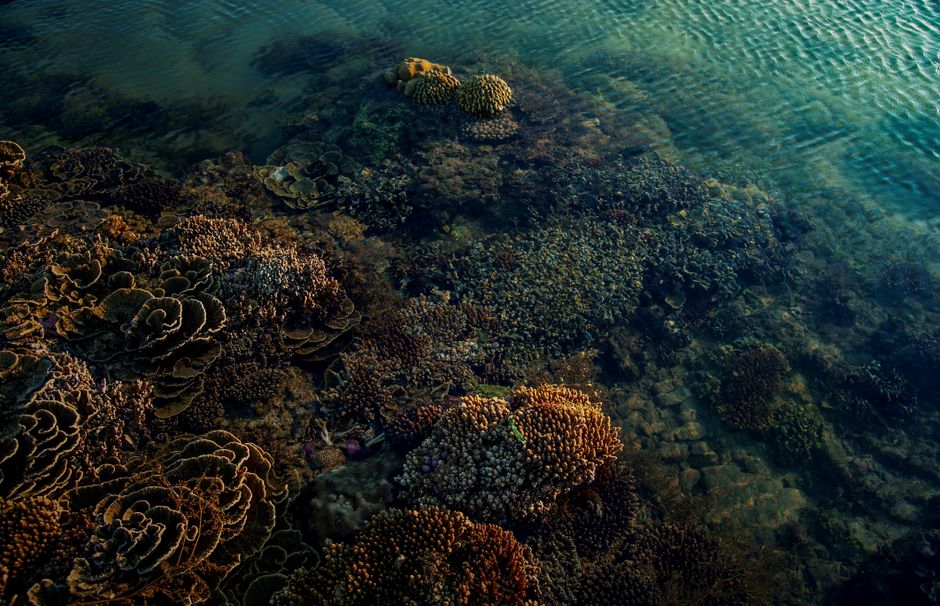
Coral reefs don’t eat the way animals do. They don’t hunt, graze, or swallow. Instead, a reef is a living structure built by tiny animals called coral polyps, and those polyps get their food in two very different ways. Some of it they make themselves using sunlight. Some of it they catch from the water around them. Everything else on the reef — the fish, the crabs, the sea turtles, the sharks — feeds on what the corals and their neighbors produce.
That is the short answer. The longer answer is a food web that starts with microscopic algae living inside coral tissue and ends with top predators like reef sharks and groupers. Understanding it explains why coral reefs are among the most productive ecosystems in the ocean, and why damage to one part of the web ripples through the rest.
What Do Coral Polyps Actually Eat?
Coral polyps are small animals, usually a few millimeters across, with a mouth surrounded by tentacles. They eat in two ways, and both matter.
The first is a partnership with single-celled algae called zooxanthellae that live inside the coral’s tissue. These algae photosynthesize, using sunlight to make sugars and other energy-rich compounds. They pass most of that energy to the coral. In return, the coral gives the algae a safe place to live and the nitrogen and phosphorus they need. This relationship is the engine of the whole reef. For many reef-building corals, the majority of their energy comes from this source.
The second way is direct feeding. At night, coral polyps extend their tentacles and catch small drifting animals called zooplankton, along with tiny particles of organic matter. They sting and pull prey into their mouths. This captured food supplies nutrients the algae cannot provide, especially nitrogen and phosphorus that the coral needs to grow and build its skeleton.
So the honest answer to “what does coral eat” is: mostly what its algae partners make, plus whatever small prey it can capture from the water. Neither source alone is enough. Corals that lose their algae — a process called bleaching — can sometimes survive by feeding on zooplankton, but they are weakened and may starve if the loss lasts too long.
How Does the Coral Reef Food Web Start?
Every food web needs a base, and on a reef that base is a mix of photosynthesis and drifting organic matter.
At the very bottom are the producers: the zooxanthellae inside coral tissue, plus free-floating phytoplankton in the surrounding water, plus seaweeds and other algae that grow on the reef surface. These organisms convert sunlight into food.
Next come the primary consumers. These include the corals themselves, which act as both producer and consumer because of their algae partners. They also include small plant-eating fish like parrotfish and surgeonfish that graze on algae, and tiny animals like copepods that feed on phytoplankton.
A detail that surprises many people: coral reefs are not especially rich in nutrients in the surrounding water. Tropical waters are often described as clear and low in dissolved nutrients, similar to a desert on land. The reef is productive anyway because nutrients are recycled tightly inside the system. A fish eats, excretes, and the waste feeds algae, which feeds another fish. Very little is wasted. This recycling is what allows a busy reef to exist in water that would otherwise look empty.
Who Eats Whom on a Coral Reef?
The middle of the food web is crowded. Small fish eat plankton and algae. Larger fish eat the small fish. Crustaceans, sea urchins, and mollusks graze on algae or scavenge on the bottom. Sea turtles, some of which eat seagrass and algae, sit in the middle too.
Above them are the predators. Groupers, snappers, jacks, barracuda, and reef sharks hunt other fish. Moray eels hunt in crevices. These top predators keep the numbers of mid-level fish in check, which in turn affects how much algae gets eaten.
That balance matters. When overfishing removes too many grazing fish, algae can grow over corals and smother them. When too many predators are removed, mid-level fish populations can shift in ways that affect the whole reef. Reef food webs are not a simple line from small to big. They are a network with many overlapping connections, and pulling on one thread changes others.




Do Corals Get Food From Bacteria and Dissolved Matter?
Yes, and this part is easy to overlook. Corals and many other reef animals also absorb dissolved organic matter directly from the water, and they host bacteria and other microbes that help process nutrients.
Sponges, which are common on reefs, pump huge volumes of water through their bodies and filter out bacteria and fine particles. They effectively turn microscopic food that other animals cannot use into forms that can re-enter the food web when sponges are eaten or when their waste is consumed.
Some research indicates that this “microbial loop” — the cycle of bacteria, tiny grazers, and dissolved nutrients — plays a larger role in reef productivity than was once thought. The exact size of that contribution is still being studied. What is clear is that a reef is not just fish eating fish. It is a tightly connected system where nutrients pass through many small hands before reaching a shark.
How Do Reef Food Webs Compare Across Reef Types?
Not all reefs work the same way. The mix of species and the balance between feeding strategies varies with location, water clarity, temperature, and how much human activity the reef experiences.
| Reef Type | Main Energy Source | Typical Top Predators | Notes |
|---|---|---|---|
| Shallow tropical reef | Zooxanthellae photosynthesis plus zooplankton capture | Reef sharks, groupers, jacks | Most productive; strong algae-coral balance |
| Deep or mesophotic reef | More reliance on capturing drifting food; less light | Larger fish and sharks | Less studied; light limits algae partners |
| Cold-water coral reef | Almost entirely captured plankton; no sunlight | Fish and deep-sea predators | Corals here have no algae partners at all |
That last row is worth pausing on. Cold-water corals live in deep, dark water where photosynthesis is impossible. They have no zooxanthellae. Every bit of their food comes from catching plankton and particles drifting by. Same animal group, completely different feeding strategy.
Why Does the Reef Food Web Matter?
The reef food web supports an enormous number of species. Reefs cover a small fraction of the ocean floor but are home to a large share of marine species, including many that people depend on for food and income.
When the web is disrupted, the effects are practical. Coral bleaching from warm water removes the algae partners that many corals rely on. Without them, corals weaken, and the fish that depend on living coral for shelter and food decline. Overfishing removes key predators and grazers. Pollution and runoff add nutrients that fuel algae growth, which can smother corals.
These are not separate problems. They feed into each other. A reef that loses its corals loses the base of its food web, and the whole structure begins to thin out from the bottom up.
One clarification worth making: corals are animals, not plants, even though reef-building corals look like rocks or bushes and get much of their energy from photosynthesis carried out by their algae partners. That partnership is what makes them unusual. It is also what makes them vulnerable, because the algae are sensitive to temperature and light in ways the coral animal itself is not.
What Eats Coral Directly?
Plenty of animals eat coral tissue. Parrotfish scrape algae and sometimes coral from the reef surface. Crown-of-thorns sea stars feed on coral polyps and can damage reefs when their numbers spike. Some snails and worms bore into coral or feed on it. Butterflyfish nibble on coral polyps and mucus.
These coral-eaters are part of the web, not separate from it. In healthy numbers, they are normal reef residents. Problems arise when a species that eats coral becomes unusually abundant, often because its own predators have been removed or because conditions favor its young. That is another example of how connected the system is: removing a predator at the top can increase pressure on the corals at the bottom.
Frequently Asked Questions
What do coral reefs eat?
Coral polyps get most of their energy from microscopic algae living inside their tissue, which make food from sunlight. They also catch small drifting animals called zooplankton with their tentacles, usually at night.
Do corals eat fish?
Most reef-building corals are too small to eat fish and feed on plankton and tiny particles instead. A few larger coral species can capture small fish or shrimp, but this is not their main food source.
What is at the top of the coral reef food web?
Reef sharks, large groupers, jacks, and barracuda sit near the top, hunting smaller fish and other reef animals. These predators help keep the numbers of mid-level fish in balance.
Why do corals need algae to survive?
The algae, called zooxanthellae, produce sugars through photosynthesis and share most of that energy with the coral. Without them, many corals lose their main food source and can starve if the loss lasts too long.
