
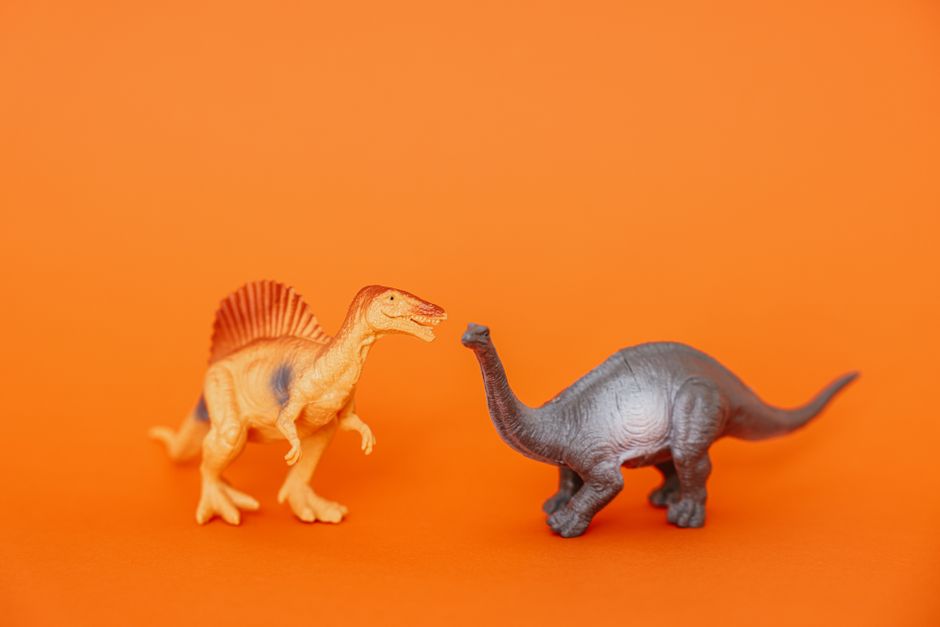
Dinosaurs ate plants, meat, insects, fish, and in some cases each other. Scientists know this not from watching them, but from reading the physical evidence they left behind: fossilized teeth, jaw shapes, stomach contents, bite marks, and chemical traces locked inside bones. Nobody has ever seen a dinosaur take a bite, so every claim about their diet is built from indirect clues that have to fit together.
What Did Dinosaurs Eat How Do Scientists Know?
The short answer is that diet gets reconstructed from anatomy first, then confirmed or corrected with fossil evidence. Teeth are the starting point because they are hard, abundant, and shaped by what an animal does with them.
Teeth that are flat, broad, and leaf-shaped with serrated edges are built for stripping and grinding plant material. Think of the wide, chisel-like teeth of Triceratops or the leaf-shaped teeth of sauropods like Brachiosaurus. Teeth that are long, curved, and pointed with sharp edges are built for piercing and slicing flesh, like those of Tyrannosaurus rex or Velociraptor.
Jaw mechanics matter too. A jaw that only moves up and down suggests a slicing bite. A jaw with a sliding or grinding motion suggests processing tough plant fibers. Paleontologists also look at where the jaw muscles attached. Large attachment sites mean powerful bites, which tells you something about what the animal needed to break down.
This is the foundation. It is also where the reasoning can go wrong. Anatomy tells you what an animal could eat. It does not prove what it actually ate. That gap is why the other lines of evidence matter so much.
How Do Fossilized Stomach Contents Prove What a Dinosaur Ate?
Direct evidence of a last meal is rare but powerful. In a small number of specimens, the contents of the ribcage have been preserved well enough to identify what was inside the digestive tract when the animal died.
One well-documented case is a small feathered dinosaur called Microraptor. Multiple specimens have been found with remains of birds, fish, and small mammals preserved in the stomach area. This told researchers something anatomy alone could not: Microraptor was not a picky specialist. It ate a range of small prey.
A famous plant-eating example comes from a specimen of Baryonyx, a large fish-eating dinosaur. Its stomach area contained fish scales and bones, along with some dinosaur remains. That combination was unexpected for an animal whose long, crocodile-like snout suggested a fish diet.
The catch is preservation. Stomach contents only survive under unusual conditions, usually when an animal is buried quickly in fine sediment with little oxygen. Most dinosaurs died and decomposed without leaving any trace of their last meal. So stomach contents give us sharp snapshots but a very incomplete picture.
What Can Fossilized Feces and Bite Marks Tell Us?
Coprolites are fossilized feces, and they are a genuine window into diet. Inside them, researchers have found bone fragments, plant material, pollen, and even tiny pieces of insects. A coprolite attributed to Tyrannosaurus rex contained crushed bone fragments from a plant-eating dinosaur, which is direct evidence of predation and bone-crushing behavior.
Bite marks on bones are another line of evidence. When a predator feeds on a carcass, its teeth leave characteristic grooves, pits, and punctures. If those marks match the tooth spacing and shape of a known predator found in the same rock layer, that is strong circumstantial evidence of who ate whom.
Some bones show evidence of healing after a bite, meaning the animal was attacked and survived. That tells researchers about hunting behavior and failed predation, not just scavenging.
There is a limitation worth naming. Bite marks show that a dinosaur’s teeth contacted a bone. They do not always prove the animal killed its prey rather than scavenging a carcass. Distinguishing active hunting from scavenging is genuinely difficult and often debated among paleontologists.





How Do Chemical Traces in Bones Reveal Dinosaur Diets?
Bones and teeth are made of minerals, and the atoms inside those minerals carry chemical signatures that reflect diet. This is one of the more technical methods, and it has limits.
Stable isotope analysis measures ratios of different forms of elements like carbon and nitrogen in fossilized tissue. In living animals, these ratios shift depending on what an animal eats. Plant eaters and meat eaters end up with different signatures because the chemistry passes up the food chain.
Researchers have applied this method to dinosaur fossils and found patterns consistent with plant-eating and meat-eating diets. Some studies have also suggested that certain dinosaurs may have eaten fish, based on isotope values that resemble those of fish-eating animals today.
The problem is that fossilization alters bone chemistry over millions of years. Isotope values in a dinosaur fossil are not the same as they were in the living animal. Researchers try to account for this, but the method carries real uncertainty. It is best used alongside anatomy and physical evidence, not on its own.
Were Any Dinosaurs Omnivores or Specialists?
Yes, and this is where the plant-versus-meat split breaks down. Some dinosaurs did not fit neatly into either category.
Oviraptorids are a good example. Their name means “egg thief,” based on an early assumption that they stole and ate eggs. That assumption turned out to be wrong. Later finds showed some of these dinosaurs were sitting on nests of their own eggs. Their toothless beaks and jaw structure suggest they ate a mix of plants, eggs, and small animals.
Therizinosaurus had enormous claws that looked predatory, but its teeth and jaw were built for plants. It is now generally considered a plant eater despite its intimidating appearance. This is a useful reminder that one feature can mislead you if you ignore the rest of the evidence.
Some large theropods, including Spinosaurus, had long, narrow snouts with cone-shaped teeth that resemble those of modern fish-eating animals. Isotope and other evidence has been used to argue for a heavily fish-based diet, though this remains an area of active research and debate.
Why Is Reconstructing Dinosaur Diets So Difficult?
Every method has a blind spot, and that is the core challenge.
- Teeth show what an animal could process, not what it actually ate.
- Stomach contents only survive under rare conditions and capture one meal.
- Coprolites are scarce and not always linked to a specific species.
- Bite marks cannot always distinguish hunting from scavenging.
- Isotope values are altered by fossilization and carry uncertainty.
When several independent lines of evidence point the same direction, confidence goes up. When they conflict, researchers have to explain why. A dinosaur with plant-eating teeth but isotope values suggesting meat would be a genuine puzzle.
This is also why scientific understanding of dinosaur diets changes over time. New fossils, better imaging, and improved chemical methods keep revising the picture. What looked like a specialist can turn out to be a generalist. What looked like a predator can turn out to be a plant eater.
What Did Baby Dinosaurs Eat?
For most dinosaur species, nobody knows. Direct evidence of what juveniles ate is extremely rare because small, young animals are less likely to fossilize and less likely to be found.
Some evidence suggests that at least a few dinosaurs cared for their young. Fossil nests with adults positioned over eggs, and hatchlings found together in groups, point toward parental behavior in some species. Whether that included feeding young is not established.
For plant-eating dinosaurs, it is reasonable to think juveniles ate the same plants as adults, possibly softer ones given smaller jaws. But that is inference from anatomy and modern animal behavior, not direct fossil evidence. No clinical or fossil guideline exists for reconstructing juvenile dinosaur diets, and researchers treat this as an open question.
How Has Dinosaur Diet Research Changed Over Time?
Early paleontologists leaned heavily on teeth and jaw shape. That approach produced some correct conclusions and some wrong ones. The “egg thief” mistake with Oviraptor is a classic example of anatomy leading to a confident but incorrect story.
The shift came as new methods were added. Scanning electron microscopy let researchers examine wear patterns on teeth. Isotope analysis brought chemistry into the picture. CT scanning allowed scientists to look inside fossils without damaging them. Each new tool added a check on the others.
The result is a field that is more careful about certainty. Modern paleontologists are more likely to say “the evidence suggests” than to declare a definitive answer, because they know how many assumptions go into each method.
Frequently Asked Questions
How do scientists know what dinosaurs ate?
They combine several lines of evidence, including tooth shape, jaw mechanics, fossilized stomach contents, coprolites, bite marks, and chemical isotope analysis. When multiple methods agree, confidence in the conclusion is higher.
Did all dinosaurs eat meat?
No. Many dinosaurs were plant eaters, including sauropods and horned dinosaurs, while others were meat eaters or omnivores. Some, like Therizinosaurus, had features that initially misled researchers about their diet.
What is the most reliable evidence of dinosaur diet?
Direct evidence like preserved stomach contents and coprolites is the most reliable because it shows what an animal actually consumed. However, these fossils are rare, so anatomy and chemical analysis are used to fill in the gaps.
Can we tell if a dinosaur was a hunter or a scavenger?
Not always. Bite marks on bones show that teeth contacted bone, but distinguishing active hunting from scavenging a carcass is genuinely difficult and often debated.
