
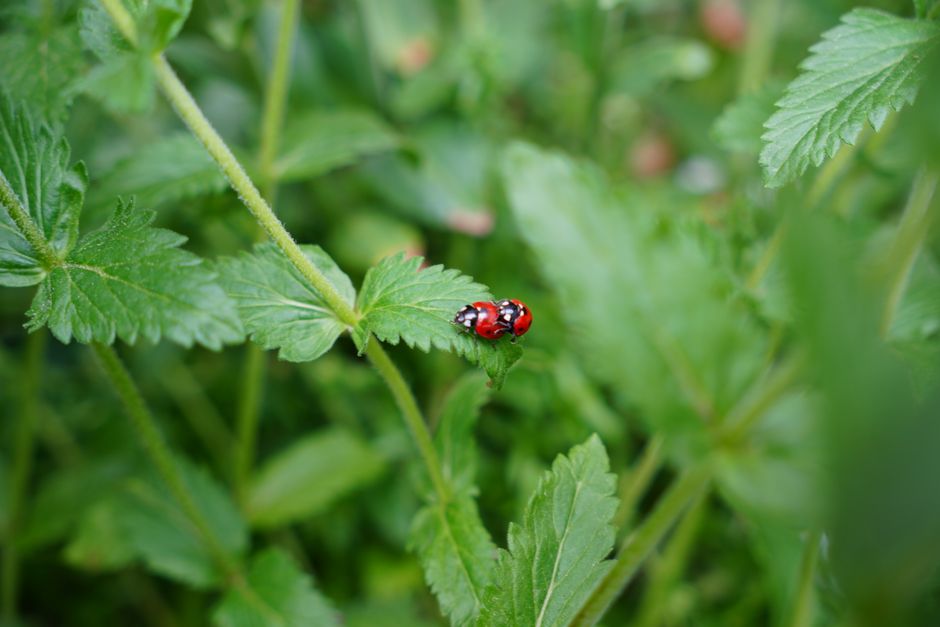
Ladybugs are not all red with black spots. The color of a ladybug depends on its species, age, and even its environment. Most people picture the classic seven-spot ladybug, which is bright red, but ladybugs can also be yellow, orange, pink, black, gray, or even solid brown without any spots. Some species have no spots at all, while others have stripes or intricate patterns. The simple answer is that ladybugs come in many colors, and the red ones are just the most famous.
Why Are Ladybugs Different Colors?
A ladybug’s color is not random. It serves a real purpose. The bright red and orange colors act as a warning to predators. This is known as aposematism. The message is clear: “I taste bad, and I might be poisonous.” Ladybugs can secrete a foul-smelling fluid from their leg joints when threatened. The bright color helps birds and other predators remember that lesson.
Different species evolved different colors based on their habitat and diet. A ladybug living on a green leaf might benefit from a different shade than one living on tree bark. The color also helps with temperature regulation. Darker ladybugs absorb more heat, which helps them in cooler climates. Lighter ladybugs reflect heat, which helps them in warmer areas. Research published in the journal Functional Ecology found that ladybug color variation is directly linked to local climate conditions. This is not a random quirk. It is an adaptation.
What Are the Most Common Ladybug Colors?
There are over 5,000 species of ladybugs worldwide. In North America, the most common colors you will see are red, orange, and yellow. Here is a breakdown of the most frequent colors and what they usually mean:
- Red with black spots: This is the classic ladybug, often the seven-spot or two-spot species. It is the most widespread and recognizable.
- Orange with black spots: The Asian lady beetle (Harmonia axyridis) is often orange. It was introduced to control pests and is now very common. It can sometimes be confused with red ladybugs.
- Yellow with black spots: Several species are yellow. The 22-spot ladybug is a common yellow variety. Yellow ladybugs are often smaller than red ones.
- Black with red spots: Some species are mostly black with two or four red spots. These are less common but easy to identify.
- Solid brown or gray: Some species have no spots at all. The larch ladybug is a solid brown color. These are often mistaken for other beetles.
The color can also change as the ladybug ages. A newly emerged ladybug is often pale and soft. Its shell hardens and darkens over the first few hours. This is why you might see a very light yellow ladybug that looks different from the others.
What Color Are Ladybugs When They Are Born?
Ladybugs are not born in their final color. They go through a complete metamorphosis. They start as eggs, then become larvae, then pupae, and finally adults. The eggs are usually bright yellow or orange. The larvae look nothing like the adults. They are long, dark, and spiky, sometimes with orange or yellow markings. They look more like tiny alligators than bugs.
The pupa is the stage where the transformation happens. It is often immobile and can be yellow, orange, or black. When the adult ladybug first emerges from the pupa, it is soft and pale. Its shell, called the elytra, is a light cream or yellow color. Over the next few hours, the shell hardens and the final color develops. This process is called sclerotization. The spots also appear during this time. So a ladybug’s “birth” color is actually a pale, soft version of its final color. The bright red or orange does not show up until the shell is fully hardened.





Does a Ladybug’s Color Mean Something About Its Poison?
This is a common question. The short answer is yes, but not in the way most people think. The bright colors are a warning. They signal that the ladybug is not a good meal. However, the level of toxicity varies by species. The redder the ladybug, the more toxic it tends to be. Research from the University of Cambridge found that red ladybugs are more toxic to birds than yellow ladybugs. The red color is a stronger signal because it is more visible against green leaves.
But this is not a rule. Some yellow ladybugs are also toxic. The key is that the color is a general warning, not a precise toxicity meter. The Asian lady beetle, which is often orange, can bite and secrete a foul-smelling liquid. It is not deadly to humans, but it can cause allergic reactions in some people. The classic red ladybug is also not dangerous to humans. The toxins are designed to deter small predators like birds and lizards. For humans, the biggest risk is an allergic reaction to the fluid, not poisoning.
How Can You Tell Different Ladybug Colors Apart?
Identifying a ladybug by color alone is not reliable. Many species share similar colors. You need to look at the pattern of spots and the shape of the body. Here is a simple comparison of common North American ladybugs:
| Species | Common Color | Spot Pattern | Body Shape |
|---|---|---|---|
| Seven-spot ladybug | Bright red | Seven black spots (one on the head) | Round, dome-shaped |
| Two-spot ladybug | Red or black | Two black spots on red, or two red spots on black | Smaller, more oval |
| Asian lady beetle | Orange to red | Variable, often 19 spots or no spots | Dome-shaped, has a white “M” on the head |
| 22-spot ladybug | Yellow | 22 black spots | Small, flat, and elongated |
| Convergent ladybug | Red to orange | 13 spots, often fused together | Round, medium size |
The most reliable way to tell an Asian lady beetle from a native ladybug is to look at the head. The Asian lady beetle has a white marking that looks like an “M” or a “W” on its pronotum (the segment behind the head). Native ladybugs do not have this marking. Color alone will not help you here because both species can be red or orange.
Common Misconceptions About Ladybug Colors
There are several myths about ladybug colors that are worth clearing up. One of the most common is that the number of spots tells you the ladybug’s age. This is false. The number of spots is determined by the species, not by how old the ladybug is. A seven-spot ladybug will always have seven spots. The spots do not grow or multiply over time.
Another myth is that all yellow ladybugs are baby red ladybugs. This is also false. Yellow ladybugs are a different species. They do not turn red as they age. A yellow ladybug stays yellow for its entire adult life. There is also a belief that a ladybug’s color predicts the weather. Some people say a red ladybug means a warm winter, while a yellow one means a cold winter. There is no scientific evidence for this. Ladybug color is determined by genetics and local climate, not by short-term weather patterns.
Finally, some people think that a bright red ladybug is always a native species. This is not true. The Asian lady beetle, which is an invasive species, can also be bright red. Color alone is not a reliable way to tell if a ladybug is native or not. You need to check for the “M” marking on the head to be sure.
Frequently Asked Questions
Can ladybugs be blue?
No, there are no naturally blue ladybugs. Some species can appear blueish due to a waxy coating, but their true color is not blue.
Do ladybug spots change color?
No, once the shell hardens, the spots are fixed. The color of the spots is determined by the species and does not change over the ladybug’s life.
What color are baby ladybugs?
Baby ladybugs, called larvae, are usually dark gray or black with orange or yellow markings. They do not look like the adult form at all.
Are red ladybugs more poisonous than yellow ones?
Some studies suggest red ladybugs are more toxic to predators than yellow ones, but both can be toxic. The color is a general warning, not a precise measure of poison.
