
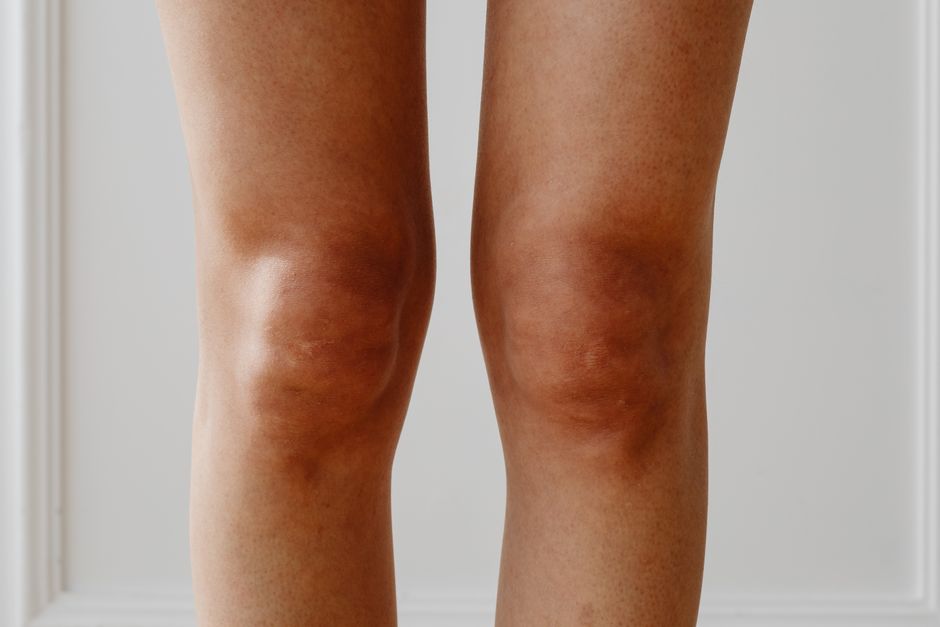
Going down stairs should not hurt. If a sharp, jabbing pain hits the front of your knee with each step down, the most common cause is a problem where your kneecap meets your thigh bone — a joint called the patellofemoral joint. The pain is usually worse going down than up because your thigh muscle is working while lengthening, a motion called eccentric contraction, and that loads the kneecap joint harder than climbing does.
This is a mechanical problem before it is a disease. Something in the way your knee tracks, cushions, or aligns has changed, and the downward step exposes it. Below is what the evidence actually shows about why it happens, what it might be, and what tends to help.
What Causes Sharp Knee Pain When Going Down Stairs?
The kneecap, or patella, sits in a groove at the end of your thigh bone. When you bend and straighten your leg, the kneecap glides up and down that groove. The cartilage on its underside and the bone beneath it absorb load every time you move.
Going downstairs, your quadriceps muscle controls your descent by contracting while it lengthens. This produces higher force through the patellofemoral joint than going up. If the cartilage is worn, the tracking is off, or the joint is inflamed, that force becomes pain.
The sharp quality matters. Dull ache suggests inflammation or overload. A sharp, catching, or giving-way sensation points more toward a structural or tracking problem. That distinction helps narrow down the cause.
Is It Chondromalacia Patellae or Runner’s Knee?
These two terms are often used interchangeably, and that causes confusion. They describe overlapping but not identical things.
Chondromalacia patellae refers to softening and breakdown of the cartilage on the underside of the kneecap. It is a description of tissue change, confirmed on imaging. Patellofemoral pain syndrome, sometimes called runner’s knee, is a clinical diagnosis based on symptoms — pain around or behind the kneecap without other clear cause. Many people with patellofemoral pain have no cartilage damage visible on scans, and some people with cartilage damage have no pain at all.
That mismatch is important. It means imaging findings do not always explain symptoms. A person can have a normal-looking MRI and significant pain, or visible cartilage wear and no pain. Clinicians generally treat the symptoms and function, not the scan alone.
Why Does the Pain Get Worse Going Down Instead of Up?
Stair descent loads the patellofemoral joint more than ascent. During ascent, your quadriceps shortens to push you up. During descent, it lengthens under tension to lower your body weight against gravity. This eccentric loading generates greater force through the joint and the tendon.
The knee also bends more deeply during descent in many people, and deeper bending increases the contact pressure between the kneecap and the groove. Combine higher force with deeper flexion and the joint takes more stress per step. That is why a knee that feels fine walking on flat ground can hurt sharply on the way down.
This is also why stair descent is used in clinics as a provocation test. If it reproduces the pain, the patellofemoral joint is a leading suspect.

What Other Conditions Cause This Specific Pain?
Patellofemoral problems are the most common cause, but not the only one. A few others produce sharp pain on descent and are worth knowing about.
- Patellar tendinopathy. Pain is usually just below the kneecap, at the tendon. It is more common in people who jump or run, and it hurts with loading.
- Osteoarthritis of the knee. Cartilage loss can cause pain with stairs, especially in adults over 50. It often comes with stiffness and reduced range of motion.
- Meniscus tears. A torn meniscus can cause sharp pain, catching, or locking with certain movements, including twisting or deep bending.
- Plica syndrome. A fold of tissue inside the joint can become inflamed and catch during bending.
- Patellar instability. If the kneecap partially slips out of its groove, it can cause sharp pain and a feeling that the knee is giving way.
These are not equally likely, and they often feel different from each other. A clinician can usually separate them with an exam, and sometimes imaging.
What Makes Someone More Likely to Get This Pain?
Several factors show up repeatedly in the research, though none of them guarantees pain on their own.
Weakness in the quadriceps and hip muscles is common in people with patellofemoral pain. The hip muscles control how the thigh rotates, which affects how the kneecap tracks. When they are weak, the kneecap can be pulled slightly off-center.
Sudden increases in activity — a new running program, more stairs at a new job, a long hike — often precede the pain. The joint is being asked to handle more load than it is conditioned for. This is one of the more consistent patterns clinicians see.
Other factors include being overweight, which increases the load through the knee with every step, and having a prior knee injury. Some people have natural variations in leg alignment or kneecap position that make the joint more vulnerable, but these are not destiny. Many people with those variations never develop pain.
When Should You See a Doctor?
Most knee pain from overload improves with rest and gradual reloading. Some signs mean you should get it checked rather than wait.
- The knee locks, catches, or gives way repeatedly.
- You cannot bear weight on the leg.
- The knee is swollen, red, or hot.
- Pain follows a specific injury, like a fall or a twist.
- Pain is getting worse rather than better over weeks.
- You have fever along with knee pain and swelling.
Those last two matter because infection in a joint is uncommon but serious, and it needs prompt treatment. A hot, swollen, painful knee with fever is not something to watch at home.
What Actually Helps Patellofemoral Knee Pain?
Exercise therapy is the best-supported treatment for patellofemoral pain. Research consistently shows that strengthening the quadriceps and hip muscles reduces pain and improves function, though it takes weeks to months, not days.
The evidence for some other common approaches is weaker. Braces, taping, and orthotics are widely used, and some people find them helpful, but the research on whether they change outcomes is mixed. They are often used alongside exercise rather than instead of it.
Surgery is generally reserved for specific structural problems, such as a torn meniscus or significant instability, not for routine patellofemoral pain. For most people with this pain, the evidence does not support going under the knife as a first step.
One useful clarification: rest helps calm an irritated joint, but prolonged rest tends to make knee pain worse over time because the muscles that support the joint get weaker. The general clinical direction is to reduce the aggravating activity, not stop moving entirely, and to rebuild strength gradually. A physical therapist can guide the pace.
Does It Go Away on Its Own?
Many cases improve, but not always quickly and not always without effort. Patellofemoral pain often follows a fluctuating course. Some people get better in a few weeks with activity changes. Others have symptoms that come and go for months or longer.
The honest position is that outcomes vary. There is no single timeline that applies to everyone. What the evidence does support is that people who do structured strengthening tend to do better than those who simply wait. If pain persists beyond a few weeks despite rest and sensible activity changes, seeing a clinician or physical therapist is reasonable.
Frequently Asked Questions
Why does my knee hurt going down stairs but not going up?
Going down loads the kneecap joint more because your thigh muscle works while lengthening, which puts higher force through the joint than climbing does. That is why descent often hurts when ascent does not.
Is sharp knee pain going down stairs a sign of arthritis?
It can be, especially in adults over 50, but it is more often a patellofemoral tracking or overload problem. Only an exam and sometimes imaging can tell the difference.
Should I rest my knee or keep moving?
Reducing the activity that provokes the pain helps in the short term, but prolonged rest tends to weaken the muscles that support the knee. Gradual strengthening is the better-supported approach.
When should sharp knee pain be checked by a doctor?
Get it checked if the knee locks, gives way, swells, or if pain follows an injury or keeps getting worse. A hot, swollen knee with fever needs prompt medical care.
