
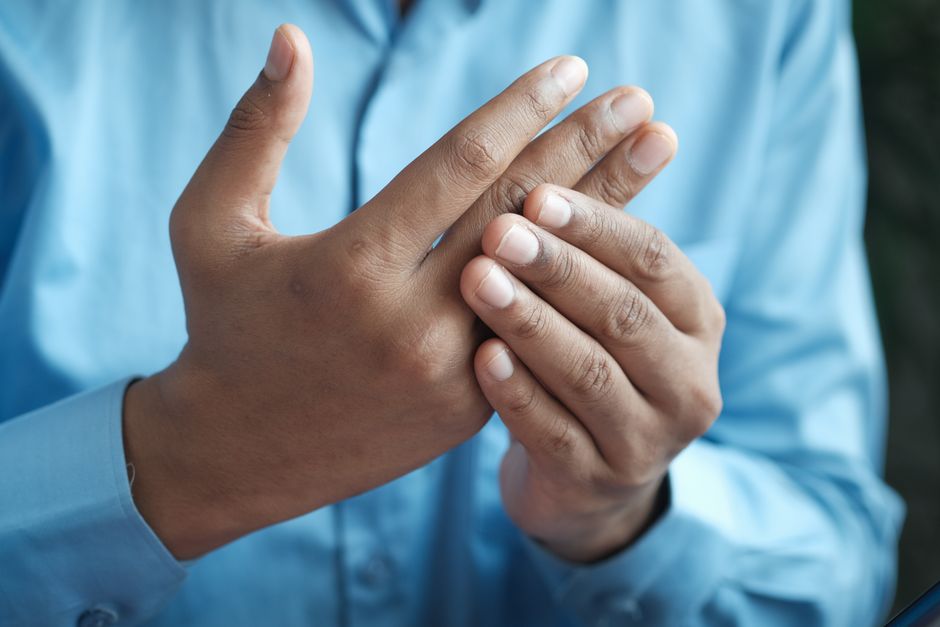
Painful finger joints have many possible causes, and the right explanation depends on which joints hurt, how they look, and how the pain behaves over time. The most common causes fall into three broad groups: osteoarthritis from wear on the joint’s cartilage, inflammatory arthritis where the immune system attacks the joint lining, and injury or overuse of the tendons and ligaments around the joint. Each produces a different pattern of symptoms, and each is managed differently.
What Causes Painful Finger Joints?
Osteoarthritis is the most common cause of finger joint pain in adults over 40. It develops when the cartilage that cushions the ends of bones gradually thins and roughens. Without that smooth surface, bone rubs against bone, and the joint can grow small bony bumps called nodes.
In the fingers, osteoarthritis typically affects three locations: the joint nearest the fingertip (the distal interphalangeal joint), the middle joint (the proximal interphalangeal joint), and the joint at the base of the thumb. Bony nodes at the end joint are called Heberden nodes. Nodes at the middle joint are called Bouchard nodes. These are not just cosmetic — they often mark the point where the joint has already changed shape.
Rheumatoid arthritis is a different process entirely. It is an autoimmune condition in which the immune system attacks the synovium, the thin membrane that lines the joint. The result is inflammation: warmth, swelling, and pain that tends to affect the same joints on both hands. Rheumatoid arthritis often starts in the small joints of the fingers and wrists before moving to larger joints.
Psoriatic arthritis is another inflammatory type, linked to the skin condition psoriasis. It can cause finger swelling severe enough that the whole digit looks like a sausage — a pattern clinicians call dactylitis.
Gout, more familiar as a big-toe problem, can also deposit urate crystals in finger joints, though this is less common. A joint infection, called septic arthritis, is rare in the fingers but is a medical emergency when it happens.
Finally, a large share of finger pain never involves the joint at all. Trigger finger is inflammation of the tendon sheath that makes a finger catch or lock. De Quervain syndrome affects tendons at the thumb side of the wrist. These feel like joint pain but originate in the soft tissue around the joint.
How Do Osteoarthritis and Inflammatory Arthritis Differ?
The two most common causes produce opposite daily patterns, and that difference is one of the most useful clues a doctor uses.
Osteoarthritis pain typically worsens with use and eases with rest. It is often worst at the end of the day. Inflammatory arthritis is the reverse: stiffness and pain are worst in the morning, often lasting more than an hour, and improve as the day goes on and the joints loosen up.
Location matters too. Osteoarthritis favors the joint closest to the fingertip and the base of the thumb. Rheumatoid arthritis favors the knuckles and the middle joints, and tends to be symmetric — both hands affected in the same places.
Swelling looks different as well. Osteoarthritis produces hard, bony enlargement. Inflammatory arthritis produces soft, spongy swelling from fluid and thickened tissue.
| Feature | Osteoarthritis | Inflammatory arthritis |
|---|---|---|
| Typical joints | Fingertip joint, thumb base | Knuckles, middle joints |
| Symmetry | Often uneven | Usually both hands |
| Morning stiffness | Brief, under 30 minutes | Often over an hour |
| Pain with activity | Worse with use | Often better with use |
| Swelling type | Hard and bony | Soft and spongy |
This table is a guide, not a diagnosis. Some people have features of both, and only a clinician can sort out which condition is driving the symptoms.
Why Do Finger Joints Hurt More as We Age?
Cartilage has limited capacity to repair itself. It contains no blood vessels, so it depends on nutrients diffusing through the joint fluid. Over decades of use, that slow supply chain leaves cartilage less able to recover from daily stress.
Hand osteoarthritis becomes more common with each passing decade, and it is more common in women than men, particularly after menopause. The reasons are not fully understood, but hormonal changes are thought to play a role.
Genetics matter as well. Hand osteoarthritis runs in families. If your mother had prominent Heberden nodes, you are more likely to develop them too.
Age-related changes are not the same as inevitable decline. Many people over 70 have joint changes visible on X-rays and no pain at all. Imaging findings and symptoms do not always match, which is why treatment focuses on function and comfort rather than on what a scan shows.





When Is Finger Joint Pain a Sign of Something Serious?
Most finger joint pain is not dangerous. A few patterns warrant prompt medical attention.
See a doctor quickly if a single joint becomes hot, red, and swollen within hours, especially with fever. That combination can signal infection and needs urgent evaluation.
Also seek care if you have morning stiffness lasting more than an hour for several weeks, swelling in the same joints on both hands, or joint pain accompanied by fatigue and low-grade fever. These point toward inflammatory arthritis, and early treatment can limit joint damage.
Rapid onset of pain and swelling after a fall or injury may mean a fracture or ligament tear. Deformity, inability to move the finger, or numbness should be checked.
For most other cases — gradual aching, stiffness after activity, or a finger that clicks — a routine appointment is reasonable rather than an urgent one.
What Actually Helps Finger Joint Pain?
Treatment depends on the cause, and the evidence is stronger for some approaches than others.
For osteoarthritis, the best-supported measures are exercise, activity pacing, and pain relief. Hand exercises that maintain grip strength and range of motion help preserve function. Research consistently shows that staying active is more helpful than resting the hands, even when activity causes some discomfort.
Topical NSAIDs — anti-inflammatory gels applied to the skin — are widely recommended for hand osteoarthritis. Oral NSAIDs can help but carry gastrointestinal and cardiovascular risks with long-term use, so they are usually used at the lowest effective dose for the shortest time. Acetaminophen is often recommended for pain, though its effect on osteoarthritis pain is modest.
Heat helps stiffness. Cold helps acute swelling. Many people find paraffin wax baths soothing for stiff hands, though the evidence for lasting benefit is limited.
For inflammatory arthritis, the picture is different. Disease-modifying drugs, including methotrexate and biologic agents, can slow joint damage and are the cornerstone of treatment. These require a doctor’s supervision. Early diagnosis and treatment make a real difference in long-term outcomes.
Steroid injections into a finger joint can relieve pain for weeks to months. They are used sparingly because repeated injections carry risks, including tendon damage and infection.
Surgery is reserved for severe cases — joint fusion or replacement for a badly damaged joint, or release of a tendon sheath for trigger finger. These are not first-line options.
Do Supplements and Home Remedies Work?
The honest answer is that most supplements marketed for joint pain have weak or absent evidence.
Glucosamine and chondroitin are the most studied. Large trials have produced mixed results. Some people report benefit; overall, the evidence does not consistently show that these supplements reduce pain or slow joint damage in hand osteoarthritis. If you want to try them, discuss it with your doctor, particularly if you take blood thinners.
Turmeric and its active compound curcumin have shown anti-inflammatory effects in some small studies. The evidence is not strong enough to recommend it as a treatment, and curcumin is poorly absorbed without special formulations.
Omega-3 fatty acids from fish oil have been studied for inflammatory arthritis with modest and inconsistent results. They are not a substitute for disease-modifying drugs.
What does help, based on consistent evidence:
- Regular hand exercises to maintain strength and motion
- Joint protection techniques, like using larger joints and tools with wider grips
- Topical NSAIDs for osteoarthritis pain
- Weight management, which reduces load on joints throughout the body
- Avoiding repetitive gripping and forceful pinching when possible
None of these is a cure. For most people with osteoarthritis, the realistic goal is managing symptoms and preserving function, not reversing the joint changes.
When Should You See a Doctor?
See a doctor if finger pain lasts more than a few weeks, interferes with daily tasks, or comes with swelling, redness, or warmth. Morning stiffness lasting over an hour, joint pain on both sides of the body, or symptoms that wake you at night all point toward an inflammatory cause that deserves evaluation.
A primary care doctor can order blood tests and X-rays and refer you to a rheumatologist if needed. Rheumatologists specialize in inflammatory joint diseases and can start treatment that may prevent lasting damage.
Do not wait for pain to become severe. In inflammatory arthritis, damage can begin early, and treatment works best when started sooner.
Frequently Asked Questions
What is the most common cause of painful finger joints?
Osteoarthritis is the most common cause in adults over 40, caused by gradual cartilage wear. It typically affects the joint nearest the fingertip and the base of the thumb.
Can finger joint pain be arthritis?
Yes, arthritis is a common cause, but not all finger pain is arthritis. Tendon problems like trigger finger can cause similar pain without joint involvement.
How do I know if my finger pain is osteoarthritis or rheumatoid arthritis?
Osteoarthritis pain worsens with use and causes brief morning stiffness, while rheumatoid arthritis causes prolonged morning stiffness and symmetric swelling. A doctor can confirm with exams and tests.
Do glucosamine supplements help finger joint pain?
The evidence is mixed, and large trials have not consistently shown benefit for hand osteoarthritis. Talk to your doctor before starting any supplement.
