
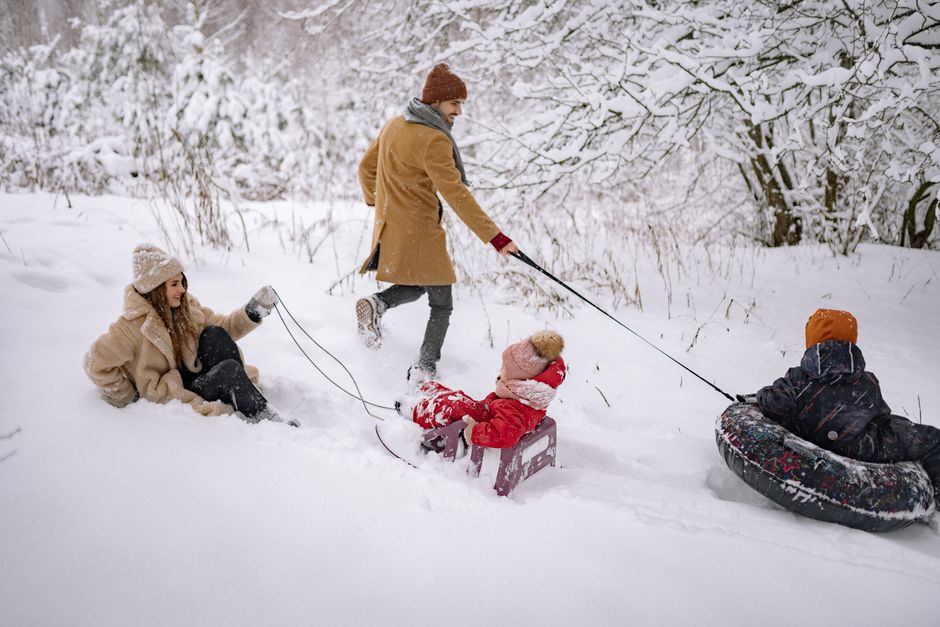
If you want to slide down a snowy hill without buying a sled, the safest household option is a large, heavy-duty plastic storage bin lid turned smooth side down. A heavy-gauge plastic garbage bag works for a gentle slope. A flattened cardboard box works for one or two runs before it gets wet and falls apart.
Those three items come up again and again because they share the same basic requirements: a smooth bottom, enough rigidity to hold your weight, and a surface that will not dig into the snow. Most other household objects fail at least one of those tests.
What follows is an honest look at which household items can work, which ones are genuinely dangerous, and why the difference matters more than most people realize.
What Can I Use As A Sled Best Household Options?
The short list of items that actually function as a sled is smaller than most people assume. Here is how the realistic options compare.
| Item | Works on | Main limitation |
|---|---|---|
| Large plastic bin lid | Packed snow, gentle to moderate slope | No steering, can crack in extreme cold |
| Heavy plastic garbage bag | Packed snow, gentle slope only | Tears easily, no structure, no control |
| Flattened cardboard box | Packed snow, gentle slope | Soaks through fast, usually one or two runs |
| Plastic kiddie pool | Fresh powder, very gentle slope | Cracks in cold, hard to grip, awkward shape |
| Air mattress | Not recommended | Poor control, can deflate mid-run |
A large plastic storage bin lid is the closest thing to a real sled on this list. The smooth underside slides reasonably well on packed snow, and the raised rim gives you something to hold. It has no steering, so it belongs on a short, gentle hill with a clear, obstacle-free runout.
Heavy plastic bags and flattened cardboard both work because they create a low-friction layer between you and the snow. Neither offers any structure or control. Both are best treated as gentle-slope options for kids, on hills where a slow slide is the whole point.
Why Do Some Household Items Slide and Others Don’t?
Sliding comes down to friction and pressure. Snow is not a solid surface — it is a mix of ice crystals, air, and a thin layer of water that forms under pressure and friction. A sled works when its underside can glide across that layer without digging in.
Two things determine whether a household item will slide:
- Surface smoothness. A smooth, non-porous bottom glides. A rough or textured bottom catches and digs in.
- Weight distribution. A rigid surface spreads your weight across a wider area, which keeps you on top of the snow instead of sinking into it.
This is why a stiff plastic lid outperforms a soft garbage bag. The bag conforms to the snow and creates drag. The lid stays flat and keeps its shape.
Temperature matters too. Snow gets faster and slicker as it gets colder and more packed. On a warm day with wet, heavy snow, almost nothing household-grade will slide well, because the surface grabs instead of glides.
Which Household Items Are Actually Dangerous to Use as a Sled?
Some household items look like they would work and are genuinely unsafe. The problem is usually control, not sliding.
Air mattresses and inflatable pool floats are the most common mistake. They are large, they look fun, and they offer almost no way to steer or stop. An inflatable can also lose air or flip, which turns a controlled slide into a tumble. The same problem applies to anything soft and round that rolls or spins.
Laundry baskets are another frequent suggestion. A round plastic basket has no flat bottom, so it tends to spin and tip. A rectangular one can work on a very gentle slope, but the edges catch and the plastic can crack in cold weather.
Anything with sharp edges, exposed metal, or protruding parts should be ruled out. So should anything you cannot grip with both hands.
The core issue is that real sleds are designed with a low center of gravity, a smooth bottom, and some way to hold on. Most household substitutes have at most one of those three.




What Makes a Slope Safe Enough for Improvised Sledding?
With a proper sled, a steep hill can still be risky. With a household substitute that has no steering, the margin for error shrinks fast. That changes what counts as a safe slope.
A slope that works for an improvised sled usually has these features:
- A gentle grade with a long, flat runout at the bottom
- No trees, fences, poles, rocks, or parked cars anywhere in the path
- Packed snow rather than icy, hard-packed crust
- No road, driveway, or water at the bottom
- Clear visibility from top to bottom
Ice is the single biggest hazard. Hard, icy snow turns a gentle slide into a fast, uncontrollable one, and a plastic lid or cardboard box offers no braking. If the surface is icy, the honest answer is that no household substitute is a good idea.
Sledding injuries are a real concern, not a theoretical one. Head injuries are among the most serious, which is why helmets are recommended for sledding the same way they are for biking or skiing. That advice applies even more when the sled has no steering.
Can You Make a Household Sled Slide Better?
A few adjustments can improve how well a household item slides, though none of them add steering or braking.
Waxing the bottom of a plastic lid or cardboard box with a plain candle or a bar of paraffin can reduce friction on packed snow. This is the same principle behind ski wax. The effect is real but modest, and it does not last long.
Keeping the sliding surface dry matters more than most people expect. Wet cardboard loses its stiffness and stops sliding almost immediately. A plastic bag or lid stays slicker because it does not absorb water.
Choosing the right snow conditions helps as much as any modification. Cold, packed snow slides best. Wet, heavy snow is slow no matter what you are riding on.
What you cannot fix with wax or technique is the lack of control. A waxed garbage bag still cannot be steered. That limitation does not go away.
When Should You Just Buy a Real Sled?
If you are sledding more than once or twice, a real sled is worth the money. Inexpensive plastic sleds are widely available, and they are designed with the features household items lack: a smooth bottom, a low center of gravity, and something to hold onto.
The gap between a real sled and a household substitute is not about speed. It is about control. A sled you can steer and stop is fundamentally safer than a lid or a bag you cannot.
Household options make sense for a one-time, gentle, supervised slide on a small hill with a soft landing. Beyond that, the risk-to-fun ratio stops making sense.
Frequently Asked Questions
What is the best household item to use as a sled?
A large, heavy-duty plastic storage bin lid is the best household option because it has a smooth bottom and a rim to hold. It still has no steering, so it belongs on a short, gentle hill.
Can you use a garbage bag as a sled?
A heavy plastic garbage bag can work on a gentle, packed-snow slope for a slow slide. It tears easily and offers no control, so it is not suitable for steeper or icier hills.
Is it safe to sled on an air mattress?
No, an air mattress is not a safe sled substitute because it cannot be steered or stopped and can deflate or flip mid-run. The lack of control is the main danger, not the sliding itself.
Do you need a helmet for sledding?
Yes, a helmet is recommended for sledding, especially with improvised sleds that cannot be steered. Head injuries are among the most serious sledding injuries, and a helmet reduces that risk.
