
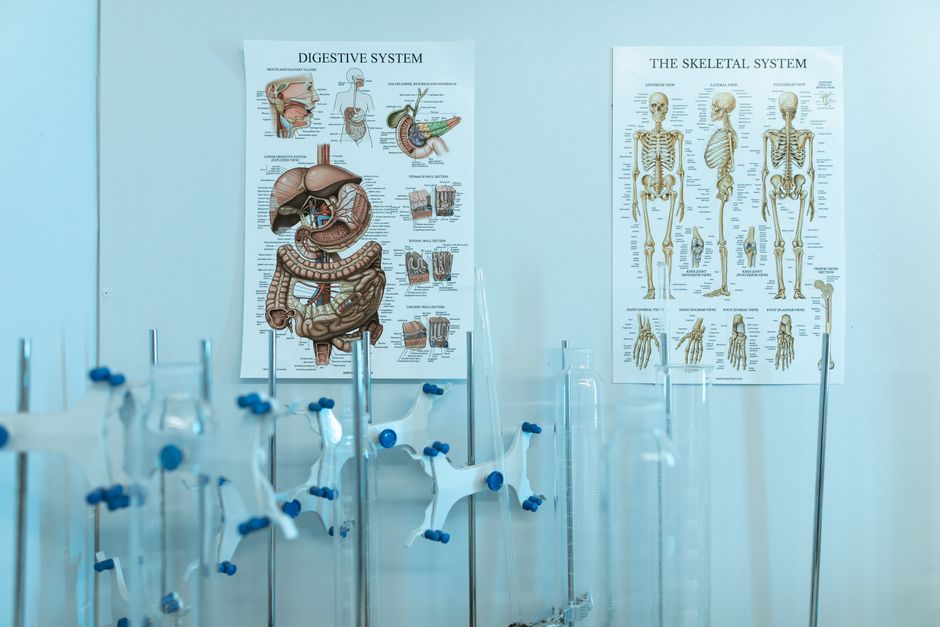
Your skeleton is not just a rack of bones holding you up. It is a working organ system that supports your body, lets you move, shields vital organs, stores minerals, and manufactures blood cells every single day. The main functions of the skeletal system are support, movement, protection, mineral storage, and blood cell production. It also serves as a reserve of energy stored in fat within bone marrow.
Most people picture bones as dry, dead scaffolding. In reality, bone is living tissue with its own blood supply, nerves, and constant turnover. Your body breaks down old bone and builds new bone throughout your life. That process is how your skeleton stays strong and how it responds to the demands you place on it.
What Are The Functions Of A Skeletal System?
The skeletal system performs five core jobs that keep you alive and functional. Each one depends on the structure and chemistry of bone itself.
- Support. Bones form the framework that holds your body upright and gives it shape. Without this framework, your muscles and organs would have nothing to anchor to.
- Movement. Muscles pull on bones to create motion. Bones act as levers, and joints act as the pivots where that motion happens.
- Protection. The skull surrounds the brain, the rib cage guards the heart and lungs, and the spine shields the spinal cord.
- Mineral storage. Bone stores calcium and phosphorus and releases them into the blood when levels drop.
- Blood cell production. Bone marrow makes red blood cells, white blood cells, and platelets.
There is a sixth function worth naming. Bone marrow fat serves as an energy reserve. This is a real storage role, though it gets far less attention than the other five.
How Does The Skeletal System Support The Body?
Support starts with the structure of bone tissue. Bone gets its strength from a mineral framework, mostly calcium phosphate, laid down along protein fibers called collagen. That combination works the way reinforced concrete does. The mineral gives hardness. The protein gives flexibility. Together they make bone strong without making it brittle.
The spine is a good example of how support works in practice. It is a stack of bones called vertebrae, separated by discs that act as cushions. The spine holds your head up and carries the weight of your upper body down to your hips. Its natural curves help distribute that load rather than concentrating it in one spot.
Bone is not static. It remodels constantly in response to the forces placed on it. This is why weight-bearing activity tends to be associated with higher bone density, and why prolonged immobility is associated with bone loss. The skeleton adapts to what you ask of it.
How Do Bones And Muscles Work Together For Movement?
Movement happens when muscles contract and pull on bones across a joint. Bones themselves do not move on their own. They are the levers, and muscles are the engines.
Picture your elbow. The biceps muscle attaches to a bone near the shoulder and to a bone in the forearm. When the biceps contracts, it shortens and pulls the forearm upward, and the elbow bends. To straighten the arm, the triceps on the other side contracts. Muscles generally work in opposing pairs like this.
Joints determine what kind of movement is possible. A hinge joint like the elbow allows bending and straightening. A ball-and-socket joint like the shoulder allows a wide range of motion in multiple directions. The shape of the joint sets the limits.
Ligaments connect bone to bone and stabilize joints. Tendons connect muscle to bone and transmit the pulling force. Cartilage covers the ends of bones where they meet, reducing friction during movement.





What Organs Does The Skeletal System Protect?
Protection is one of the most intuitive functions of the skeleton, and it is also one of the most important.
- The skull forms a bony case around the brain.
- The rib cage surrounds the heart and lungs.
- The vertebrae enclose the spinal cord, the main pathway between brain and body.
- The pelvis shields parts of the digestive and reproductive organs.
The ribs illustrate the trade-off built into this design. A rigid cage would protect the heart and lungs well, but those organs need to expand and contract with every breath. The ribs solve this by forming a semi-flexible cage that moves with breathing while still absorbing impact.
Protection is never absolute. Bones reduce the force that reaches delicate organs, but they cannot eliminate injury. That is why the skeleton is best understood as a strong first line of defense rather than an unbreakable shield.
How Does Bone Store Minerals And Release Them?
Bone is the body’s main reservoir of calcium. Roughly 99 percent of the calcium in your body is stored in bone and teeth. The remaining small fraction circulates in blood and fluids, where it carries out jobs that cannot wait.
Calcium in the bloodstream is involved in muscle contraction, nerve signaling, and blood clotting. These functions are so important that the body tightly controls blood calcium levels. When they drop, hormones signal bone to release calcium. When levels are adequate, the body can deposit calcium back into bone.
This is a key point. Your skeleton is not just a vault that locks calcium away. It is an active bank that makes deposits and withdrawals to keep blood levels stable. Bone also stores phosphorus, which plays a role in energy metabolism and in building the mineral structure of bone itself.
Because bone is constantly remodeling, the balance between building and breaking down shifts over a lifetime. Bone mass tends to build during youth and early adulthood, holds fairly steady for a period, and then gradually declines with age. That is why nutrition and physical activity across the lifespan matter for bone health.
How Does Bone Marrow Make Blood Cells?
Inside many bones is marrow, a soft tissue with two main types. Red marrow produces blood cells. Yellow marrow stores fat.
Red marrow is where hematopoiesis happens. That is the process of forming new blood cells. Red marrow produces three major cell types:
- Red blood cells, which carry oxygen from the lungs to the rest of the body.
- White blood cells, which defend against infection.
- Platelets, which help blood clot when you are injured.
In adults, red marrow is concentrated in certain areas, including the pelvis, spine, ribs, skull, and the ends of long bones. In infants and young children, red marrow is found in more places, and much of it converts to yellow marrow over time.
This function is a striking reminder that bones are not inert. They are factories that produce billions of blood cells on an ongoing basis.
What Else Does The Skeletal System Do?
Two additional roles deserve mention because they affect health in ways people rarely connect to bone.
Bone tissue acts as an endocrine organ. It releases signaling molecules that influence other parts of the body, including how the body handles energy and how it uses glucose. Research in this area has grown over the past two decades, and while the details are still being worked out, the general finding that bone communicates with other organs is now well accepted.
Bone marrow fat serves as an energy reserve. This stored fat can be drawn on when the body needs energy, similar to fat stored elsewhere. It is a genuine function, though it is often overlooked because the other roles of the skeleton are more visible.
How Many Bones Does An Adult Have?
An adult human skeleton has 206 bones. A newborn has far more, around 270. The difference comes from fusion.
Many bones in a baby are separate pieces that join together as the child grows. The skull is a clear example. It starts as separate plates with soft gaps between them, which allows the head to pass through the birth canal and gives the brain room to grow. Over time those plates fuse into the solid structure of an adult skull.
Bones are also living tissue that rebuilds itself. A broken bone heals by forming new bone at the fracture site, which is why a fracture can knit back together given time and proper alignment. This healing capacity is one more sign that bone is active tissue rather than dead material.
Why Does The Skeletal System Matter For Overall Health?
The skeleton touches nearly every system in the body. It supports you, moves you, guards your organs, manages your calcium, and makes your blood. When something goes wrong with bone, the effects reach well beyond the skeleton itself.
Bone health is influenced by several factors that are largely within reach. Adequate calcium and vitamin D intake supports the raw materials of bone. Weight-bearing and resistance activity signals bone to stay strong. Avoiding smoking and limiting excess alcohol are associated with better bone outcomes. These are general associations supported by a broad body of research, not guarantees for any one person.
It is also worth being honest about what is not fully settled. The exact balance of nutrients, the ideal amount of exercise, and the role of bone-derived hormones in overall health are areas of ongoing study. What is clear is the basic architecture. Your skeleton is a living, working system that does far more than hold you up.
Frequently Asked Questions
What are the five main functions of the skeletal system?
The five main functions are support, movement, protection, mineral storage, and blood cell production. Some descriptions also include energy storage in bone marrow fat as a sixth function.
How many bones are in the adult human body?
An adult human skeleton has 206 bones, while a newborn has around 270. The number drops because many separate bones fuse together during growth.
Does bone marrow make blood cells?
Yes, red bone marrow produces red blood cells, white blood cells, and platelets through a process called hematopoiesis. In adults, red marrow is concentrated in the pelvis, spine, ribs, skull, and the ends of long bones.
Is bone a living tissue?
Yes, bone is living tissue with its own blood supply and nerves, and it constantly breaks down and rebuilds itself. This is why broken bones can heal and why bone responds to physical activity.
