
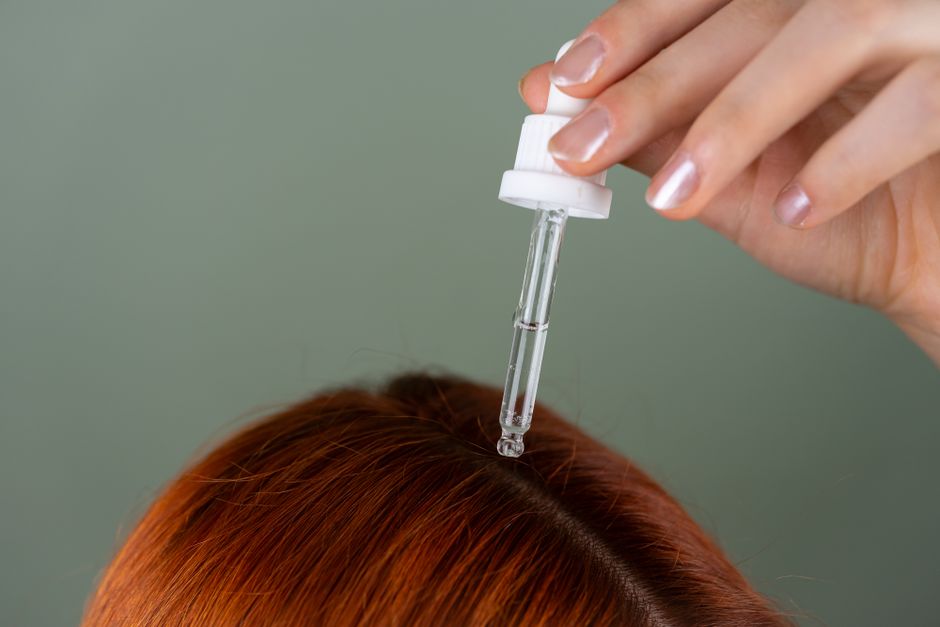
There is no ingredient that grows hair on a scalp where follicles have permanently stopped producing hair. That is the first honest thing to say. For hair that is thinning but still growing, a small number of ingredients have real human trial data behind them. Most of what fills store shelves does not.
The ingredients with the strongest evidence are topical minoxidil, oral finasteride (for men), and a handful of others with smaller but real studies. Nutrition matters mainly when a deficiency exists. Biotin, collagen, and most “hair growth” supplements have little or no evidence in people who are not deficient.
What Are The Best Ingredients For Hair Growth?
The best-evidenced ingredients for hair growth are minoxidil applied to the scalp and finasteride taken by mouth in men. Both have been tested in large human trials and are approved by the FDA for treating pattern hair loss.
Minoxidil works on both men and women. It is available over the counter as a topical liquid or foam. Finasteride is prescription-only and is not approved for women of childbearing age because of serious risks in pregnancy.
Beyond these two, the evidence drops sharply. Some ingredients show promise in smaller studies. Many popular ones have no human trial data at all. Knowing which category an ingredient falls into is the difference between spending money on something that might work and spending it on something that almost certainly will not.
How Do Minoxidil and Finasteride Actually Work?
These two drugs work through completely different mechanisms. Understanding that helps explain why they are sometimes used together.
Minoxidil is a vasodilator. It was originally a blood pressure medication, and hair growth was noticed as a side effect. How it grows hair is still not fully understood. The leading explanation involves prolonging the growth phase of the hair cycle and widening blood vessels near the follicle. It does not stop the underlying hormonal process that causes pattern baldness. It buys time.
Finasteride blocks the enzyme that converts testosterone into dihydrotestosterone, or DHT. DHT is the hormone that shrinks hair follicles in genetically prone men. By lowering DHT, finasteride slows or partially reverses that shrinking. It targets the cause rather than the symptom.
This is why finasteride generally produces better long-term results in men than minoxidil alone. It is also why both drugs only work while you keep using them. Stop either one and the benefit reverses over months.
What Does the Evidence Actually Show for Each Ingredient?
Human trial evidence varies enormously across the ingredients people ask about. Here is where the main ones stand.
| Ingredient | Evidence Level | Notes |
|---|---|---|
| Topical minoxidil | Strong | FDA-approved, large trials, works in men and women |
| Oral finasteride | Strong | FDA-approved for men, prescription only |
| Ketoconazole shampoo | Moderate | Some trials show benefit in androgenetic alopecia |
| Topical caffeine | Limited | Small studies, often compared to minoxidil |
| Rosemary oil | Limited | One small trial compared it to minoxidil |
| Biotin | None unless deficient | No benefit in people with normal levels |
| Collagen | None for hair | Broken down into amino acids when eaten |
| Multivitamins | None unless deficient | Corrects deficiency, does not add growth |
Ketoconazole shampoo is worth a mention because it is often overlooked. It is an antifungal shampoo used for dandruff. Some studies suggest it may have a mild effect on androgenetic alopecia, possibly through an anti-androgenic action on the scalp. The evidence is not strong enough to call it a primary treatment, but some dermatologists recommend it as an add-on.
Rosemary oil gets a lot of attention online. One small trial compared it to minoxidil in people with androgenetic alopecia and found similar hair counts after six months. That sounds impressive until you consider the trial was small and has not been widely replicated. It is reasonable to say the evidence is limited.





Does Biotin or Collagen Help Hair Growth?
No, not in people who are not deficient. This is one of the most persistent myths in the hair supplement aisle.
Biotin is a B vitamin. True biotin deficiency causes hair loss, and it is rare. It occurs mainly in people with certain genetic conditions, long-term parenteral nutrition, or heavy raw egg white consumption. If you are not deficient, taking biotin does not increase hair growth. It just comes out in your urine.
There is a second problem with biotin worth knowing. High doses can interfere with certain lab tests, including thyroid and cardiac tests. The FDA has issued a safety communication about this. It is a real risk, not a theoretical one.
Collagen is a protein. When you eat it, your digestive system breaks it into amino acids. Those amino acids go into a general pool your body draws from. There is no mechanism by which eating collagen sends it specifically to your hair follicles. Any protein you eat does the same job.
This does not mean nutrition is irrelevant. It means the relevant issue is deficiency, not supplementation. Correcting a real deficiency helps. Adding nutrients you already have enough of does not.
Which Nutrient Deficiencies Actually Cause Hair Loss?
A few deficiencies are well documented as causes of hair loss. The key word is deficiency.
- Iron — low ferritin is linked to telogen effluvium and may worsen pattern hair loss, especially in women
- Zinc — deficiency causes hair loss and poor wound healing
- Vitamin D — low levels are associated with several forms of hair loss, though cause and effect are debated
- Protein — severe protein malnutrition causes hair shedding
- Vitamin B12 — deficiency is linked to hair loss, most often alongside other symptoms
The right move if you suspect a deficiency is a blood test, not a supplement. A doctor can check ferritin, zinc, vitamin D, and B12. Taking iron when you do not need it is not harmless. Iron overload is a real medical condition.
One clarification that surprises people: hair loss from a deficiency usually shows up as diffuse shedding across the whole scalp, not a receding hairline or a bald patch. Patterned loss points to genetics and hormones, not nutrition.
What About Supplements Marketed for Hair Growth?
Most hair growth supplements have not been tested in rigorous human trials. That is the plain truth.
Some contain ingredients with limited evidence, like saw palmetto or certain vitamins. A few small studies on saw palmetto in men with androgenetic alopecia have shown modest results. The studies are generally small and short. That is not the same as proven.
Others contain ingredients with no hair-specific evidence at all, packaged with marketing language about “nourishing follicles.” There is no standard for what that means.
Supplements are also loosely regulated in the US. They do not need FDA approval before sale. What is on the label is not always what is in the bottle.
None of this means every supplement is useless. It means the burden of proof has not been met for most of them, and the price you pay is often for hope rather than evidence.
When Should You See a Doctor About Hair Loss?
See a doctor if your hair loss is sudden, patchy, or accompanied by scalp pain, redness, or scaling. These patterns suggest conditions other than pattern baldness and need a proper diagnosis.
Sudden diffuse shedding is often telogen effluvium. It typically follows a trigger like illness, surgery, severe stress, or childbirth, and it usually resolves on its own over months. A doctor can confirm this and rule out other causes.
Patchy, smooth bald spots can indicate alopecia areata, an autoimmune condition. This is a different disease with different treatments. It does not respond to minoxidil or finasteride in the same way.
If you are a woman with thinning hair, get evaluated before assuming it is pattern loss. Causes in women include thyroid disorders, polycystic ovary syndrome, and iron deficiency. Each has its own treatment.
The most useful thing you can do is get an accurate diagnosis. The best ingredient for your hair depends entirely on what is causing the loss.
Frequently Asked Questions
What is the most effective ingredient for hair growth?
Topical minoxidil has the strongest evidence and is approved for both men and women. Oral finasteride is more effective for men but requires a prescription and is not approved for women of childbearing age.
Does biotin actually help hair grow?
No, not unless you have a true biotin deficiency, which is rare. High-dose biotin can also interfere with certain lab tests, so it is not a harmless add-on.
Can rosemary oil regrow hair?
One small trial found results similar to minoxidil after six months, but the evidence is limited and has not been widely replicated. It is not a substitute for proven treatments.
How long before a hair growth ingredient shows results?
Most proven treatments take several months before visible change, and hair loss often continues for a period before improvement starts. Any product promising fast results is not being honest about how hair cycles work.
