
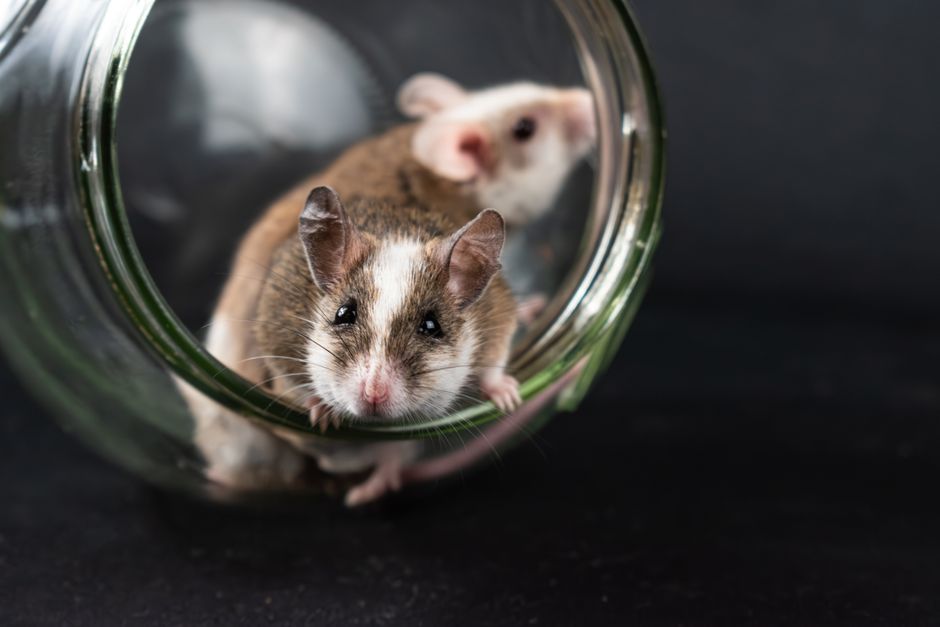
Knockout mice are laboratory mice that have had a specific gene intentionally inactivated, or “knocked out,” to study that gene’s function. Gene silencing is the broader process of reducing or eliminating gene activity, and creating a knockout mouse is one of the most powerful ways to achieve this permanently. By disabling a single gene, researchers can observe what goes wrong in the animal, which reveals what that gene normally does in a living organism.
How Are Knockout Mice Created?
Scientists create knockout mice using a technique called gene targeting. The process begins with mouse embryonic stem cells. These are early-stage cells that can develop into any type of tissue.
Researchers introduce a modified version of the target gene into these stem cells. This modified gene is designed to be non-functional. Through a natural process called homologous recombination, the modified gene replaces the normal gene in the cell’s DNA.
The altered stem cells are then injected into early mouse embryos. These embryos are implanted into a surrogate mother. The resulting offspring are chimeras, meaning some of their cells contain the modified gene and some do not.
Breeding these chimeras ultimately produces mice where every cell in the body carries the disabled gene. These are the true knockout mice used in research.
What Is the Difference Between Gene Silencing and Knockout?
Gene silencing is an umbrella term. It covers any method that reduces gene expression. This includes temporary methods like RNA interference, which uses short RNA molecules to degrade messenger RNA and prevent protein production.
A knockout is permanent. The gene itself is destroyed or altered in the DNA. This is a fundamental difference.
Temporary silencing allows researchers to study a gene’s effect over a short period. Knockouts show the lifelong consequences of having no gene at all. Both are valuable, but they answer different research questions.
Conditional knockouts add another layer of precision. These allow scientists to disable a gene in a specific tissue or at a specific time. This is useful when a complete knockout is lethal or when researchers want to study a gene’s role in one organ without affecting the whole body.
What Can Knockout Mice Tell Us About Human Disease?
Many human diseases have a genetic component. If a gene is linked to a condition, disabling that gene in a mouse can recreate aspects of the disease. This gives researchers a living model to study.
For example, knockout mice have been created for genes involved in cancer, diabetes, obesity, and neurological disorders. These models help researchers understand how diseases develop and progress at the molecular level.
Knockout mice are also essential for drug development. A new drug can be tested on knockout mice to see if it reverses or improves the symptoms caused by the missing gene. This provides early evidence about whether a treatment might work in humans.
Research using knockout mice has already contributed to major medical advances. The technology has helped clarify the roles of genes in immune function, metabolism, and brain development.





How Does Gene Silencing Work at the Molecular Level?
To understand knockout mice, it helps to understand how genes normally produce proteins. A gene is a segment of DNA that contains instructions. These instructions are copied into messenger RNA, which is then used as a template to build a protein.
Gene silencing interrupts this process. In a knockout mouse, the interruption happens at the DNA level. The gene is non-functional, so no messenger RNA is produced from it. No messenger RNA means no protein.
Other silencing methods work at different stages. RNA interference, for instance, targets the messenger RNA after it is produced. The RNA molecules bind to the messenger RNA and mark it for destruction, preventing protein synthesis.
Epigenetic silencing is another mechanism. This involves chemical modifications to DNA that turn genes off without changing the underlying sequence. These modifications can be inherited and can be influenced by environmental factors.
What Are the Limitations of Knockout Mouse Research?
Knockout mice are powerful tools, but they have clear limitations. A mouse is not a human. Genes can have different functions in different species.
Some knockouts are lethal. If a gene is essential for development, the embryo will not survive. This makes it impossible to study the gene’s role in adult life. Conditional knockouts help address this, but they are more complex to create.
Compensation is another issue. When one gene is disabled, other genes may increase their activity to compensate for the loss. This can mask the true effect of the knockout and make results difficult to interpret.
The genetic background of the mouse strain also matters. Different strains can respond differently to the same knockout. This can lead to inconsistent results between laboratories.
What Are the Ethical Considerations?
Creating knockout mice involves genetic modification of animals. This raises ethical questions that researchers must address.
Most knockout mouse research is governed by strict animal welfare regulations. Studies must be reviewed by institutional animal care committees. Researchers must justify the scientific value of the work and minimize animal suffering.
The number of animals used is also a concern. Creating and breeding knockout lines requires many mice. Researchers are encouraged to use the minimum number needed to obtain statistically valid results.
There is also a broader concern about the implications of genetic modification. Public opinion on genetic engineering varies. Transparent communication about the purpose and benefits of this research is important.
What Is the Future of Gene Silencing Research?
Newer technologies are expanding what is possible in gene research. CRISPR is a gene editing tool that allows scientists to make precise changes to DNA more quickly and efficiently than older methods.
CRISPR can be used to create knockout mice faster than traditional gene targeting. It also allows for more complex modifications, such as introducing specific disease-causing mutations.
Another emerging approach is base editing. This technique changes a single DNA letter without cutting the DNA strand. It offers even greater precision and may reduce unintended effects.
These tools are not replacements for knockout mice. They are complementary. They allow researchers to ask more detailed questions about gene function and disease.
Frequently Asked Questions
What is a knockout mouse used for?
A knockout mouse is used to study the function of a specific gene by observing the effects of its absence. This helps researchers understand disease mechanisms and test potential treatments.
How long does it take to create a knockout mouse?
Creating a knockout mouse typically takes several months to over a year. The timeline depends on the gene, the method used, and how many generations of breeding are needed.
Is a knockout mouse the same as a genetically modified mouse?
Yes, a knockout mouse is a type of genetically modified mouse. The modification specifically inactivates a targeted gene.
Can knockout mice be used to study human diseases?
Yes, knockout mice can model human diseases that have a genetic basis. They are widely used to study cancer, diabetes, and neurological conditions, but results must be interpreted with caution since mice are not humans.
