
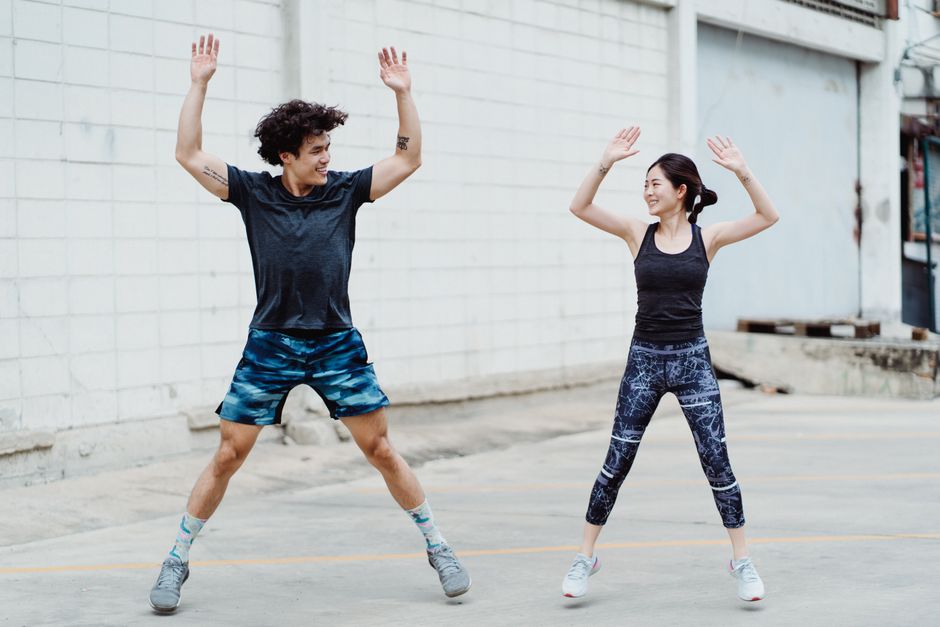
Jumping jacks are a full-body calisthenics exercise where you jump your feet out to the sides while raising your arms overhead, then jump back to the starting position. They are a form of plyometric and cardiovascular training that raises your heart rate quickly. This simple movement builds stamina, improves coordination, and strengthens the muscles in your legs, shoulders, and core.
What Are Jumping Jacks Good For?
Jumping jacks are primarily a cardiovascular exercise. They get your heart pumping and your lungs working harder, which improves your aerobic fitness over time. They also count as a weight-bearing exercise, which means they stress your bones enough to help maintain bone density, similar to jogging or brisk walking.
Beyond the heart and lungs, jumping jacks engage several muscle groups at once. Your calf muscles, quadriceps, and glutes power the jumping motion. Your shoulder muscles and upper back activate as you raise your arms overhead. Your core muscles work continuously to keep your torso stable as you land and jump again.
Because they use your own body weight for resistance, jumping jacks are considered a beginner-friendly exercise. You do not need equipment, a gym membership, or much space. This makes them a practical option for home workouts, travel, or quick breaks during a sedentary workday.
How Many Calories Do Jumping Jacks Burn?
Calorie burn depends heavily on your body weight and intensity. A person weighing around 150 pounds can expect to burn roughly 100 calories in 10 minutes of moderate jumping jacks. A heavier person burns more; a lighter person burns less.
The exact number varies based on how high you jump, how fast you move, and how consistently you maintain the pace. If you add them into a circuit with other exercises and take minimal rest, the total calorie burn increases because your heart rate stays elevated for longer.
For weight loss, jumping jacks alone are rarely enough. They work best as part of a broader routine that includes strength training and a balanced diet. The exercise is a useful tool, not a standalone solution.
What Muscles Do Jumping Jacks Work?
Jumping jacks are a compound exercise, meaning they involve multiple joints and muscle groups simultaneously. The primary movers are in your lower body.
- Calves — These power the push-off and absorb the landing.
- Quadriceps — These extend your knees as you jump.
- Glutes — These drive hip extension and stabilize your pelvis.
- Hip abductors — These move your legs outward and control the return.
- Shoulders (deltoids) — These lift your arms overhead.
- Core — These stabilize your spine during the jump and landing.
This muscle engagement is why jumping jacks are considered an efficient warm-up. They activate multiple major muscle groups in under a minute, preparing your body for more demanding exercise.





Are Jumping Jacks Good for Your Heart?
Yes. Jumping jacks are a form of aerobic exercise, and aerobic exercise is well established as beneficial for cardiovascular health. Regular aerobic activity strengthens the heart muscle, improves blood circulation, and can help lower resting blood pressure over time.
The American Heart Association recommends at least 150 minutes of moderate-intensity aerobic activity per week. Jumping jacks can count toward that goal, provided you do them at a pace that raises your heart rate noticeably.
They are not superior to other forms of cardio like brisk walking, cycling, or swimming. But they are a legitimate option, especially when time or space is limited. A 10-minute session of jumping jacks is a valid form of cardiovascular exercise.
Can Jumping Jacks Help with Coordination and Balance?
Yes, but with a caveat. Jumping jacks require you to coordinate your arms and legs simultaneously. This bilateral coordination is a skill, and practicing it improves your neuromuscular control over time.
However, jumping jacks are not a substitute for dedicated balance training. They do not challenge your stability the way single-leg exercises or standing on an unstable surface do. The coordination benefit is real but modest. If your goal is balance improvement, you are better served by exercises specifically designed for that purpose, such as single-leg stands or heel-to-toe walks.
Are Jumping Jacks Safe for Everyone?
Not for everyone. Jumping jacks are high-impact, meaning both feet leave the ground and you land with force. This impact travels through your ankles, knees, hips, and spine.
People with joint problems, particularly in the knees or ankles, may find jumping jacks painful. Those with osteoporosis, balance issues, or a history of falls should avoid them. Pregnant women should consult their healthcare provider before doing any high-impact exercise.
If you are new to exercise or have been inactive for a long time, start slowly. Begin with a few minutes and assess how your joints feel the next day. If you experience sharp pain, stop and choose a lower-impact alternative.
What Are the Best Alternatives to Jumping Jacks?
If jumping jacks are uncomfortable or not suitable for you, several exercises provide similar benefits with less impact.
Step jacks — Instead of jumping, step your feet out to the sides one at a time while raising your arms. This removes the impact while keeping the arm and leg coordination.
Low-impact cardio — Marching in place, side steps, or knee lifts raise your heart rate without the landing force.
Seated jumping jacks — Sit in a chair and move your arms and legs in the same pattern. This is a useful option for people with limited mobility or balance concerns.
Swimming or cycling — These are fully non-impact options that still provide excellent cardiovascular benefits.
The best alternative depends on your specific limitations. If the issue is impact, step jacks are the closest match. If the issue is coordination, any rhythmic cardio works.
How to Do Jumping Jacks Correctly
Proper form prevents injury and maximizes benefit. Stand tall with your feet together and arms at your sides. This is the starting position.
Jump your feet out to the sides, slightly wider than shoulder width, while simultaneously raising your arms overhead. Land softly on the balls of your feet with your knees slightly bent. Jump back to the starting position with your arms at your sides. That is one repetition.
Common mistakes include landing flat-footed, locking your knees, and letting your arms drop below shoulder height. Keep your spine neutral and your gaze forward. If you cannot maintain good form, slow down or take a break.
Frequently Asked Questions
Are jumping jacks good for weight loss?
Jumping jacks can contribute to weight loss by burning calories and raising your heart rate. They work best when combined with strength training and a calorie-controlled diet.
How many jumping jacks should I do a day?
There is no standard recommendation, but 100 to 200 jumping jacks broken into short sets is a reasonable starting point for most healthy adults. Start with fewer and increase gradually based on your fitness level.
Can jumping jacks tone your arms?
Jumping jacks activate your shoulder muscles but do not provide enough resistance to build significant arm strength. They are better for conditioning than for muscle growth.
Are jumping jacks bad for your knees?
Jumping jacks can aggravate existing knee problems because of the repeated impact. People with healthy knees generally tolerate them well, but anyone with knee pain should choose a low-impact alternative.
