
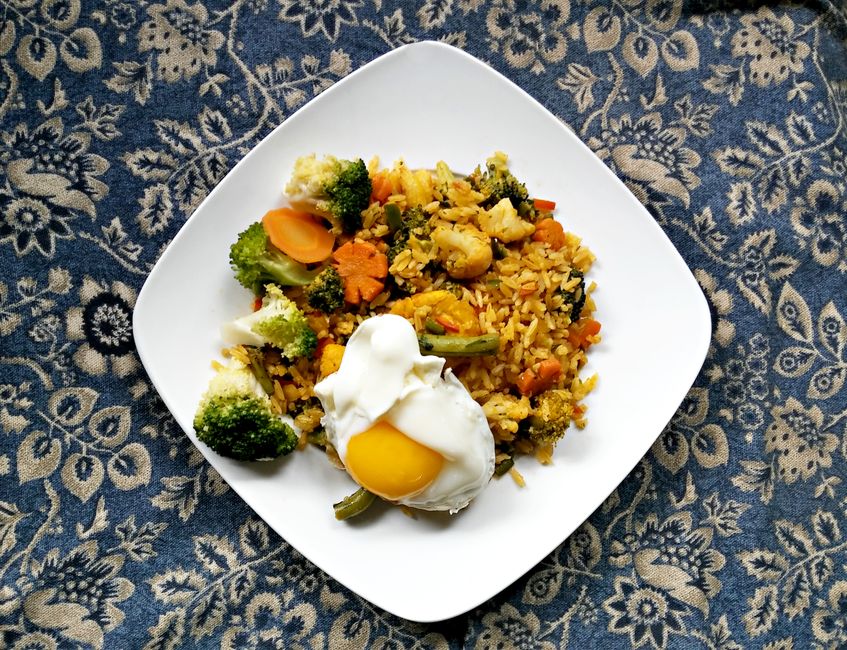
Cauliflower rice is a genuinely useful food for weight loss, but not because it has any special fat-burning property. It works for a simpler reason: it replaces higher-calorie grains with a vegetable that fills your plate for a fraction of the calories. Swapping one cup of cooked white rice for one cup of cauliflower rice saves roughly 150 to 180 calories, and most people do not feel deprived by the trade. That calorie reduction, repeated meal after meal, is what drives weight loss — not the cauliflower itself.
What Makes Cauliflower Rice Different From Regular Rice?
Regular rice is mostly starch. A cup of cooked white rice contains about 200 calories, 45 grams of carbohydrates, and less than 1 gram of fiber. Brown rice improves on that with about 3.5 grams of fiber, but it still delivers roughly 215 calories and 45 grams of carbs per cooked cup.
Cauliflower rice is a different food entirely. The same volume — one cup of riced cauliflower — contains about 25 calories, 5 grams of carbohydrates, and 2 grams of fiber. The water content is high, which means you get a large volume of food for very few calories. That volume matters for satiety, the feeling of fullness that tells you to stop eating.
This is the core mechanism behind why cauliflower rice works for weight loss. It is not a metabolic trick. It is a straightforward calorie-for-volume trade that lets you eat a normal-sized portion while consuming far fewer calories.
Does Cauliflower Rice Actually Fill You Up?
Satiety is the real question, because a food that leaves you hungry an hour later will not help you lose weight no matter how low it is in calories. Research on vegetable-based substitutes generally shows that people report similar fullness after eating high-volume, low-calorie foods compared to their calorie-dense counterparts, at least in the short term.
Cauliflower rice does contain fiber, which slows digestion and contributes to fullness. But it also contains very little protein and almost no fat, two nutrients that strongly influence satiety. A bowl of plain cauliflower rice with no added ingredients may leave you hungry sooner than a bowl of brown rice with beans.
The practical solution is to build the meal around the cauliflower rice rather than expecting it to do all the work alone. Add a protein source like chicken, tofu, or shrimp. Add a healthy fat like olive oil or avocado. The cauliflower provides volume, the protein and fat provide staying power, and the total meal stays far lower in calories than the rice-based version.
Is Cauliflower Rice Good for Weight Loss Compared to Brown Rice?
Both can fit into a weight loss diet, but they serve different purposes. Brown rice is a whole grain with more fiber, more protein, and more minerals than white rice. It is genuinely nutritious and supports steady blood sugar better than white rice. The problem is that it still carries a meaningful calorie load, and portion control is easy to lose when rice tastes good.
Cauliflower rice removes that calorie load entirely. One cup of cauliflower rice has about the same calories as two tablespoons of cooked brown rice. You can eat a large, satisfying portion of cauliflower rice for a fraction of the calories of a modest portion of brown rice.
This is where the evidence supports swapping. Studies on food substitution consistently show that replacing high-calorie foods with lower-calorie alternatives of similar volume reduces total daily calorie intake without requiring conscious portion restriction. Cauliflower rice is one of the easiest substitutions available because it takes on the flavor of whatever sauce or seasoning you add.
The trade-off is nutritional density. Brown rice provides magnesium, manganese, and B vitamins that cauliflower has in smaller amounts. If you swap cauliflower rice for brown rice at every meal, you lose those nutrients unless you get them elsewhere. A balanced approach is to use cauliflower rice most of the time and keep whole grains in the diet a few times per week.





Does Cauliflower Rice Spike Blood Sugar?
Cauliflower rice has a minimal effect on blood sugar. Its carbohydrate content is low, and its fiber slows the absorption of what carbs it does contain. The glycemic index of cauliflower is estimated in the low range, well below white rice and somewhat below brown rice.
For people with diabetes or prediabetes, this makes cauliflower rice a practical swap. Stable blood sugar reduces cravings and energy crashes, both of which can undermine weight loss efforts. The mechanism is straightforward: fewer carbohydrates entering the bloodstream at once means less insulin released, and lower insulin levels favor fat oxidation over fat storage.
One caution applies. If you buy pre-riced cauliflower in a bag, check the label. Some brands add seasonings, sauces, or preservatives that introduce sugar or sodium. Plain cauliflower rice should list one ingredient: cauliflower. The same applies to frozen versions, which are usually just cauliflower and are a perfectly good option.
What About Cauliflower Rice Nutrition Compared to Other Vegetables?
Cauliflower is a cruciferous vegetable, part of the same family as broccoli, cabbage, and Brussels sprouts. It provides vitamin C, vitamin K, folate, and a group of compounds called glucosinolates. These compounds are being studied for their potential anti-cancer properties, though the evidence in humans is not yet conclusive.
Compared to other low-calorie vegetables, cauliflower is neither the most nutrient-dense nor the least. Dark leafy greens like spinach and kale offer more vitamins per calorie. But cauliflower has an advantage that spinach does not: it can replace a starchy grain in a meal. No one is swapping their rice for a bowl of spinach and feeling satisfied. Cauliflower rice works because it occupies the same culinary space as rice while being a vegetable.
That functional role is what makes it valuable for weight loss. It is not the single most nutritious vegetable you can eat. It is the vegetable that most successfully replaces a high-calorie staple without making the meal feel like a diet food.
How Should You Prepare Cauliflower Rice for Weight Loss?
Preparation determines whether cauliflower rice helps or hurts your weight loss efforts. The cauliflower itself is nearly free of calories, but what you add to it can undo that advantage.
The best methods are sauteing in a small amount of oil, steaming, or roasting. A teaspoon of olive oil adds about 40 calories and provides healthy fat that improves absorption of fat-soluble vitamins. That is a reasonable addition. The problem comes when cauliflower rice is prepared with heavy sauces, cheese, cream, or large amounts of butter. A cauliflower rice dish with cheese sauce can easily match the calorie count of the rice dish it replaced.
Seasoning is your friend. Garlic, ginger, soy sauce, chili flakes, lemon juice, and fresh herbs add flavor without meaningful calories. Cauliflower rice has a mild taste that absorbs strong seasonings well, which is why it works in stir-fries, curries, and rice bowls.
One practical tip: do not overcook it. Cauliflower rice that is cooked too long becomes mushy and watery, which makes it less satisfying. Saute it over medium-high heat for five to seven minutes until it is tender but still has some structure. The texture matters because a food that feels like food keeps you satisfied longer than one that feels like mush.
Are There Downsides to Eating Cauliflower Rice Every Day?
For most people, daily cauliflower rice is safe and unproblematic. The main side effect is digestive discomfort. Cauliflower contains a type of carbohydrate called raffinose that ferments in the gut, which can cause gas and bloating in some people. Cooking cauliflower reduces this effect but does not eliminate it. If you notice bloating, reduce portion size or alternate cauliflower rice with other vegetables.
There is also the nutrient replacement concern mentioned earlier. If cauliflower rice completely replaces all grains in your diet, you may miss out on the B vitamins, iron, and fiber that whole grains provide. This is not a reason to avoid cauliflower rice. It is a reason to eat a varied diet that includes other vegetables, fruits, whole grains, and legumes.
People taking blood thinners should be aware that cauliflower is high in vitamin K, which plays a role in blood clotting. This is rarely a problem with normal food intake, but anyone on warfarin should keep their vitamin K intake consistent and discuss dietary changes with their doctor.
Does the Research Support Cauliflower Rice for Weight Loss?
No large clinical trial has specifically tested cauliflower rice as a weight loss intervention. That does not mean the evidence is absent. The research on vegetable substitution is consistent: replacing energy-dense foods with low-energy-density foods reduces calorie intake and supports weight loss. Cauliflower rice is a textbook example of this principle.
What the evidence does not support is the idea that cauliflower rice has any unique metabolic advantage. It does not speed up your metabolism. It does not burn fat. It does not suppress appetite through any special compound. It is a low-calorie food that replaces a higher-calorie food, and that is enough.
Weight loss still comes down to maintaining a calorie deficit over time. Cauliflower rice makes that deficit easier to achieve because it lets you eat familiar meals in familiar portions for fewer calories. That is a real benefit, and it is the honest one.
Frequently Asked Questions
Is cauliflower rice good for weight loss every day?
Yes, eating cauliflower rice daily can support weight loss because it replaces higher-calorie grains with a low-calorie vegetable. Just vary the rest of your diet to make sure you still get enough fiber, B vitamins, and minerals from other sources.
How many calories are in cauliflower rice?
One cup of plain riced cauliflower contains about 25 calories. Cooked white rice has roughly 200 calories per cup, so the swap saves about 175 calories per serving.
Does cauliflower rice make you feel full?
Cauliflower rice provides fullness through volume and fiber, but it lacks protein and fat. Pair it with a protein source and a small amount of healthy fat to stay satisfied for several hours.
Can you eat cauliflower rice on a low-carb diet?
Yes, cauliflower rice fits easily into low-carb and keto diets because one cup contains only about 5 grams of carbohydrates. It is one of the most practical grain replacements for carbohydrate-restricted eating plans.
