
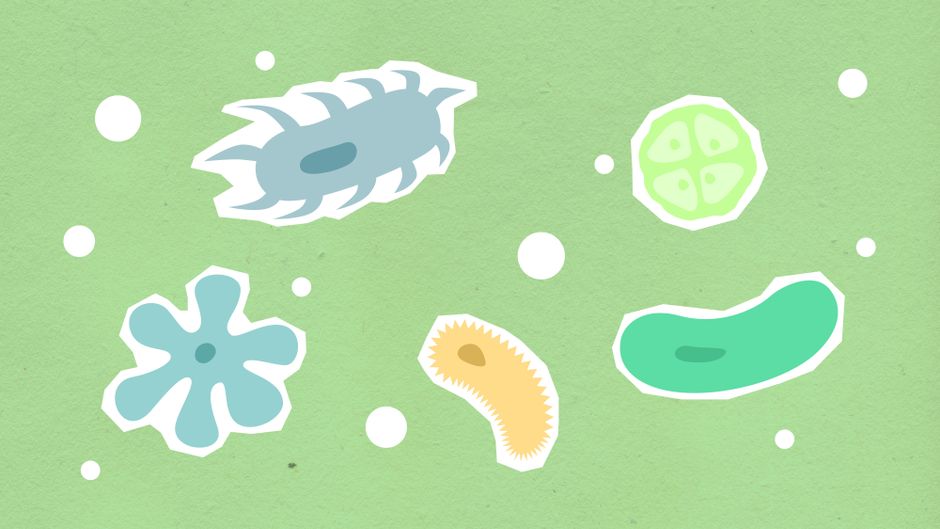
No, an amoeba is not a bacteria. They are completely different types of organisms. An amoeba is a single-celled eukaryote, meaning its cells have a defined nucleus and complex internal structures. A bacterium is a prokaryote, which lacks a nucleus and other membrane-bound organelles. This core difference in cell structure places them in entirely separate domains of life: Eukaryota and Bacteria.
What Is An Amoeba?
An amoeba is a type of single-celled organism classified as a protozoan. It belongs to the domain Eukaryota, which also includes plants, animals, and fungi. The defining feature of all eukaryotes is the presence of a true nucleus that houses the cell’s genetic material.
Amoebas are known for their ability to change shape. They move and feed using temporary extensions of their cell membrane called pseudopods, which means “false feet.” These extensions allow the amoeba to engulf food particles and pull itself forward through its environment. Most amoebas live in water, soil, or inside other organisms as parasites.
What Is A Bacterium?
Bacteria are microscopic, single-celled organisms that belong to the domain Bacteria. They are prokaryotes, which means they do not have a nucleus or other membrane-bound organelles. Their genetic material floats freely in the cytoplasm as a single circular strand of DNA.
Bacteria are among the most abundant life forms on Earth. They exist in nearly every environment, from deep ocean vents to the human digestive tract. While many people associate bacteria with illness, most are harmless or beneficial. Gut bacteria help digest food, and soil bacteria recycle nutrients.
The Core Differences Between Amoebas And Bacteria
The fundamental difference comes down to cell structure. Amoebas are eukaryotes with a nucleus. Bacteria are prokaryotes without one. This single difference drives everything else about how these organisms function.
Size is another clear distinction. Amoebas are typically much larger than bacteria. Most amoebas range from 10 to 20 micrometers in diameter, though some species can grow much larger. Most bacteria measure between 0.5 and 5 micrometers. An amoeba is often ten times or more larger than a typical bacterium.
Here is a direct comparison of the main differences:
| Feature | Amoeba | Bacterium |
|---|---|---|
| Domain | Eukaryota | Bacteria |
| Nucleus | Present | Absent |
| Cell size | Typically 10-20 micrometers | Typically 0.5-5 micrometers |
| Movement | Pseudopods (false feet) | Flagella or gliding |
| Reproduction | Binary fission (cell division) | Binary fission (cell division) |
| Cell wall | Absent | Present in most species |
| Organelles | Present (mitochondria, etc.) | Absent |
Both amoebas and bacteria reproduce through binary fission, where one cell splits into two. But the internal machinery for that process is completely different because of their distinct cell structures.





Why Do People Confuse Amoebas With Bacteria?
Both are microscopic single-celled organisms. That similarity leads many people to assume they are related. The confusion is understandable but incorrect from a biological standpoint.
Another reason for confusion is that certain amoebas can cause infections, just like certain bacteria can. For example, the amoeba Naegleria fowleri causes a rare but severe brain infection. People may hear about a “brain-eating amoeba” and assume it is a type of bacteria because they associate both with germs and illness.
Medical terminology also contributes to the mix-up. The word “amoeba” is sometimes used loosely in everyday language to describe any tiny moving organism. In reality, Amoeba is a specific genus, and the broader group includes many related protozoans.
How Are Amoebic Infections Treated Differently From Bacterial Infections?
Treatment differs because the organisms are structurally different. Antibiotics that target bacteria do not work on amoebas. This is a critical distinction for anyone dealing with an infection.
Bacterial infections are treated with antibiotics that disrupt bacterial cell walls, protein synthesis, or DNA replication. Amoebas lack the structures that most antibiotics target. Instead, amoebic infections are treated with antiparasitic drugs such as metronidazole or tinidazole. These drugs interfere with the amoeba’s DNA synthesis and are effective against several protozoan parasites.
Misdiagnosis can lead to ineffective treatment. If a patient has an amoebic infection and receives antibiotics, the infection will not resolve. Proper laboratory identification of the organism is essential before starting treatment.
Are There Any Similarities Between Amoebas And Bacteria?
Despite their differences, amoebas and bacteria share some basic features common to all cellular life. Both have a cell membrane that controls what enters and leaves the cell. Both contain cytoplasm, ribosomes for protein synthesis, and genetic material in the form of DNA.
Both organisms also interact with their environments in similar ways. They sense chemical signals, move toward food sources, and reproduce when conditions are favorable. Some amoebas even eat bacteria as a food source. In that sense, the relationship between them is sometimes predator and prey rather than close relatives.
Evolutionarily, both are ancient life forms. Bacteria appeared on Earth roughly 3.5 billion years ago. Eukaryotes, including amoebas, appeared later, around 1.5 to 2 billion years ago. Scientists believe eukaryotes evolved from prokaryotes through a process called endosymbiosis, where one prokaryotic cell engulfed another and formed a lasting relationship.
Why This Distinction Matters For Your Health
Understanding the difference between amoebas and bacteria affects how you think about infections and treatments. When a doctor prescribes an antibiotic, it targets bacteria specifically. It will not treat viral infections, fungal infections, or infections caused by protozoans like amoebas.
Water safety is one area where this distinction is practically important. Certain amoebas, including Naegleria fowleri, can live in warm freshwater lakes and rivers. These amoebas are not killed by chlorine levels that are effective against bacteria. This is why public health guidance about freshwater swimming and nasal rinsing exists. For nasal rinsing, the CDC and other health authorities recommend using distilled, sterile, or boiled water rather than tap water.
Foodborne illness is another example. Contaminated water or food can carry either bacteria like E. coli or amoebas like Entamoeba histolytica. Both cause gastrointestinal symptoms, but the treatments are completely different. Stool testing helps identify which organism is responsible.
Frequently Asked Questions
Can an amoeba turn into a bacteria?
No. Amoebas and bacteria are separate domains of life and cannot transform into one another. An amoeba will always remain a eukaryote, and a bacterium will always remain a prokaryote.
Which is bigger, an amoeba or a bacterium?
An amoeba is significantly larger than a bacterium. Most amoebas are 10 to 20 micrometers in diameter, while most bacteria are only 0.5 to 5 micrometers.
Will antibiotics kill an amoeba?
No. Antibiotics target bacterial structures and processes that amoebas do not have. Amoebic infections require antiparasitic medications instead.
Are all amoebas harmful to humans?
No. Only a few species of amoebas cause disease in humans. Most amoebas are free-living organisms in water and soil that do not infect people.
