
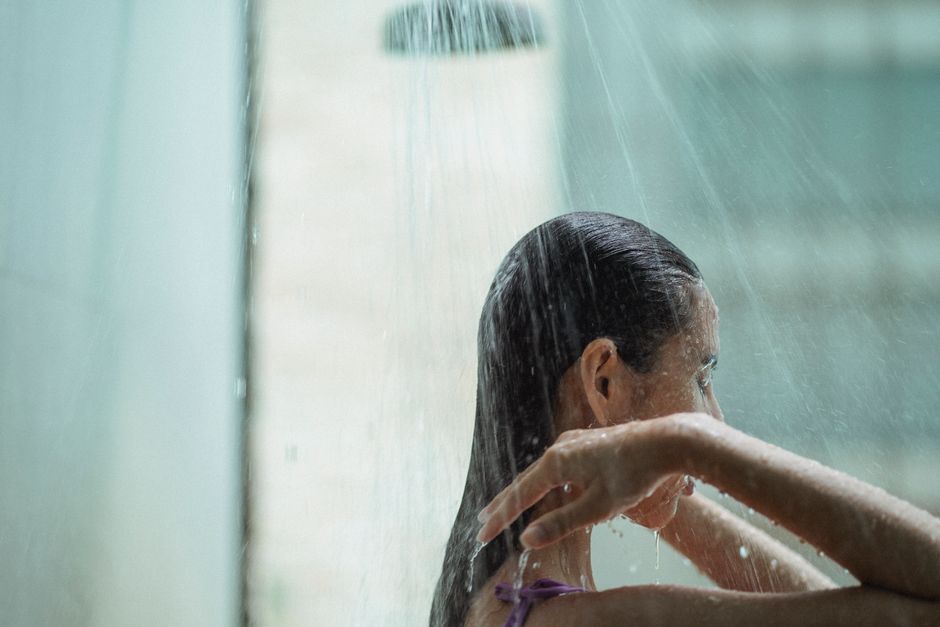
Washing your hair without getting water in your eyes comes down to three things: controlling the direction of the water, keeping your head positioned so gravity works for you, and protecting the eye area before water ever reaches it. Tilt your head back or to the side rather than straight down, and let water flow from your hairline backward toward your neck. For most people, the simplest fix is a rinse that travels away from the face, not over it.
Why Does Water In The Eyes Hurt So Much?
Plain water in the eye is uncomfortable for a reason that has nothing to do with soap. Your tears are not pure water. They contain a precise balance of salt, proteins, and oils that keeps the surface of your eye stable and comfortable.
When plain water hits the eye, it dilutes that tear film. The change in salt balance irritates the nerve endings on the cornea, which is one of the most sensitive tissues in the body. That is why even clean water can sting.
Shampoo makes it worse. Most shampoos contain surfactants, the compounds that lift oil and dirt. These break down the oily outer layer of your tear film. The result is a burning, gritty feeling that lasts until your eyes produce enough fresh tears to rebuild the film.
This matters for the method you choose. Preventing the water from reaching your eyes is easier and more reliable than trying to make the water itself gentler. There is no rinse water that is truly comfortable in the eye.
What Is The Best Head Position To Keep Water Out Of Your Eyes?
Tilting your head back is the single most effective change most people can make. When you look up at the ceiling while rinsing, water runs from your forehead back over your crown and off the back of your head. It never crosses your face.
The key is to keep your face angled upward, not downward. Many people naturally drop their chin toward the chest, which sends water straight down the forehead and into the eyes.
If tilting back is uncomfortable — for example, if you have neck problems — tilt to one side instead. Rinse along the side of your head so the water exits near your ear rather than over your face.
Here is the part people miss: the water source matters as much as the head angle. A showerhead mounted high on the wall sends water down at an angle that pushes toward the face no matter how you tilt. Handheld showerheads solve this because you control the direction. If you only have a fixed showerhead, turning your back to it and tilting your head back works better than facing it.
How Do You Wash Your Hair In The Shower Without Water In Your Eyes?
Positioning your body away from the stream is the core skill. Stand with your back to the showerhead when you rinse. Water hits the back of your head and flows down your neck and back, away from your face.
Follow this order:
- Wet your hair with your back to the water, head tilted slightly back.
- Step forward out of the stream to apply shampoo.
- Lather without leaning your face into the water.
- Step back into the stream to rinse, keeping your back turned and your chin up.
Stepping out of the water while you lather makes the biggest difference. Most shampoo gets into eyes during the lather phase, not the rinse phase, because people stand under the running water the whole time.
Keep a dry washcloth or towel within reach. If water starts running toward your face, you can wipe your forehead before it reaches your eyes. This small habit prevents most accidents.





How Do You Wash Your Hair In The Sink Or Tub Without Getting Water In Your Eyes?
Washing in a sink changes the geometry, and the fix is different. You cannot rely on gravity pulling water backward the way you can in a shower.
Use a cup or pitcher instead of putting your head under the faucet. Fill it, then pour the water starting at your hairline and moving backward toward your crown and down the back of your head. Pour slowly. A fast pour splashes.
Keep your head tilted slightly forward over the basin but your face angled down and away from the pour path. Water should travel along your scalp, not across your forehead.
For tub washing, the same cup method works. Some people find it easier to lie back in shallow water with their head supported, but this only works if the water level stays below your hairline. As soon as the water reaches your forehead, it can seep toward your eyes.
Do Visors, Goggles, Or Stickers Actually Help?
Yes, physical barriers work, and they are the most reliable option for children and for anyone who struggles with positioning. A shampoo visor is a curved piece of flexible plastic that sits on the forehead and directs water around the sides of the face.
Swimming goggles create a seal around the eyes and keep water out entirely. They are effective but can be uncomfortable, and the seal can leak if the goggles do not fit well. They also do not stop shampoo from reaching the skin around the eyes, which can still cause irritation.
Some parents use waterproof stickers or stick-on visors for young children. These can help, but they need to be placed carefully and removed gently to avoid pulling at the skin.
None of these tools are required for most adults. They are most useful when positioning alone is not enough, such as with toddlers who move unpredictably or people with limited neck mobility.
What Should You Do If Shampoo Gets In Your Eyes Anyway?
Rinse with clean, lukewarm water right away. Tilt your head so the water flows away from the eye, not into it. Keep rinsing for several minutes if the stinging continues.
Do not rub your eye. Rubbing can scratch the cornea, especially if there is a particle of grit or dried shampoo under the lid. Blink repeatedly instead. Blinking spreads fresh tears across the surface and helps flush the irritant out naturally.
If you wear contact lenses, take them out. Shampoo residue can trap against the lens and prolong the irritation. Clean the lenses before putting them back in, or switch to glasses for the rest of the day.
Most shampoo-in-the-eye irritation settles within a short time once the eye is rinsed. Seek medical attention if pain is severe, if vision changes, or if the irritation does not improve. Those signs suggest something beyond simple irritation, and an eye care professional should evaluate it.
Does The Type Of Shampoo Make A Difference?
It can affect how much it stings, but it does not change the basic problem. All shampoos contain surfactants, and surfactants irritate eyes to some degree. Some formulations are designed to be less irritating, often labeled as tear-free or gentle.
These gentler formulas usually use different surfactant compounds that are less disruptive to the tear film. They sting less, but they are not sting-proof. Water alone still irritates the eye, so even a tear-free shampoo rinsed with plain water can cause discomfort if it reaches the eye.
The honest takeaway: choosing a gentler shampoo may reduce the severity of irritation, but it is not a substitute for keeping water and lather out of your eyes in the first place. Positioning and barriers do more work than product choice.
Practical Habits That Prevent Water In The Eyes Every Time
Small routines make the biggest difference over time. None of them require special equipment.
- Rinse with your back to the water and your chin lifted.
- Step out of the stream while you lather.
- Keep a dry towel or washcloth within arm’s reach.
- Use a cup or pitcher in the sink instead of the faucet.
- Lower the water pressure. High pressure splashes more.
- Keep your eyes gently closed during the rinse, but do not squeeze them shut, which can push water toward the lashes.
For children, the cup method combined with a visor works well. Let them hold a dry washcloth over their eyes while you pour. Giving them a job keeps them still and gives them a sense of control.
One detail worth knowing: closing your eyes tightly does not seal them. Water can still reach the corners and seep in. The goal is to keep water away from the face entirely, not to rely on closed eyelids as a barrier.
Frequently Asked Questions
How do you wash your hair without getting water in your eyes?
Tilt your head back and rinse with your back to the water so it flows away from your face. Stepping out of the stream while you lather prevents most water from reaching your eyes.
Does tilting your head back really keep water out of your eyes?
Yes, tilting back lets water run from your forehead over your crown and off the back of your head instead of down your face. It is one of the most effective single changes you can make.
What can I use to keep shampoo out of my child’s eyes?
A shampoo visor or a dry washcloth held over the eyes works well for children. Using a cup to pour water slowly from the hairline backward also helps.
What should I do if shampoo gets in my eye?
Rinse with clean, lukewarm water and blink repeatedly instead of rubbing. Seek medical care if pain is severe or your vision changes.
