
Rubber bands for exercise — often called resistance bands — are a practical way to build strength at home without heavy equipment. You can use them for full-body workouts targeting your arms, legs, back, and core. They work by adding tension throughout a movement, which forces your muscles to work harder than they would with bodyweight alone.
What Makes Rubber Bands Effective for Strength Training?
Rubber bands provide resistance through elasticity. Unlike dumbbells, where gravity provides a fixed weight, bands create tension that increases as the band stretches. This means the muscle works hardest at the top of the movement, which is different from free weights.
This variable resistance has a real benefit. Research consistently shows that resistance bands can build muscle strength comparable to conventional weight training when used with proper form and progressive overload. Progressive overload simply means gradually increasing the resistance over time — either by using a thicker band or stretching it further.
Bands are also joint-friendly. Because the resistance is smooth and doesn’t rely on momentum, there is less stress on joints compared to some explosive weightlifting movements. This makes them a reasonable option for beginners and for people recovering from certain injuries, though you should check with a healthcare provider before starting any new exercise program if you have an existing condition.
How To Use Rubber Bands For Exercise At Home: Basic Setup
Before you start moving, you need to set up correctly. A band that is too light won’t challenge your muscles. A band that is too heavy can compromise your form and increase injury risk.
Here is how to choose and set up:
- Check the band’s resistance level. Most bands are color-coded by resistance. If you are new, start with a light or medium band. You should be able to complete 12 to 15 repetitions with good form but feel significant fatigue in the last few reps.
- Anchor the band securely. You can step on the band with your feet, wrap it around a sturdy post, or close it in a door anchor. Always check that the anchor point is stable before you pull.
- Inspect the band. Look for tears, cracks, or weak spots before each use. A snapped band can whip back and cause injury.
- Maintain tension. Keep the band slightly stretched even at the starting position. This ensures the muscle stays engaged throughout the entire movement.
If you are using a door anchor, place it at the height appropriate for the exercise. For chest presses, anchor at chest height. For rows, anchor at waist height. For overhead presses, anchor low and pull upward.
Upper Body Exercises You Can Do With Bands
You can train every major upper body muscle group with a single band. Here are exercises with clear setup instructions.
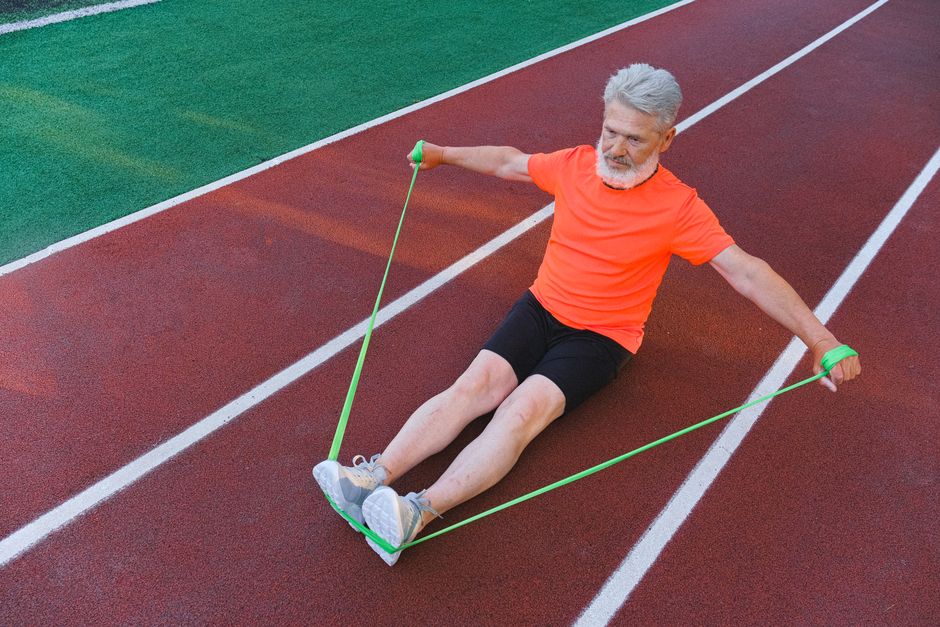
Band rows target the back and biceps. Sit on the floor with your legs extended. Loop the band around the soles of your feet. Hold one end in each hand. Keep your back straight and pull the band toward your waist, squeezing your shoulder blades together. Lower slowly back to the start.
Band chest press works the chest and triceps. Anchor the band at chest height behind you. Hold one end in each hand with your elbows bent at 90 degrees. Press your arms forward until they are fully extended but not locked. Return slowly.
Band overhead press targets the shoulders. Stand on the center of the band with your feet shoulder-width apart. Hold the handles at shoulder height with palms facing forward. Press upward until your arms are straight overhead. Lower with control.
Band bicep curls are straightforward. Stand on the band with feet shoulder-width apart. Hold the handles with palms facing up. Curl upward toward your shoulders, keeping your elbows tucked at your sides. Lower slowly.
For each exercise, aim for 3 sets of 10 to 15 repetitions. Rest about 60 seconds between sets. If the last few reps feel easy, use a thicker band or shorten the band by stepping on it closer to your hands.




Lower Body and Core Exercises With Bands
Lower body work with bands is effective because the tension challenges the large muscles of the legs and glutes. These muscles respond well to resistance training and can help with everyday movements like climbing stairs and standing up from a chair.
Band squats add resistance to a fundamental movement. Stand on the center of the band with feet shoulder-width apart. Hold the handles at shoulder height. Squat down as if sitting in a chair, keeping your chest up and knees tracking over your toes. Push through your heels to stand.
Band glute bridges target the glutes and hamstrings. Lie on your back with your knees bent and feet flat on the floor. Place the band just above your knees. Press your knees outward against the band as you lift your hips toward the ceiling. Squeeze your glutes at the top, then lower.
Band lateral walks strengthen the hip abductors, which are important for knee stability. Place the band around your thighs just above the knees. Stand with feet hip-width apart and a slight bend in your knees. Take small steps to the side, keeping tension in the band. Do 10 steps in each direction.
Band pallof press works the core. Anchor the band at chest height to your side. Stand sideways to the anchor and hold the handle with both hands at your chest. Press your arms straight out in front of you, resisting the pull of the band. Hold for a second, then bring your hands back to your chest. This exercise trains anti-rotation strength, which is a key function of the core.
How Many Reps and Sets Should You Do?
The right number depends on your goal. For general fitness and muscle endurance, 3 sets of 12 to 15 repetitions works well. For building muscle size, you want to work closer to 8 to 12 repetitions with a heavier band that makes the last few reps challenging.
For strength gains, some research suggests that lower repetitions with higher resistance are effective — around 6 to 8 reps per set. However, the most important factor is effort. The last few repetitions of each set should feel difficult. If you can easily complete all repetitions in every set, it is time to increase the resistance.
Frequency matters too. Aim to train each muscle group 2 to 3 times per week with at least one day of rest between sessions for the same muscle group. This allows time for muscle recovery and growth.
Common Mistakes and How to Avoid Them
Several mistakes can reduce the effectiveness of band training or increase injury risk. Being aware of them helps you get better results.
Letting the band snap back. Always lower the band with control. Letting it snap back suddenly can strain the joint or cause the band to hit you.
Using poor posture. Keep your shoulders back and down, and your core engaged during upper body exercises. Avoid rounding your back, especially during rows and presses.
Moving too fast. Fast, jerky movements reduce muscle engagement and increase injury risk. Aim for a controlled tempo — about 2 seconds to lift and 3 seconds to lower.
Not feeling resistance at the start. If the band is loose at the beginning of the movement, the muscle is not working through the full range. Start with the band slightly stretched.
Ignoring pain. Muscle fatigue and mild burning are normal. Sharp pain is not. Stop immediately if you feel sharp pain in a joint or muscle.
How to Progress Over Time
Your muscles adapt to stress. If you keep using the same band at the same tension, progress will stall. Progressive overload is the solution.
There are several ways to increase difficulty without buying new equipment:
- Use a thicker band. Most band sets include multiple resistance levels. Move up when the current band feels easy.
- Shorten the band. Stepping on the band closer to your hands increases the tension at the starting position.
- Slow down the lowering phase. Taking 4 to 5 seconds to lower the band increases time under tension, which stimulates muscle growth.
- Add more sets. Increasing from 3 sets to 4 sets is a simple way to add volume.
- Increase repetitions. If you can comfortably complete 15 reps, add a few more before moving to a heavier band.
Track your workouts in a simple notebook or phone app. Write down the band color, the number of reps, and how difficult the last set felt. This helps you make consistent progress rather than guessing.
Frequently Asked Questions
Are rubber bands as effective as weights for building muscle?
Research indicates resistance bands can build muscle strength comparable to conventional weights when used with consistent progressive overload. The key is increasing resistance over time and maintaining proper form.
How often should I use resistance bands at home?
Train each muscle group 2 to 3 times per week with at least one rest day between sessions for the same muscles. This schedule allows adequate recovery while providing enough stimulus for strength gains.
Can beginners use rubber bands for exercise?
Yes, resistance bands are well-suited for beginners because they allow you to start with light resistance and progress gradually. Start with a light band and focus on learning proper form before increasing tension.
How do I know when to move to a heavier band?
Move to a heavier band when you can complete all repetitions in every set with good form and the last few reps feel manageable. If you finish 15 reps without significant fatigue, increase the resistance.
