
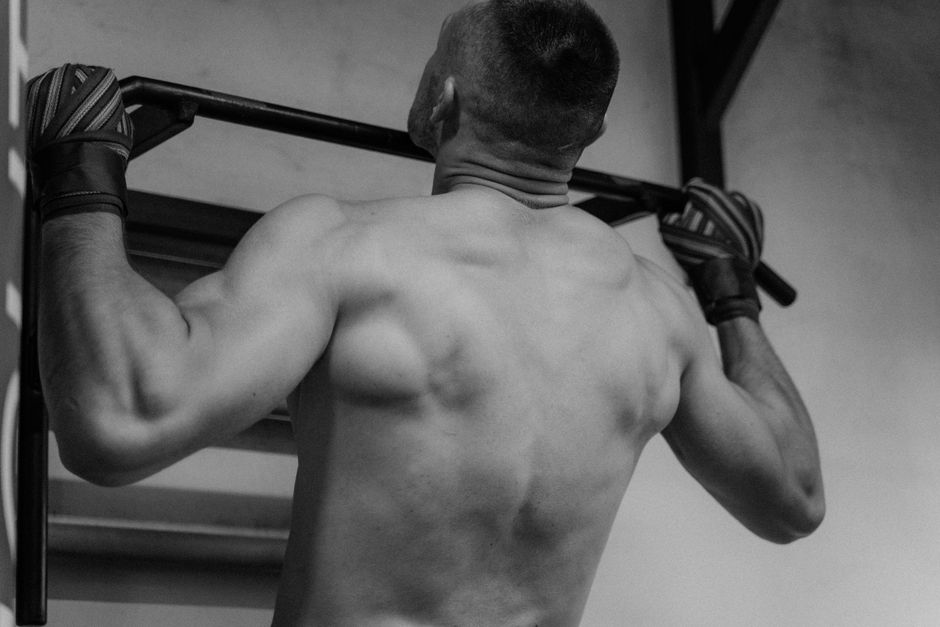
You train your back by pulling, not pushing. Every effective back exercise — at home or in the gym — involves pulling a resistance toward your torso or pulling your body toward a fixed bar. That single principle covers rows, pull-ups, and the many variations of each. Here is how to build a complete back routine with whatever equipment you have.
What Muscles Make Up Your Back?
Your back is not one muscle. It is a layered system of muscles that pull your arms down and back, extend your spine, and stabilize your shoulder blades.
The largest is the latissimus dorsi, the broad muscle that gives the back its V-shape. It runs from your lower spine and pelvis up to your upper arm. When it contracts, it pulls your arm down and toward your body.
Between and beneath your shoulder blades sit the rhomboids and the middle and lower trapezius. These muscles retract your shoulder blades — they squeeze them together. The erector spinae run vertically along your spine and handle extension and posture. The rear deltoids cap the back of your shoulders.
This matters for programming. A rowing motion hits the mid-back and lats. A pull-up or pulldown emphasizes the lats. A face pull or reverse fly targets the rear delts and upper traps. You want all of them.
How Do You Train Back Muscles Without Equipment?
Bodyweight training can build a strong back, but the options are narrower than for the chest or legs. You cannot easily row your own bodyweight without something to pull against. That constraint shapes the routine.
The pull-up is the gold standard. If you have a doorway bar or a sturdy branch, you have the single best back exercise available. If you cannot yet do one, you train the movement with negatives or band assistance (more on that below).
For the mid-back, the inverted row is the workhorse. Lie under a sturdy table, a low bar, or a set of rings. Grab the edge, keep your body straight, and pull your chest up to your hands. The lower the bar, the harder it gets. A table edge is a fine starting point for most people.
Floor-based movements fill the gaps:
- Prone Y-T-W raises. Lie face down and lift your arms into a Y, then a T, then a W shape. These target the lower traps and rear shoulders. Light or no resistance is plenty.
- Superman holds. Lie face down, lift your arms and legs off the floor, and hold. This trains the erector spinae.
- Bird dogs. On hands and knees, extend one arm and the opposite leg. This builds spinal stability and coordination more than raw strength.
- Reverse snow angels. Face down, sweep your arms from overhead to your sides without letting them touch the floor.
Bodyweight back work builds endurance and control well. It builds maximum strength less efficiently than loaded pulling, because you cannot easily add resistance over time. The fix is progression through leverage and range of motion, not just more reps.
What Is the Best Home Back Workout With Bands or Dumbbells?
One pair of adjustable dumbbells and one resistance band cover nearly every back movement pattern. This is the most practical home setup for most people.
Bands are underrated for back training because resistance increases as you stretch them. That matches the strength curve of a row reasonably well — hardest at the end range where your shoulder blades are fully squeezed.
A complete home session looks like this:
- Band pull-aparts. Hold a band at chest height and pull it apart until your arms are straight out to your sides. Great warm-up and rear-delt builder.
- Single-arm dumbbell rows. Brace one hand on a bench or chair, row the dumbbell to your hip. Let the shoulder blade move — do not lock it in place.
- Bent-over dumbbell rows. Hinge at the hips, keep your back flat, and row both dumbbells to your ribs.
- Band rows. Anchor a band at chest height, sit or stand tall, and pull the handles to your sides.
- Dumbbell pullovers. Lie on a bench or the floor, hold one dumbbell overhead, and lower it back behind your head. This stretches and works the lats through a long range.
- Reverse flyes. Bend forward with light dumbbells and raise your arms out to the sides. Keep the weight light — this is a small-muscle movement.
Two or three sets of each, taken close to but not to failure, is a solid session. If you are new to training, start with fewer sets and add over weeks.





How Do You Do Pull-Ups and Rows With Proper Form?
Form is where most back training quietly fails. People move the weight with their arms and never engage the muscles they came to train. Two cues fix most of it.
First, start every pull by setting your shoulder blades. Before your elbows bend, think about pulling your shoulder blades down and together. This engages the mid-back first and takes strain off the shoulder joint.
Second, drive your elbows, not your hands. On a row, imagine your elbows going back and down toward your hips. On a pull-up, imagine pulling your elbows down to your ribs. This shifts the work from your biceps to your lats.
For pull-ups specifically:
- Start from a dead hang with straight arms, shoulders active not slumped.
- Pull until your chin clears the bar, or as high as you can go.
- Lower under control. The lowering phase builds strength too — do not drop.
- If you cannot do a full rep, do negatives: jump or step to the top and lower yourself as slowly as you can. Three to five seconds down is a good target.
For rows, keep your spine neutral and avoid jerking your torso to move the weight. If you have to swing, the weight is too heavy.
How Often Should You Train Your Back?
Two sessions per week is enough to build back strength for most people. Research on resistance training consistently shows that training a muscle group roughly twice a week produces solid gains, and more frequent sessions offer diminishing returns for the same total volume.
Spread your back work out rather than cramming it into one day. Two shorter sessions beat one long one, both for recovery and for the quality of each set.
Recovery matters more than people expect. Back muscles are large and respond to training the same way other muscles do — they need rest to rebuild. Soreness lasting a day or two after a new routine is normal. Sharp pain during a movement is not, and you should stop and get it checked.
If you are training your back alongside chest and shoulders, remember that your back does a lot of stabilizing work during pressing movements. Give it at least a day between hard back sessions.
What Mistakes Limit Back Growth?
The most common mistake is treating the back as a single exercise. People do a set of rows and call it done. The back has multiple muscles with different jobs, and a complete routine trains them all.
The second mistake is going too heavy too soon. Back muscles are hard to feel, so people add weight to compensate. That usually means the biceps and lower back take over while the lats and mid-back stay underworked. Lighter weight with a full squeeze and a slow lowering phase builds more than heavy, sloppy reps.
The third is skipping the rear delts and upper back. These muscles are easy to neglect because they are not visible in the mirror. They matter for posture and shoulder health, not just appearance.
Finally, do not neglect the eccentric — the lowering phase of every rep. That is where a lot of the strength-building stimulus lives. Rushing the way down wastes half the exercise.
Frequently Asked Questions
Can you build back muscles at home without any equipment?
Yes, but your options are limited to pull-ups (if you have a bar), inverted rows using a table, and floor movements like supermans and prone raises. Bodyweight work builds endurance and control well but adds strength more slowly than loaded training.
How many days a week should I train my back?
Two sessions per week is enough for most people to build strength and size. More frequent training offers diminishing returns unless your total weekly volume is very high.
Are resistance bands good for back training?
Bands work well for rows, pull-aparts, and face pulls because their resistance increases as they stretch. They are less suited to heavy maximum-strength work, where free weights or machines are more effective.
Why can’t I feel my back muscles working during rows?
Most people use their arms and lower back instead of their lats and mid-back. Try starting each rep by setting your shoulder blades down and back, then drive your elbows toward your hips rather than pulling with your hands.
