
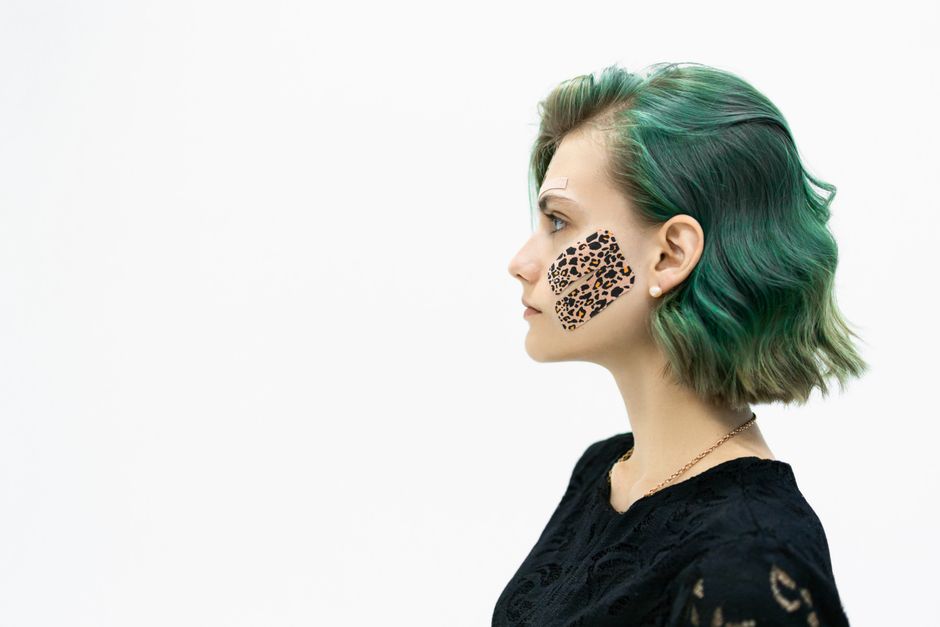
Kinesiology tape for face wrinkles is a technique where short, thin strips of elastic therapeutic tape are applied to the face and left on for a period of time, with the goal of lifting skin and reducing the appearance of lines. The practice has spread widely on social media, but there is no strong clinical evidence that it reduces wrinkles. The most reliable information available concerns what the tape physically does to skin, what it cannot do, and the safety issues that come with putting adhesive on the face.
What Is Kinesiology Tape and Why Do People Put It on Their Face?
Kinesiology tape is an elastic cotton or synthetic strip with a gentle adhesive backing. It was developed in the 1970s for sports medicine and physical therapy, where it is used to support muscles and joints. It stretches in one direction and is designed to move with the body.
Applying it to the face is a much newer and less studied use. The idea behind “face taping” is that holding the skin in a lifted or smoothed position for hours might train the muscles or prevent creases from forming. Some users report that skin looks smoother right after the tape is removed.
That immediate smoothing is real but temporary. It comes from the skin being held flat and from the adhesive lifting the top layer slightly. It does not mean the underlying structure of the skin has changed. This is the line most social media posts blur, whether on purpose or not.
Does Face Taping Actually Reduce Wrinkles?
No clinical evidence currently confirms that kinesiology tape reduces wrinkles. This is the honest position, and it matters because the marketing around face tape often implies otherwise.
Wrinkles form for two main reasons. One is the repeated movement of facial muscles over decades, which creates expression lines. The other is the breakdown of collagen and elastin in the deeper skin layers as we age, along with sun damage and moisture loss. Tape sits on the surface. It cannot rebuild collagen or elastin, and it cannot stop the muscles underneath from moving.
Some small studies have looked at facial taping and reported short-term changes in how skin looks. These studies tend to be small, short, and sometimes funded by tape manufacturers. They are not the kind of evidence that supports a real treatment claim. No large, independent, long-term trial has shown that face taping reduces wrinkles.
There is one useful distinction here. Taping is not the same as the silicone gel sheets used on scars, which do have some clinical support for flattening and softening raised scars. People sometimes lump these together. They are different products with different evidence.
How Do You Apply Kinesiology Tape to the Face?
If you want to try it, the technique matters mostly for safety and comfort, not for results. The face has thin skin, many small blood vessels, and sensitive areas around the eyes and mouth. A few practical points help.
- Start with clean, dry skin. Oils and moisturizers stop the adhesive from sticking and can trap product under the tape.
- Cut thin strips, roughly a centimeter wide or less, rather than using the wide strips sold for shoulders and knees.
- Apply with the skin relaxed and the tape only lightly stretched. Overstretching pulls the skin and can cause irritation.
- Keep tape away from the eyelids and directly under the eyes. The skin there is very thin and easily damaged.
- Leave it on for a limited time and remove it slowly. Ripping tape off thin facial skin can tear the surface.
There is no established standard for how long to leave face tape on. Some people wear it overnight and some for a few hours. Because no clinical guidelines exist for this use, any specific timing you see online is someone’s personal routine, not a recommendation.





What Are the Risks of Taping Your Face?
The most common problem is skin irritation from the adhesive. Facial skin is more reactive than skin on the arm or leg, and reactions range from mild redness to a raised, itchy rash. People with sensitive skin or a history of eczema are more likely to react.
Repeated use can also pull at the skin. Over time, the mechanical stress of peeling tape off thin skin is not harmless. There is a reasonable concern that frequent tugging could contribute to laxity rather than reduce it, though this has not been formally studied. It is a logical worry, not a proven one, and it should be described that way.
There is also a risk of allergic reaction to the adhesive itself. If redness, swelling, or blistering appears, remove the tape and stop using it. Anyone with very sensitive skin should test a small strip on the inner arm first and wait a day before putting it on the face.
Tape should never be applied over broken skin, a rash, a sunburn, or a healing wound. And it should not be used as a substitute for sun protection, which is the single most established way to slow skin aging.
How Does Face Taping Compare to Proven Skin Care?
The gap between taping and proven approaches is large. It helps to see them side by side, because the comparison makes the evidence clear.
| Approach | What the evidence shows |
|---|---|
| Daily sunscreen | Strong evidence that it reduces sun-related skin damage and signs of aging |
| Topical retinoids | Well-established for improving fine lines and skin texture; prescription versions are stronger than over-the-counter |
| Moisturizers | Improve skin hydration and the look of fine lines in the short term |
| Kinesiology tape | No clinical evidence of lasting wrinkle reduction; short-term smoothing only |
| In-office treatments (lasers, peels, injectables) | Vary by procedure; many have clinical support, with real risks and costs |
None of this means tape is useless to everyone. Some people enjoy the ritual and find the temporary smoothing pleasant. The problem is when tape is presented as a replacement for sun protection or proven skin care. It is not.
Who Should Avoid Face Taping?
Some people should skip it entirely. Anyone with an active skin condition on the face, such as eczema, rosacea, or psoriasis, should not tape over affected areas. The adhesive can trigger flares.
People with very thin or fragile skin, which becomes more common with age and with certain medications, should be cautious. So should anyone who has had recent facial procedures, peels, or laser treatments. Skin needs to heal first.
If you are unsure whether your skin can handle the adhesive, ask a dermatologist. A pharmacist can also advise on adhesive sensitivities. This is a low-stakes decision for most people, but it is not risk-free, and the people most worried about wrinkles are often the ones with the most sensitive skin.
What Is a Realistic Takeaway?
Kinesiology tape on the face is a low-cost experiment with a modest chance of short-term cosmetic smoothing and a real chance of irritation. It is not a wrinkle treatment. The evidence for lasting benefit is absent, not just thin.
The habits with the strongest support for skin aging are unglamorous. Protect skin from the sun daily. Don’t smoke. Keep skin moisturized. Use proven ingredients if you want to go further, and talk to a clinician about stronger options. Those steps rest on decades of research. Face tape rests on social media momentum and small studies.
If you try taping, treat it as a temporary cosmetic trick, patch-test first, and stop at the first sign of irritation. That is the honest way to use it, without expecting it to do more than it can.
Frequently Asked Questions
Does kinesiology tape really remove wrinkles?
No clinical evidence confirms that it removes wrinkles. Any smoothing you see is temporary and comes from the skin being held flat, not from a change in the skin’s structure.
How long should you leave face tape on?
There is no established guideline for how long to leave it on. Any specific timing you see online is a personal routine, not a clinical recommendation.
Can face taping damage your skin?
It can cause irritation or an allergic reaction to the adhesive, and repeated peeling can stress thin facial skin. Stop using it if redness, swelling, or itching appears.
What actually reduces wrinkles?
Daily sun protection, not smoking, and moisturizing have the strongest support, and topical retinoids are well established for fine lines. Talk to a dermatologist about stronger options.
