
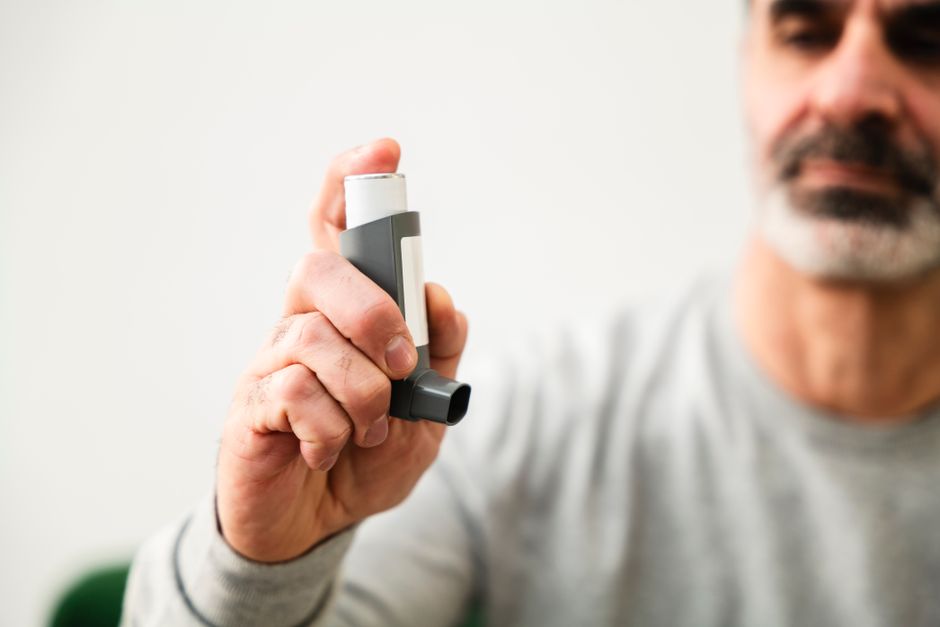
How you use an inhaler decides how much medicine actually reaches your lungs. For COPD, that difference is not small. Poor technique means the drug lands in your mouth and throat instead of your airways, so you get less benefit and more side effects. The right way is simple but specific: shake the inhaler, breathe all the way out, seal your lips around the mouthpiece, press the canister as you begin a slow deep breath, hold that breath for about 10 seconds, then breathe out slowly. Rinse your mouth afterward if it is a steroid inhaler.
How To Use An Inhaler For COPD The Right Way
Most people who use an inhaler make at least one mistake. That is not a criticism of them. It is what the research keeps finding, and it is the reason technique deserves to be practiced and checked, not assumed.
The steps below apply to a standard pressurized metered-dose inhaler, often called an MDI. This is the familiar canister-in-a-plastic-case device.
- Remove the cap and check the mouthpiece for dust or debris.
- Shake the inhaler for about 5 seconds. This mixes the medicine with the propellant.
- Breathe out fully, away from the inhaler, to empty your lungs.
- Seal your lips around the mouthpiece so no air escapes around it.
- Press the canister at the same moment you start a slow, deep breath in.
- Breathe in steadily for about 3 to 5 seconds, as deeply as you can.
- Hold your breath for about 10 seconds, or as long as is comfortable.
- Breathe out slowly through pursed lips.
- Wait about 30 to 60 seconds before a second puff, if one is prescribed. Shake again first.
- Rinse your mouth and spit out the water after any steroid-containing inhaler.
If your prescription calls for two puffs, they are two separate breaths, not two presses in one breath. Pressing twice in a single breath does not deliver twice the medicine — the second press mostly hits the back of your throat.
One detail many people miss: the coordination. The press and the breath have to happen together. If you press and then take a breath a second later, most of the medicine is already gone. If you breathe in first and then press, the same thing happens. This timing is the hardest part of using an MDI, and it is the reason spacers exist.
Why Does Inhaler Technique Matter So Much?
The medicine only works where it lands. Inhaled COPD drugs are designed to act on the airways, and the dose in each puff is small and carefully measured. When technique is poor, a large share of that dose deposits in the mouth, throat, and upper airway instead of the lungs.
That produces two problems at once. You get less of the drug where it is needed, and you get more of it where it is not — which is how you end up with a hoarse voice or a yeast infection in the mouth from steroid inhalers. Rinsing after those inhalers is not a small formality. It is how you reduce that risk.
Poor technique is common enough that it is worth treating as the norm rather than the exception. It also tends to drift over time. People who were taught correctly when they started often slip into shortcuts within months. This is why a fresh check of your technique at appointments is genuinely useful, not just a box to tick.
What Is a Spacer and Do You Need One?
A spacer is a hollow chamber that attaches to the inhaler. You press the canister into the chamber, then breathe in slowly from the other end. The chamber holds the mist long enough for you to inhale it without needing perfect timing.
Spacers solve the coordination problem. They also reduce how much medicine sticks to the back of your throat, which lowers the risk of mouth and throat side effects from steroid inhalers. For many people, a spacer means more medicine reaches the lungs than the same inhaler used alone.
Not everyone uses one. But if you struggle with the press-and-breathe timing, if you have trouble breathing in deeply, or if you keep getting a hoarse voice or oral irritation, a spacer is worth asking your clinician or pharmacist about. Some spacers are one-piece and need no cleaning beyond a periodic wash. Others come apart. Follow the instructions that came with yours.





What About Dry Powder and Soft Mist Inhalers?
Not all inhalers work the same way, and the technique is not interchangeable.
A dry powder inhaler does not use a propellant. You load a dose, breathe out fully, then take a fast, forceful breath in through the mouthpiece. The force of your breath is what pulls the powder into your lungs. A slow breath will not work here. You also should not shake most dry powder devices, and you must keep them dry — moisture can make the powder clump.
A soft mist inhaler releases a slow-moving mist. You press the dose, then breathe in slowly and deeply, similar to a metered-dose inhaler but with more forgiving timing because the mist lingers longer.
The practical takeaway: the right technique depends on the device in your hand. Using dry powder technique on a metered-dose inhaler, or the reverse, will not deliver the drug properly. If you are not sure which type you have, ask your pharmacist to show you.
Common Mistakes That Waste Your Dose
These show up again and again, and each one costs you medicine.
- Not shaking a metered-dose inhaler. Without shaking, you may get mostly propellant and little drug.
- Pressing too early or too late. The press and the start of your breath must line up.
- Breathing in too fast with an MDI. A slow, steady breath lets the particles reach deeper airways.
- Breathing in too slow with a dry powder inhaler. This device needs force.
- Skipping the breath hold. Holding your breath gives the medicine time to settle in the airways instead of being breathed back out.
- Not rinsing after a steroid inhaler. This raises the risk of oral thrush and voice changes.
- Letting the canister run empty without tracking it. Some devices have dose counters; use them.
- Using an expired or clogged device. Check the date and keep the mouthpiece clean.
How Often Should You Check Your Technique?
More often than most people do. Technique tends to slip quietly, and you may not notice the decline because the change is gradual.
A reasonable approach is to have your technique reviewed whenever your inhaler or dose changes, whenever your symptoms seem worse than expected, and at routine COPD visits. A pharmacist can also check it. Many pharmacies offer this, and it takes only a few minutes.
If your breathing has gotten worse but your medication has not changed, poor technique is one possible reason — not the only one. Other causes include worsening disease, a respiratory infection, or a device that is empty or not working. Do not assume it is technique alone, and do not adjust your own medication. Talk to your clinician.
Does the Order of Your Inhalers Matter?
It can, and it depends on what you have been prescribed.
Many people with COPD use more than one inhaled medicine — often a bronchodilator and a steroid-containing inhaler. When a bronchodilator is used first, it opens the airways, which some clinicians believe helps the second inhaler reach deeper. This is common practice, but the evidence that the order changes outcomes is not strong. If your clinician has given you a specific order, follow it rather than reasoning it out yourself.
What is clearer is the timing between puffs. Waiting about 30 to 60 seconds between puffs of the same inhaler gives the first dose time to work and lets you reset your breathing. Shake again before the second puff.
When to Get Help
An inhaler is a maintenance and rescue tool, not a substitute for emergency care. Seek urgent help if your breathing becomes severe, if you cannot speak in full sentences, if your lips or fingertips turn blue or gray, if you feel confused or very drowsy, or if your rescue inhaler is not helping the way it usually does.
These are signs of a serious breathing emergency. Do not wait to see if it passes.
Frequently Asked Questions
Should I hold my breath after using an inhaler?
Yes. Holding your breath for about 10 seconds after breathing in gives the medicine time to settle in your airways instead of being breathed back out. If 10 seconds is uncomfortable, hold as long as you comfortably can.
Do I need a spacer with my COPD inhaler?
Not everyone needs one, but a spacer makes a metered-dose inhaler easier to use and helps more medicine reach your lungs while reducing throat side effects. Ask your clinician or pharmacist whether a spacer fits your device and your needs.
Why do I have to rinse my mouth after my inhaler?
Steroid-containing inhalers can leave medicine in your mouth and throat, which raises the risk of oral thrush and voice changes. Rinsing and spitting after each use lowers that risk.
How do I know if my inhaler is empty?
Some inhalers have a built-in dose counter, which is the most reliable way to track remaining doses. If yours does not, keep a written count of how many puffs you have used and follow the device instructions for when to replace it.
