
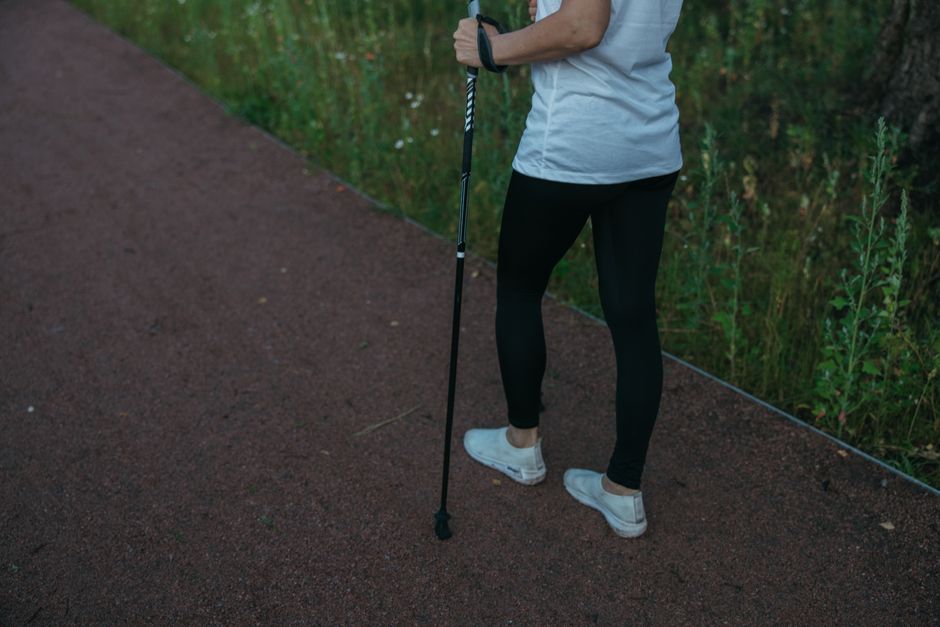
Walking with a stick can steady your steps and take pressure off a sore leg or joint. But using one the wrong way can throw off your balance or strain your wrist and shoulder. The key is to hold the stick in the hand opposite to the side that needs support, and to move the stick at the same time as the weaker leg. This guide walks you through the steps, from choosing the right height to walking on stairs and uneven ground.
Why Do You Hold The Walking Stick On The Opposite Side?
Your body naturally crosses its movements when you walk. Your right arm swings forward with your left leg. This is called a reciprocal gait pattern.
Holding the stick on the opposite side of the weak leg mimics this natural motion. It lets the stick and the weak leg share the load while your strong leg carries your weight. This keeps your hips and spine aligned and reduces the stress on the weaker side.
Holding the stick on the same side as the weak leg is a common error. It forces your body to lean sideways and places uneven strain on your lower back and hip. For most people, the opposite-side method is safer and more stable.
Step 1: Set The Correct Stick Height
The wrong height is the most common reason people struggle with a walking stick. An incorrect height causes backache, shoulder strain, or a bent-over posture.
Stand in your normal walking shoes with your arms relaxed at your sides. The top of the stick should line up with the crease of your wrist. This position allows your elbow to bend at about 15 to 20 degrees when you grip the handle. This slight bend gives you the best leverage and control.
If you are buying a stick online, measure the distance from the floor to your wrist crease while standing. Most adjustable sticks can be set to this length. A stick that is too tall forces your shoulder upward. A stick that is too short makes you hunch forward.
Step 2: Grip The Handle Correctly
Place your hand through the strap if your stick has one. Rest the strap over the back of your hand and wrist, not in your palm. This lets the strap take some of the weight so your grip can stay relaxed.
Wrap your fingers around the handle with your thumb pointing forward. Keep your wrist straight. A bent wrist puts extra pressure on the carpal tunnel and can cause hand pain over time.
Your grip should feel firm but not tight. A death grip tenses the muscles in your forearm and shoulder. If you notice your knuckles turning white, relax your hand.



Step 3: Position The Stick Before You Move
Stand tall with your weight evenly on both feet. Place the stick tip slightly to the side and a small step ahead of your weak leg. The tip should be about the width of your foot away from your body.
This starting position gives you a stable tripod base. Your two feet and the stick tip form three points of contact with the ground. This triangle of support is what keeps you balanced.
Step 4: The Walking Sequence
Move the stick and your weak leg at the same time. Step forward with the weak leg while the stick touches the ground beside it. Push down on the stick to take weight off that leg as you move it forward.
Then bring your strong leg forward past the stick. Your strong leg carries your full weight briefly while the stick and weak leg prepare for the next step.
The rhythm is simple: stick and weak leg together, then strong leg. Repeat this pattern at a comfortable pace. Do not rush. A slow, steady rhythm is safer than a fast, uneven one.
Step 5: Turning Around Safely
Turning quickly is a leading cause of falls for walking stick users. Never pivot on one foot while holding the stick. This twists your body and can easily throw you off balance.
Instead, take small steps to turn. Move your feet one at a time in the direction you want to go. Keep the stick planted on the ground for support while you reposition each foot. Take as many small steps as you need to complete the turn.
Give yourself extra space in tight areas. Move chairs and obstacles out of your path before you attempt to turn in a crowded room.
Step 6: Sitting Down And Standing Up
To sit down, back up until you feel the chair against the back of your legs. Reach behind you and place one hand on the armrest or seat. Keep the stick in your other hand or set it aside within reach.
Lower yourself slowly, keeping your weak leg extended slightly forward. Use your arms and your strong leg to control the descent. Do not drop heavily into the chair.
To stand up, slide forward to the edge of the seat. Place both feet flat on the floor. Push up with your arms and your strong leg. Once you are standing and steady, pick up the stick and position it before you take your first step.
How To Use A Walking Stick On Stairs Step By Step Technique
Stairs are the most dangerous part of using a walking stick. The rule to remember is: up with the good, down with the bad.
Going up stairs: Lead with your strong leg. Step up with the strong leg first. Then bring the stick and the weak leg up to the same step. Use the stick for support as you lift the weak leg.
Going down stairs: Lead with the stick and the weak leg. Place the stick one step down. Follow with the weak leg onto the same step. Then bring the strong leg down to join it.
This pattern keeps your strong leg supporting you on the way up and controlling your descent on the way down. Always use the handrail if one is available. Hold the rail with one hand and the stick in the other. If you must choose, the handrail offers more stability than the stick.
If the stairs have no handrail, take extra care. Move slowly and ensure the stick tip is fully planted before shifting your weight.
Walking On Uneven Ground And Slopes
Grass, gravel, and dirt paths are harder to navigate than smooth floors. The stick tip can sink into soft ground or slide on loose stones.
Take shorter steps on uneven surfaces. Look ahead and plan your path around obvious obstacles. A stick with a wider base or a snow basket attachment provides more stability on soft ground.
When walking uphill, lean slightly forward and take shorter steps. When walking downhill, keep your weight centered and bend your knees a little more than usual. This lowers your center of gravity and improves your balance.
Common Mistakes And How To Avoid Them
Walking too fast is a frequent error. The stick slows you down for a reason. Match your step length to the stick placement, not the other way around.
Looking down at your feet is another common mistake. This throws off your posture and makes the stick less effective. Look ahead at the path about 10 to 15 feet in front of you. Use your peripheral vision to guide your foot placement.
Wearing improper footwear undermines everything the stick does. Non-slip soles with good tread are essential. Slippers, loose shoes, or worn-out soles increase your fall risk even with a stick.
Some people stop using the stick too early. If you still feel pain or instability when walking without it, keep using it. A few extra weeks of support is safer than a fall that sets your recovery back.
When To See A Physical Therapist
A physical therapist can evaluate your walking pattern and adjust your technique. This is especially valuable if you feel unsteady, experience new pain, or have a complex condition like a recent hip replacement or neurological issue.
Therapy can also strengthen the muscles you need for walking. Stronger leg and core muscles reduce your reliance on the stick over time. Some people need only one or two sessions to correct their form.
If you notice new shoulder, wrist, or back pain after starting to use a stick, have your technique checked. Pain in these areas often means the stick height is wrong or you are using the wrong side.
Frequently Asked Questions
Which hand should hold the walking stick?
Hold the stick in the hand opposite to the weak or injured leg. This keeps your body aligned and provides the most stable support.
How do I know if my walking stick is the right height?
Stand with your arms relaxed at your sides. The top of the stick should reach the crease of your wrist, and your elbow should bend about 15 to 20 degrees when you grip the handle.
Can a walking stick cause more harm than good?
Yes, if the height is wrong or you hold it on the wrong side, it can strain your shoulder, wrist, or back. Using a stick incorrectly can also increase your fall risk.
Should I use a walking stick on stairs?
Yes, but use the handrail whenever possible. Going up, lead with your strong leg. Going down, lead with the stick and your weak leg.
