
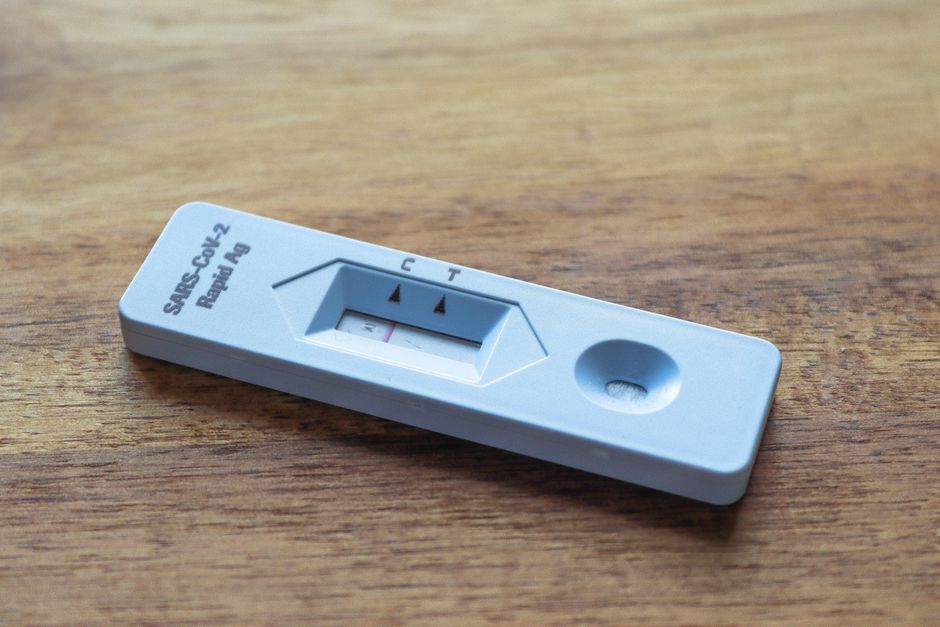
Using a Covid test kit correctly comes down to a few simple steps: wash your hands, swab both your throat and nostrils (or just nostrils, depending on the kit), mix the swab in the buffer solution, and drop the exact number of drops onto the test strip. Then you wait the specific time listed in the instructions — usually 15 minutes — and read the result. A single line at the control position means negative. Two lines, even if the test line is faint, means positive. The instructions that came with your specific kit are the final authority, because brands differ slightly.
What Is In A Covid Test Kit And How Does It Work?
Most at-home Covid tests are rapid antigen tests. They detect proteins from the virus, not the virus itself. The kit contains a small test cassette, a buffer solution, a swab, and sometimes a tube for mixing.
When you mix your swab sample with the buffer and drop it on the test strip, the liquid travels up the strip. If viral proteins are present, they bind to antibodies on the strip and create a visible line. The control line always appears if the test worked properly. It shows the liquid moved through the strip correctly.
These tests are less sensitive than PCR tests, which detect the virus’s genetic material. Antigen tests work best when you have symptoms or when you are in the early days of an infection, when viral load is highest.
How To Use A Covid Test Kit And Read The Results Correctly
Start by washing your hands with soap and water for at least 20 seconds. Lay out all the kit components on a clean surface. Check the expiration date before you open anything. An expired test may give a false result.
Open the swab package carefully. Do not touch the soft tip of the swab with your fingers. Tilt your head back slightly and insert the swab into your nostril. The instructions will tell you how far to insert it — usually about half an inch to an inch. Rotate the swab for about 10 to 15 seconds in each nostril. Some kits direct you to swab the back of your throat first. Follow your kit’s specific instructions.
Place the swab tip into the buffer tube and swirl it for the time stated in the instructions, usually about 10 seconds. Squeeze the tube as you remove the swab to get as much liquid out as possible. Then put the cap on the tube and squeeze the exact number of drops the instructions specify — typically 3 to 4 drops — onto the sample well of the test cassette.
Set a timer. Do not guess at the time. Read the result at the exact time the instructions say, usually 15 minutes. Reading too early can show a false negative. Reading too late can show a false positive because the strip can develop a faint line as it dries.
What Do The Lines On The Test Mean?
Look at the test cassette in good light. There are two possible line positions: the control line (C) and the test line (T).
One line at C only: This is a negative result. No viral proteins were detected. If you have symptoms and test negative, it is possible the test was done too early or the viral load was too low to detect.
Two lines, one at C and one at T: This is a positive result, even if the T line is very faint. A faint line is not a weak positive. It means viral proteins were present in your sample. You should treat this as an active infection and follow current isolation guidance.
No line at C: This is an invalid result, regardless of whether a T line appears. The test did not work correctly. This can happen if you did not add enough drops, if the buffer was contaminated, or if the test was defective. Run a new test with a fresh kit.
Some tests use colored lines, and some use digital displays. The principle is the same: the control must appear for the result to mean anything.


When Should You Take A Covid Test?
Timing matters for accurate results. If you have symptoms, test as soon as possible after symptoms start. Antigen tests are most reliable in the first 5 to 7 days of symptoms, when viral load is highest.
If you were exposed to someone with Covid but have no symptoms, wait at least 3 to 5 days after exposure before testing. Testing immediately after exposure often gives a false negative because the virus has not replicated enough to be detected.
If you test negative but still have symptoms, consider testing again 24 to 48 hours later. Some people test negative on day one of symptoms and positive on day two or three. A single negative test is not a guarantee you are not infected.
How Accurate Are At-Home Covid Tests?
Rapid antigen tests are reasonably accurate when used correctly and at the right time. They are more likely to give a false negative than a false positive. This means a positive result is highly reliable, but a negative result does not completely rule out infection.
Research consistently shows that antigen tests detect the majority of infections in people with symptoms, especially when viral load is high. Sensitivity is lower in people without symptoms and in early infection before the virus has multiplied significantly.
False positives are uncommon but possible. If you get a positive result but have no symptoms and no known exposure, you may want to confirm with a second test or a PCR test. This is especially important if you are about to visit someone at high risk for severe illness.
Common Mistakes That Ruin Test Results
Many people get invalid or inaccurate results because of small errors. The most common mistake is not swabbing correctly. The swab needs enough contact with the nasal lining to collect a good sample. A quick, shallow swipe often misses the virus.
Another common error is using the wrong number of drops. Too few drops and the liquid may not travel up the strip. Too many drops can flood the test and produce unclear results. Always use the exact number stated in the instructions.
Reading the test too early or too late is also a frequent problem. A test read at 5 minutes may not show a positive line yet. A test read at 30 minutes may show a faint line that appeared as the strip dried, which is not a true positive.
Storing tests improperly can also cause problems. Kits should be kept at room temperature, away from heat and moisture. Do not use a test that has been frozen or left in a hot car.
What To Do With Your Results
If you test positive, isolate from others in your household as much as possible. Wear a mask if you must be around other people. Follow current public health guidance for isolation duration, which may vary depending on your symptoms and vaccination status.
If you test negative but have symptoms, assume you may still be infectious. Stay home and away from others until your symptoms improve. Consider retesting in a day or two.
If you test positive and are at higher risk for severe illness — because of age, pregnancy, or underlying medical conditions — contact your healthcare provider. They can discuss whether antiviral treatment is appropriate for you. Antiviral medications work best when started early, usually within 5 days of symptom onset.
If you have difficulty breathing, persistent chest pain, confusion, or bluish lips or face, seek emergency medical care immediately. These are signs of severe illness that require urgent attention.
Frequently Asked Questions
Can I use an expired Covid test kit?
No, you should not use an expired test kit. The chemicals on the test strip degrade over time, which can cause false results.
Is a faint line on a Covid test still positive?
Yes, a faint line at the T position is still a positive result. The line’s intensity does not indicate how sick you are.
How long should I wait to read a Covid test result?
Wait the exact time stated in your kit’s instructions, usually 15 minutes. Reading earlier or later can produce an inaccurate result.
Should I swab my throat or nose for a Covid test?
Follow the instructions that came with your kit. Some tests direct you to swab both throat and nostrils, while others only require nasal swabbing.
