
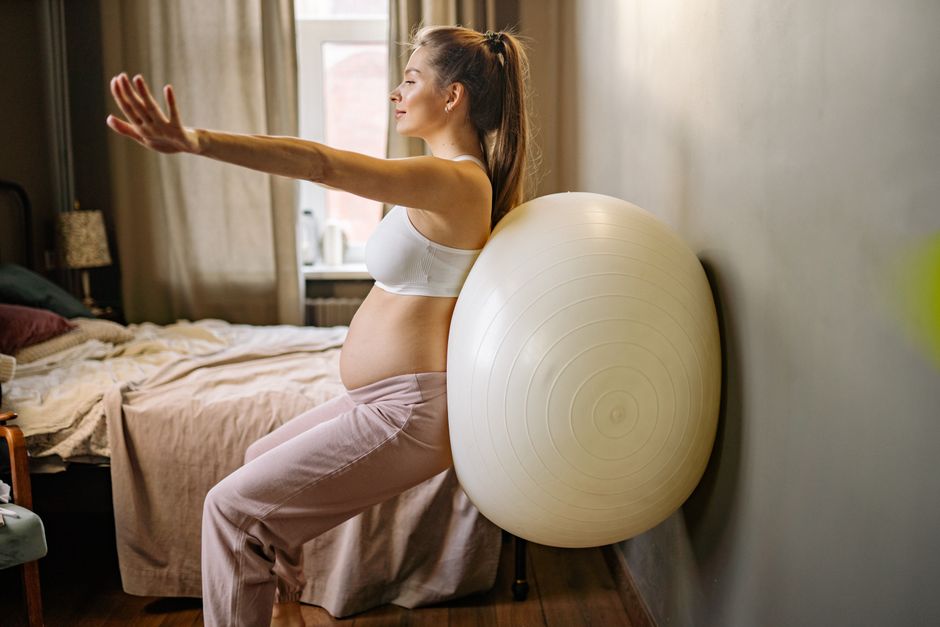
A birthing ball is a large, inflatable exercise ball used during pregnancy and labor to support movement, positioning, and comfort. To use one, you sit on it with your feet flat on the floor and your knees at or slightly below hip level, then gently rock, bounce, or circle your hips. The ball lets your pelvis move more freely than a chair does, which many people find eases back pressure and helps the baby settle into a good position for birth.
What Is a Birthing Ball and Why Do People Use One?
A birthing ball is the same object as a standard exercise ball, often called a Swiss ball or stability ball. It is large, round, and slightly squishy when inflated. The name changes with the setting. In a gym, it is fitness equipment. In a birthing room, it is a tool for comfort and positioning.
The reason it works comes down to how your body is built. When you sit on a firm chair, your pelvis is locked in one position. On a ball, your pelvis can tilt, rotate, and shift. Those small movements engage your core muscles and change the angle of your pelvis. For many pregnant people, that change in angle takes pressure off the lower back and hips.
There is also a positioning benefit. Certain pelvic positions may give the baby more room to rotate and descend. This is the same principle behind leaning forward, kneeling, and other upright labor positions. The evidence that any single position shortens labor is limited. What is better supported is that staying upright and mobile tends to be more comfortable than lying flat on your back, and comfort matters during a long labor.
How Do You Choose the Right Size Birthing Ball?
Size matters more than most people expect. A ball that is too small puts your knees above your hips, which can increase pressure in the wrong places. A ball that is too large may not let your feet reach the floor properly.
The general guide is based on your height:
- Under 5’0″ to 5’4″: a 55 cm ball often fits
- 5’5″ to 5’11”: a 65 cm ball is the common choice
- 6’0″ and taller: a 75 cm ball may work best
These are general ranges, not strict rules. Your leg length and torso length matter too. The real test is simple: sit on the ball. Your hips should be level with or slightly higher than your knees. Your feet should rest flat on the floor. If your knees sit above your hips, the ball is too small. If your feet dangle or barely touch, it is too big.
Look for a ball rated as anti-burst. That means if it is punctured, it deflates slowly instead of popping. This matters during labor when you may be leaning your full weight on it. Check the weight rating too, since some balls support less than others.
How To Use a Birthing Ball During Pregnancy
During pregnancy, the ball is mostly a comfort and posture tool. You can use it in place of a chair for short periods while you work, watch TV, or rest. The gentle movement keeps your hips mobile and can ease the stiffness that builds up from sitting still.
A few simple ways to use it:
- Gentle bouncing: small up-and-down movements that relax the pelvic floor
- Hip circles: slow circles in both directions to loosen the lower back
- Side-to-side swaying: shifts weight from one hip to the other
- Leaning forward: rest your arms or chest on the ball while kneeling, which takes weight off your spine
Keep movements slow and steady. If anything causes pain, dizziness, or shortness of breath, stop. During pregnancy, the hormone relaxin loosens your joints, so your balance is not what it usually is. Sit near a wall or a sturdy surface the first few times until you feel stable.
One thing worth knowing: sitting on a ball for hours is not better than sitting in a chair. The ball is a tool for movement, not a replacement for a supportive seat. Use it in stretches, not all day.




How To Use a Birthing Ball During Labor
During labor, the ball becomes a positioning tool. Upright positions use gravity to your advantage and can make contractions feel more manageable for some people. The ball lets you stay upright while still having something to sit on.
Common ways to use it in labor:
- Sitting and rocking: sit on the ball and rock your hips forward and back with each contraction
- Circling your hips: slow circles can help you cope with the pressure
- Leaning over the ball: kneel and drape your upper body over the ball, which many people find relieves back labor
- Partner support: your partner can steady the ball or apply counter-pressure to your lower back while you sit
There is no rule that says you must use the ball for the whole labor. Use it when it helps and switch to something else when it stops helping. Labor changes hour by hour, and the position that feels right at 3 centimeters may feel wrong at 7. Follow your body.
If you have an epidural, ask your care team before using the ball. Many hospitals allow sitting on a ball with an epidural under supervision, but policies vary. You should not get on or off the ball by yourself with an epidural, because your legs may be numb or weak and you could fall. Staff assistance is needed.
Is a Birthing Ball Proven to Help Labor?
The evidence here is mixed, and it is worth being honest about that. Some studies suggest that using a birthing ball during labor may reduce pain and increase satisfaction with the birth experience. Other studies find little or no difference in labor length or pain scores.
What the research generally does support is that upright and mobile positions are safe and often more comfortable than lying on your back. The ball is one way to stay upright. It is not a treatment that guarantees a faster or easier labor, and no study has shown that it prevents complications or changes medical outcomes on its own.
Think of it as a comfort tool, not a medical intervention. If it helps you cope, that is a real benefit. If it does not, there is no harm in setting it aside.
What Safety Points Should You Keep in Mind?
A birthing ball is low risk when used sensibly, but a few safety points matter.
- Balance: always have something sturdy within reach, especially late in pregnancy
- Falls: get on and off slowly, and use support if your balance is off
- Epidural: do not use a ball without staff help if you have one
- Inflation: do not overinflate, since a firm ball is harder to sit on and more likely to roll
- Inspection: check for punctures or wear before each use
If you have any condition that affects your balance, blood pressure, or joints, talk to your healthcare provider before using a ball. This is especially true if you have been told to limit activity during pregnancy. No clinical guidelines exist for using a birthing ball with certain high-risk pregnancies, so individual medical advice is the right source here.
Can You Use a Birthing Ball After Birth?
Yes, and many people find it useful during recovery. Sitting on a ball can be gentler on healing tissue than a hard chair, and the gentle movement may help with circulation. If you had a cesarean birth or perineal stitches, ask your provider when it is safe to sit on a ball, since the answer depends on your recovery.
The ball is also a common tool for gentle core and pelvic floor exercises once you are cleared for activity. As always, follow your provider’s guidance on what is safe and when.
Frequently Asked Questions
What size birthing ball should I get?
Most people between 5’5″ and 5’11” do well with a 65 cm ball, while shorter people often use 55 cm and taller people use 75 cm. The real test is that your hips sit level with or slightly above your knees when you sit on it.
Can you use a birthing ball with an epidural?
Many hospitals allow it with staff supervision, but policies vary and you should never get on or off the ball by yourself with an epidural. Ask your care team first.
How long can you sit on a birthing ball while pregnant?
There is no set time limit, but it works best in short stretches rather than all day. Use it for movement and comfort, and switch to a supportive chair when you need back support.
Does a birthing ball actually help labor?
Some studies suggest it may reduce pain and improve satisfaction, but results vary and it is not proven to shorten labor or change medical outcomes. It is best viewed as a comfort tool.
