
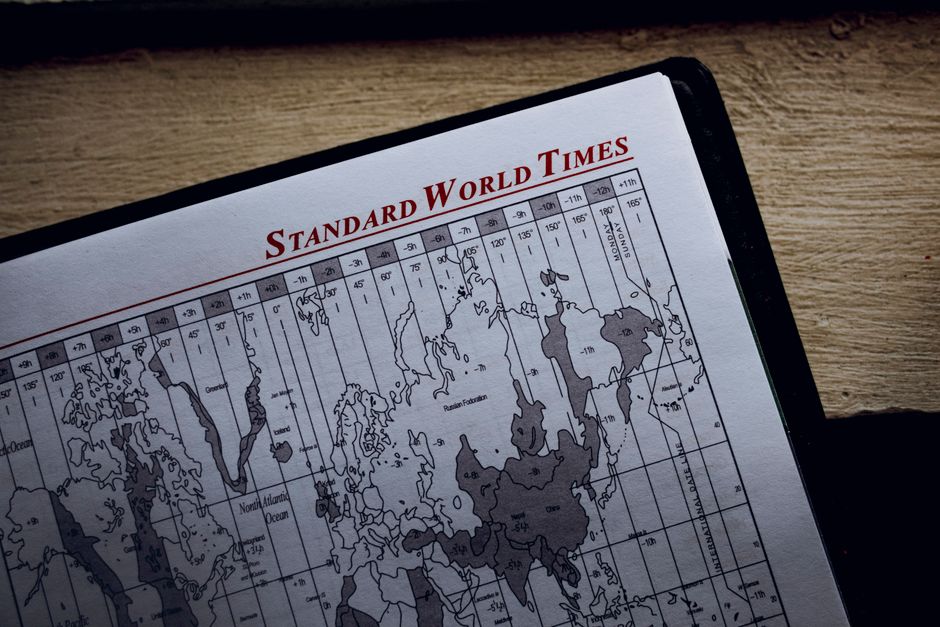
Time zones exist because the Earth rotates, and different parts of the planet face the sun at different times. When it is midday in London, it is early morning in New York and late evening in Tokyo. To keep clocks consistent with daylight in each region, the world is divided into roughly 24 zones, each about 15 degrees of longitude wide. This system lets people set their clocks so that noon generally aligns with the sun being highest in the sky.
Why Does the Earth Have Time Zones at All?
Before time zones, cities set their clocks by the sun. When it was directly overhead, it was noon. That worked locally, but it became a problem when trains and telegraphs connected distant cities. A train schedule could not work if every station had a different time based on its own longitude.
In 1884, delegates from 25 countries met in Washington, D.C., at the International Meridian Conference. They agreed to divide the globe into 24 time zones, each one hour apart. They also chose the Prime Meridian, which runs through Greenwich, England, as the starting point. That is why you see “GMT” or “UTC” on clocks and schedules.
What Is UTC and How Is It Different From GMT?
UTC stands for Coordinated Universal Time. It is the global standard that all time zones are measured against. You can think of it as the “zero point.” Every time zone in the world is described as UTC plus or minus a number of hours.
GMT, or Greenwich Mean Time, is the solar time at the Prime Meridian. For most practical purposes, UTC and GMT are the same. The technical difference is that UTC is based on atomic clocks, while GMT was historically based on the position of the sun. In everyday life, people use the terms interchangeably.
How Do Time Zone Offsets Work?
Every location on Earth is assigned an offset from UTC. For example, New York is UTC-5 during standard time. That means when it is 12:00 UTC, it is 7:00 AM in New York. Tokyo is UTC+9, so when it is 12:00 UTC, it is 9:00 PM in Tokyo.
To figure out the time difference between two places, you subtract their offsets. If one city is UTC+2 and another is UTC-5, the difference is 7 hours. This is the core math behind time zone conversion. Once you know the offsets, you can calculate any time difference in the world.





Why Are Some Time Zones Not Exactly One Hour Apart?
Not every time zone follows the neat 15-degree rule. Some countries use half-hour or even 45-minute offsets. India, for example, is UTC+5:30. Nepal is UTC+5:45. These unusual offsets exist because some nations chose a time that better matches the sun’s position across their land, or because of political decisions made decades ago.
China is a notable example. The country is geographically wide enough to span five solar time zones, but the entire nation uses a single time zone, UTC+8. This means people in western China experience sunrise much later than people in the east. The decision was made for national unity in 1949, and it remains in effect today.
What Is Daylight Saving Time and Why Does It Complicate Things?
Daylight saving time, or DST, is the practice of setting clocks forward by one hour during warmer months. The idea is to extend evening daylight and reduce energy use. Clocks spring forward in spring and fall back in autumn.
DST is not observed everywhere. The United States, Canada, and most of Europe use it. Japan, India, and most of Africa do not. Even within the United States, Arizona and Hawaii do not observe DST. This creates seasonal shifts in time zone offsets that can be confusing when scheduling international calls or travel.
When DST is active, a city that is normally UTC-5 becomes UTC-4. You must know whether each location is currently observing DST to calculate the correct time difference. Many online tools handle this automatically, but understanding the mechanism helps when you need to do the math yourself.
How Do You Read a Time Zone Map?
A time zone map shows the world divided into colored bands. Each band represents a specific offset from UTC. The lines between zones are not straight because they follow political borders and natural geography. For instance, the line between Eastern and Central time in the United States zigzags to keep cities and counties together.
When you look at a map, find the location you are interested in and note its color or label. The label usually shows the offset, like UTC+1 or UTC-8. Then compare that to the offset of your own location. The difference between the two offsets is the time difference.
How To Understand Time Zones Explained Simply: The Practical Method
The simplest way to understand time zones is to memorize a few key reference points and then calculate from there. If you know that London is UTC+0, New York is UTC-5, and Tokyo is UTC+9, you can estimate most other times by comparing them to these anchors.
For a quick mental calculation, remember that moving east adds hours and moving west subtracts them. If it is 3:00 PM in New York and you want to know the time in London, add 5 hours to get 8:00 PM. If you want the time in Tokyo, add 14 hours to get 5:00 AM the next day.
For frequent conversions, use a world clock app or a website that handles DST automatically. These tools are reliable and remove the risk of arithmetic errors. But knowing the logic behind the numbers means you can always verify what the tool tells you.
Why Do Some Countries Have Multiple Time Zones?
Large countries that span many degrees of longitude naturally need multiple time zones. The United States has six time zones, including Alaska and Hawaii. Russia has eleven. Canada has six. Australia has three.
Having multiple time zones in one country can create logistical challenges. A business meeting between New York and Los Angeles requires coordinating a three-hour difference. Television networks must decide whether to broadcast live events at the same moment nationwide or delay them for each time zone. These are practical realities of living in a geographically large nation.
Common Mistakes People Make With Time Zones
The most common mistake is forgetting about DST. People calculate a time difference correctly in January, then use the same offset in July, and end up an hour off. Always check whether DST is currently active in both locations.
Another mistake is assuming that the date line is a straight line. The International Date Line, located roughly at 180 degrees longitude, bends to avoid splitting island nations. When you cross it going west, you add a day. Going east, you subtract a day. This is why a flight from the United States to Asia can arrive “later” than it departed, even though the flight took many hours.
A third mistake is confusing the offset with the actual time. Saying “New York is UTC-5” is correct, but it does not tell you what time it is there. You still need to know the current UTC time to calculate the local time.
Frequently Asked Questions
Why are time zones 15 degrees apart?
The Earth rotates 360 degrees in 24 hours, which works out to 15 degrees per hour. Dividing the globe into 24 zones of 15 degrees each creates one zone for every hour of the day.
What is the difference between UTC and GMT?
UTC is the atomic-clock-based global standard, while GMT is the solar time at the Prime Meridian. For everyday purposes, they are treated as the same.
Do all countries observe daylight saving time?
No. Many countries, including Japan, India, and most of Africa, do not use DST. Even within countries that do use it, some regions opt out.
How do I calculate time difference quickly?
Find the UTC offset for both locations, subtract one from the other, and adjust for DST if it is active. The result is the time difference in hours.
