
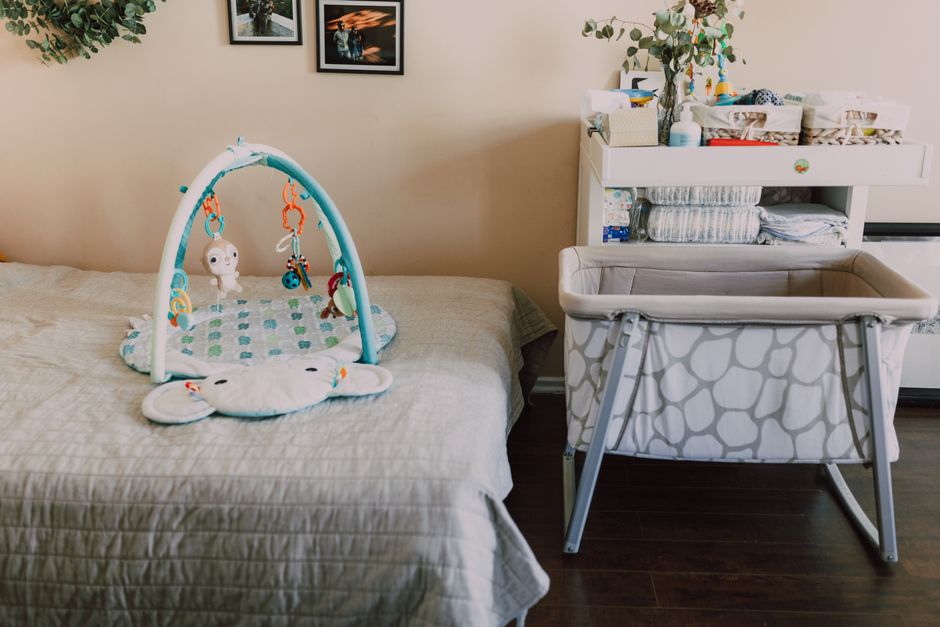
Moving a baby from a bassinet to a crib is a normal developmental step, and it usually goes more smoothly when you do it in stages rather than all at once. The most common approach is to start with naps in the crib, keep the same bedtime routine, and place the crib in the same room as the bassinet at first if space allows. Most families make the full switch somewhere between 3 and 6 months, though the right timing depends on your baby’s size and development, not just the calendar.
Why Do Babies Need to Move Out of a Bassinet?
Bassinets are designed for newborns. They are small, shallow, and easy to reach into during the night feedings that dominate the first weeks.
The problem is that babies grow. Most bassinet manufacturers set a weight limit, often around 15 to 20 pounds, and many also include a length or developmental limit. Once a baby can roll over, push up on their hands, or sit, a bassinet is no longer safe. Those limits exist because a baby who can move independently can press against the sides, tip the bassinet, or roll into a position that blocks breathing.
You should stop using a bassinet as soon as your baby reaches the manufacturer’s weight limit, shows signs of rolling, or can push up. That is not a judgment call. It is a safety line.
Cribs are built to a different standard. They are deeper, sturdier, and designed to hold a growing baby who moves around during sleep. The transition is not about preference. It is about matching the sleep surface to what your baby can now physically do.
When Is the Right Time to Make the Switch?
There is no single correct age. The switch is driven by three factors: weight, mobility, and your baby’s sleep patterns.
Weight is the clearest marker. Check your bassinet’s manual for the exact limit. Many are rated up to 15 pounds, though some go higher. Once your baby approaches that number, start planning the move.
Mobility matters just as much. A baby who has learned to roll should not stay in a bassinet, even if they are under the weight limit. Rolling changes everything about how a baby interacts with the sides of a small sleep space.
Some parents move their baby earlier for other reasons. A baby who has outgrown the bassinet’s length, who wakes frequently when they touch the sides, or who seems to sleep better in a larger space may do well with an earlier transition. Others wait until the bassinet is genuinely too small.
Talk to your pediatrician if your baby was born prematurely or has any health conditions that affect sleep or breathing. In those cases, the timing may need individual guidance.
How To Transition Your Baby From Bassinet To Crib Step by Step
The transition works best when you change one thing at a time. Here is a practical sequence that many families find manageable.
- Start with naps. Put your baby in the crib for daytime sleep first. Naps are shorter, and if a nap goes poorly, you can try again the next day without disrupting the whole night.
- Keep the routine identical. Use the same sleep sack, the same white noise, the same dim light, and the same order of steps you used with the bassinet. Familiarity signals safety to a baby.
- Place the crib in the same room at first if you can. If your room has space for the crib, set it up where the bassinet was. Your baby wakes in the same room with the same sounds and smells.
- Move to nights once naps are going well. After several days of decent crib naps, try the first part of the night in the crib. If your baby wakes and struggles, you can respond as you normally would.
- Give it time. Most babies adjust within a week or two, but some take longer. A few rough nights are normal and do not mean the transition failed.
If your baby is used to being placed in a bassinet right next to your bed, the distance can feel like a big change. Some parents find it helps to sit nearby for the first few nights, then gradually move back toward the door.





What If Your Baby Fights the Crib?
Resistance is common and usually temporary. A baby who slept well in a bassinet may protest the crib simply because it is unfamiliar.
One thing that helps is to make the crib feel less empty. A fitted sheet that smells like home, a dim room, and consistent timing all reduce the sense of strangeness. Do not add pillows, blankets, bumper pads, or stuffed animals to make the crib cozier. Those items increase the risk of suffocation and are not safe for sleep, regardless of how the crib looks.
If your baby wakes more often in the crib, check the basics first. Is the room too warm or too cold? Is the sleep sack the right size? Is the crib mattress firm and flat, with a tightly fitted sheet? Sometimes the issue is not the crib at all but a small change in the sleep environment.
Some babies go through a developmental phase around the same time as the transition. Rolling, teething, and growth spurts can all disrupt sleep. If your baby was already sleeping poorly before the move, the crib may not be the cause.
How Do You Handle Night Waking After the Switch?
Night waking does not necessarily mean the transition is going badly. Babies wake at night for many reasons, and a new sleep space is only one of them.
Respond the way you normally would. If you fed or rocked your baby back to sleep before, you can keep doing that. The goal is not to change everything at once. It is to move the sleep location while keeping the rest of your approach familiar.
Some parents find that night waking increases for a few nights and then settles. Others notice no change at all. Both are normal.
If your baby is waking because they have learned to roll and get stuck, give them time to practice rolling during the day. Babies who can roll both ways usually settle more easily at night once the skill is familiar.
What About Room Sharing and Safe Sleep?
Health organizations recommend that babies sleep in the same room as a parent for the first several months, ideally for the first year. Room sharing is associated with a lower risk of sleep-related deaths, though the reasons are not fully understood.
That recommendation does not require a bassinet. A crib or a portable crib placed in your room meets the same goal. So moving from bassinet to crib does not mean moving your baby to a separate room. You can keep the crib next to your bed for as long as you and your baby are comfortable with it.
Wherever the crib is, follow the same safe sleep basics you used with the bassinet:
- Place your baby on their back for every sleep.
- Use a firm, flat sleep surface with a tightly fitted sheet.
- Keep the crib free of blankets, pillows, bumper pads, and toys.
- Avoid letting your baby sleep in a car seat, swing, or bouncer for extended periods.
If you are unsure whether your crib meets current safety standards, check the manufacturer’s label. Cribs made before 2011 may not meet the current federal safety rules, and drop-side cribs are no longer considered safe.
How Long Does the Transition Usually Take?
There is no fixed timeline. Some babies adapt within a few nights. Others take a couple of weeks. A small number seem to resist for longer, especially if the change lines up with teething, illness, or a growth spurt.
The most useful thing you can do is stay consistent. If you try the crib for one night and then go back to the bassinet, the process often takes longer. If you keep the routine steady and give your baby repeated chances to get used to the new space, most will settle.
If weeks pass and your baby is still sleeping worse than before, or if you are worried about their breathing, weight, or development, talk to your pediatrician. There may be something else going on that is worth checking.
Frequently Asked Questions
What age should a baby move from bassinet to crib?
Most babies move between 3 and 6 months, but the right time depends on your bassinet’s weight limit and your baby’s ability to roll. Stop using the bassinet as soon as your baby reaches the limit or can roll, push up, or sit.
Can I put my baby in a crib for naps first?
Yes, starting with naps is one of the most common and effective approaches. Naps are shorter, so a rough nap is easier to recover from than a rough night.
How do I stop my baby from rolling into the sides of the crib?
You do not need to stop the rolling itself, since a crib is designed to keep a rolling baby safe. Keep the crib free of blankets and bumpers, and give your baby daytime practice so the skill feels familiar.
Is it okay to keep the crib in my room?
Yes, room sharing is recommended for the first several months and can continue longer. A crib in your room meets the same goal as a bassinet in your room.
