
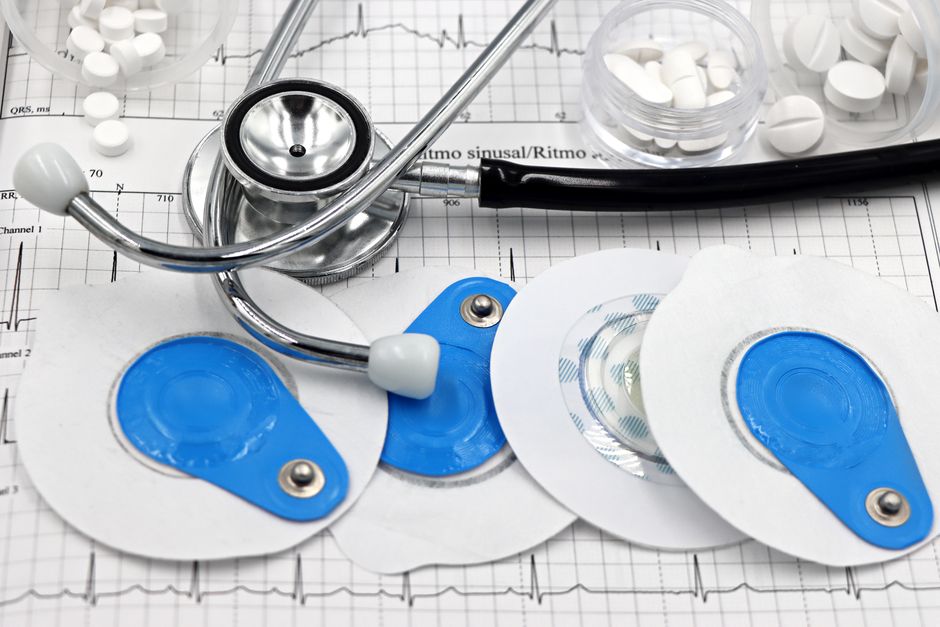
If you feel your heart skip, flutter, or race, the first step is usually an electrocardiogram, or ECG. A standard 12-lead ECG in a clinic or hospital is the most reliable first test for detecting an arrhythmia, but it only records about ten seconds of your heart’s rhythm. Because many arrhythmias come and go, a normal ECG does not rule one out. That is why doctors often move to longer monitoring, from a 24-hour Holter to a wearable device you can buy yourself.
How Does a Standard ECG Test for Arrhythmia?
An ECG records the electrical signals that trigger each heartbeat. Sticky electrodes placed on your chest, arms, and legs pick up those signals, and a machine traces them onto a graph. The pattern of waves tells a clinician how fast your heart is beating, whether the rhythm is regular, and where in the heart each beat begins.
For arrhythmia, the ECG is looking at a few key things. It measures the rate, checks the spacing between beats, and examines the shape of each wave. A normal resting heart rate for adults is generally 60 to 100 beats per minute, though trained athletes are often slower. A rhythm that is too fast, too slow, or irregular can point to a specific type of arrhythmia.
The limitation is time. A standard ECG captures roughly ten seconds. If your arrhythmia is intermittent — which many are — those ten seconds may show a perfectly normal rhythm. This is the single most common reason people are told their heart is fine when they know something is wrong.
Some arrhythmias do show up reliably on a resting ECG. Others, like atrial fibrillation that comes and goes, or brief runs of a fast rhythm, often do not. That gap is what longer monitoring is designed to close.
What Are the Options From Holter Monitors to Event Recorders?
When a standard ECG does not catch the problem, clinicians use monitors that record over a longer stretch of time. The choice depends on how often your symptoms happen.
- Holter monitor: a continuous recorder worn for 24 to 48 hours. Best when symptoms happen most days.
- Event recorder: worn for weeks, it records only when you press a button during symptoms, or automatically when it detects an abnormal rhythm.
- Patch monitor: a small adhesive device worn for up to two weeks. It records continuously and has largely replaced older wired monitors for many patients.
- Implantable loop recorder: a tiny device placed under the skin that can monitor for months to years. Used when symptoms are rare but serious.
The logic is straightforward. The rarer your symptoms, the longer you need to record. A person who feels fluttering several times a day may be diagnosed with a 24-hour Holter. Someone who has one strange episode every few months may need an implantable recorder to catch it.
These devices are prescribed and interpreted by a clinician. They are not the same as consumer wearables, though the two are increasingly compared.
Can a Smartwatch Really Detect an Arrhythmia?
Some consumer wearables can detect certain arrhythmias, and this is one of the more genuinely useful developments in heart monitoring. Many smartwatches and fitness trackers include an ECG feature that records a single-lead tracing when you place a finger on the device. Others use optical sensors to track pulse and flag irregular rhythms.
What these devices can do is real but narrow. The ECG feature on a smartwatch can produce a rhythm strip that a clinician can review. Several studies have found that consumer devices can identify atrial fibrillation reasonably well in people who have it, though the exact accuracy figures vary by device and study. Regulatory clearance for these features exists for detecting signs of atrial fibrillation specifically, not for diagnosing every kind of arrhythmia.
What they cannot do is just as important. A single-lead wearable ECG gives far less information than a 12-lead clinical ECG. It cannot reliably distinguish between different types of arrhythmia. It can miss rhythms it is not designed to catch. And it can flag things that turn out to be nothing.
A clear example of the trade-off: atrial fibrillation detection on a smartwatch often produces a “possible” result rather than a diagnosis. That result is a signal to see a clinician, not a conclusion.



How To Test For Arrhythmia From ECG To Wearables: A Practical Comparison
The table below compares the main tools. Accuracy figures are not listed because they vary widely by device, population, and the specific arrhythmia being detected. Treat any single number as specific to one study, not a universal truth.
| Method | Recording time | What it can detect | Who interprets it |
|---|---|---|---|
| Standard 12-lead ECG | About 10 seconds | Most arrhythmias if present during the recording | Clinician |
| Holter monitor | 24–48 hours | Frequent or daily arrhythmias | Clinician |
| Patch or event monitor | Up to 2 weeks | Less frequent arrhythmias | Clinician |
| Implantable loop recorder | Months to years | Rare but serious arrhythmias | Clinician |
| Consumer wearable ECG | Seconds to minutes, on demand | Signs of atrial fibrillation; some rhythm changes | You, then a clinician |
One clarification worth knowing: a wearable is a screening and documentation tool, not a replacement for clinical testing. If a wearable flags something, the next step is a clinician, not a self-diagnosis.
When Should You Use a Wearable Versus See a Doctor?
If you have symptoms — palpitations, a racing or pounding heart, dizziness, fainting, or chest discomfort — see a clinician. Do not try to manage it with a wearable first. Some arrhythmias are dangerous, and delay matters.
Call emergency services for fainting, chest pain, severe shortness of breath, or a heart rate that feels dangerously fast or slow along with feeling unwell. These are not situations for a smartwatch.
A wearable can be genuinely useful in two situations. One is when a clinician has already asked you to track your rhythm. The other is when you have occasional symptoms and want a record to bring to an appointment. A saved tracing can help a doctor decide what testing to order.
What a wearable should not do is give you false reassurance. If you have symptoms and your watch says your rhythm is normal, that does not mean nothing is wrong. The device may simply have recorded at the wrong moment.
What Do the Results Actually Mean?
An arrhythmia is a disturbance in the heart’s normal rhythm. There are many types, and they range from harmless to life-threatening. That range is why interpretation matters so much.
Some findings are common and generally not dangerous. Occasional extra beats, called premature beats, are very common and often need no treatment in a healthy heart. Others, like atrial fibrillation, raise the risk of stroke and usually need medical management. Still others, like certain sustained fast rhythms, can be emergencies.
A diagnosis is not something a device produces on its own. A clinician reads the tracing in the context of your symptoms, your history, and your overall heart health. The same rhythm strip can mean different things in different people.
This is the honest bottom line on testing. The tools have improved, and consumer wearables have made it easier to catch intermittent rhythms. But the interpretation still belongs to a clinician, and no wearable replaces a proper evaluation when something feels wrong.
Frequently Asked Questions
Can a smartwatch diagnose an arrhythmia?
No, a smartwatch cannot diagnose an arrhythmia. It can detect signs of atrial fibrillation and produce a rhythm strip for a clinician to review, but diagnosis requires clinical interpretation.
What is the most accurate test for arrhythmia?
A standard 12-lead ECG is the most reliable first test, but it only records about ten seconds. If your arrhythmia is intermittent, longer monitoring such as a Holter or patch monitor is more likely to catch it.
Can an arrhythmia be missed on an ECG?
Yes, an intermittent arrhythmia can easily be missed on a standard ECG. A normal ten-second recording does not rule out an arrhythmia that comes and goes.
Should I go to the ER for heart palpitations?
Go to the emergency room if palpitations come with fainting, chest pain, or severe shortness of breath. For palpitations alone without those symptoms, contact a clinician soon for evaluation.
