
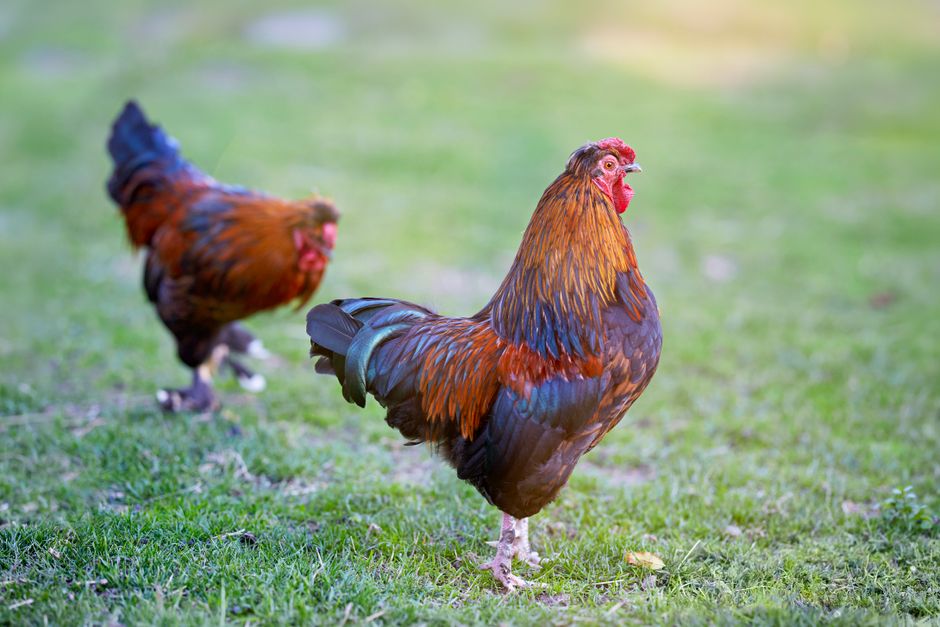
Telling a rooster’s age isn’t an exact science, but you can get a reliable estimate by looking at three physical features: the spurs, the comb, and the wattles. Spurs grow and change shape over time, the comb and wattles develop color and size as the bird matures, and the overall condition of these features helps narrow down the age range. By combining these signs, you can typically guess a rooster’s age within a few months for young birds and within a year or two for older ones.
How Do Spurs Change As A Rooster Ages?
The spurs are the sharp, bony projections on the inside of a rooster’s legs, just above the feet. They are the single most reliable physical indicator of age.
A day-old chick has a small, smooth bump where the spur will eventually grow. This bump is soft and rounded. By the time the rooster is around 4 to 6 months old, this bump begins to harden and form a distinct, conical point. At this stage, the spur is still relatively short and sharp.
Between 8 and 12 months, the spur continues to lengthen. It becomes more prominent and pointed. By the end of the first year, many roosters have spurs that are roughly half an inch to an inch long.
After the first year, the spur’s growth pattern changes. It stops growing primarily in length and starts growing in thickness at the base. The sharp point may begin to dull. A rooster between 2 and 3 years old typically has spurs that are thicker, slightly curved, and noticeably less needle-sharp than a young bird’s spurs.
In roosters older than 3 years, the spurs often become quite thick and blunt. They may curve significantly. The length does not increase much after this point, but the girth does. In very old birds, the spur can become so thick and curved that it resembles a small hook.
What Does The Comb And Wattle Size Tell You?
The comb is the fleshy red crest on top of the head. The wattles are the two fleshy lobes hanging below the beak. Both are secondary sex characteristics driven by testosterone.
In young pullets and cockerels (young roosters), the comb and wattles are pale pink and flat. They do not develop significant size or color until the bird reaches sexual maturity, which typically occurs between 4 and 6 months of age.
When a rooster reaches sexual maturity, his comb and wattles grow rapidly. They become larger, brighter red, and more textured. This change is a clear sign the bird is at least 4 months old.
For the next year or two, the comb and wattles continue to grow slowly. A mature rooster in his prime, around 1 to 2 years old, will have a full, bright red comb and wattles that stand upright and look healthy.
Age-related changes become apparent in older birds. In a rooster over 3 or 4 years old, the comb may start to look less vibrant. It can become paler, develop a slight droop, or show small nicks and scars from fighting. The wattles may also lengthen and wrinkle. These signs indicate an older bird, but they are less precise than spur development.
One important note: comb and wattle color can also fade temporarily due to poor nutrition, stress, or molting. A pale comb does not always mean an old rooster. It can mean an unhealthy or stressed one.
How To Tell The Age Of A Rooster Spurs Comb More: A Practical Timeline
Here is a practical breakdown that combines spur, comb, and wattle observations to estimate age.
- 0 to 2 months: Small bump on the leg. Comb and wattles are pale pink and flat. The bird looks like a large chick.
- 2 to 4 months: Spur bump starts to harden slightly. Comb and wattles begin to develop a slightly deeper pink color and grow a little. The bird is clearly a juvenile.
- 4 to 6 months: Spur becomes a distinct, sharp point. Comb and wattles turn bright red and enlarge quickly. This is the start of sexual maturity.
- 6 to 12 months: Spur grows rapidly in length, reaching up to an inch. Comb and wattles are full, bright red, and firm. This is a young adult rooster.
- 1 to 2 years: Spur is long and sharp but the base begins to thicken. Comb and wattles are at their peak size and color. This is a rooster in his prime.
- 2 to 3 years: Spur base is noticeably thicker. The tip becomes less sharp. Comb may start to lose some vibrancy. This is a mature rooster.
- 3 to 5 years: Spurs are thick, blunt, and may curve. Comb is paler, possibly with a slight droop or nicks. Wattles are longer and wrinkled. This is an older rooster.
- 5+ years: Spurs are very thick and often hooked. Comb and wattles are pale and may look ragged. The rooster moves more slowly. This is a senior bird.
This timeline assumes the rooster is healthy and well-fed. Poor nutrition or illness can slow spur and comb development, making a bird look younger than it is.





Are There Other Physical Signs Of Aging In Roosters?
Spurs, comb, and wattles are the primary indicators, but other physical signs can help confirm your estimate.
Leg scales: Young roosters have smooth, tight scales on their legs. As a bird ages, these scales become larger, rougher, and more raised. In very old birds, the scales may look almost shaggy or crusty. This change is gradual and less precise than spur growth, but it is a useful supporting sign.
Feather condition: A young rooster’s feathers are typically glossy and complete. Older roosters may have missing feathers, especially around the back and tail, from mating and fighting. They may also have duller feather color. This is not a reliable age indicator on its own, since feather loss can happen at any age due to molting or flock dynamics.
Mobility and behavior: Young roosters are energetic and quick. They chase hens frequently and are highly alert. Older roosters, especially those over 4 or 5 years, tend to slow down. They may still breed and patrol their territory, but they are less energetic. They may also spend more time resting. This behavioral change is subtle and varies between individual birds.
Beak condition: With age, a rooster’s beak may show more wear. It can develop small chips or a slightly overgrown appearance. This is a minor sign and not useful for precise age estimation.
No single sign is definitive. The most accurate approach is to evaluate the spurs first, then use the comb, wattles, legs, and behavior to confirm your estimate.
Why Is Knowing A Rooster’s Age Important?
Knowing a rooster’s age matters for several practical reasons, particularly for flock management and breeding decisions.
Fertility is one key reason. Roosters are most fertile and active during their first two to three years. After that, sperm quality and quantity can decline. If you are hatching eggs, a younger rooster is generally a better choice. Some studies indicate that fertility begins to drop after the second year, though individual variation is significant.
Aggression is another consideration. Young roosters, especially those reaching maturity between 6 months and 2 years, are often the most aggressive. They are establishing dominance and may be more likely to challenge humans or other males. Older roosters, after they have established their position, are often calmer but can still be protective.
Health and longevity also factor in. Roosters can live 5 to 8 years, sometimes longer. Knowing the age helps you anticipate when a rooster may become less active or more susceptible to age-related health issues such as arthritis or reproductive problems. It also helps you plan for replacement if you want to maintain a breeding flock.
Finally, if you are purchasing or adopting a rooster, knowing its age helps you avoid being misled. A seller may claim a bird is young when it is actually several years old. Checking the spurs and comb gives you a factual basis for evaluating the bird.
Frequently Asked Questions
How accurate is using spurs to tell a rooster’s age?
Spurs are the most accurate physical indicator, but they are not exact. They give you a reliable range of a few months for young birds and a year or two for older ones, not a precise birth date.
Do rooster spurs keep growing their whole life?
Spurs grow rapidly in the first year, then slow down significantly. After about two years, they grow more in thickness and curvature than in length, and they eventually stop growing altogether.
Can a hen have spurs or a large comb?
Yes, some older hens can develop small spurs and enlarged combs, especially if they have ovarian issues or certain hormone imbalances. This is less common and usually less pronounced than in a rooster.
What is the best age for a rooster to breed hens?
Roosters are typically at peak fertility between 1 and 2 years old. They can breed successfully before and after this window, but fertility and mating activity are generally highest during this period.
