
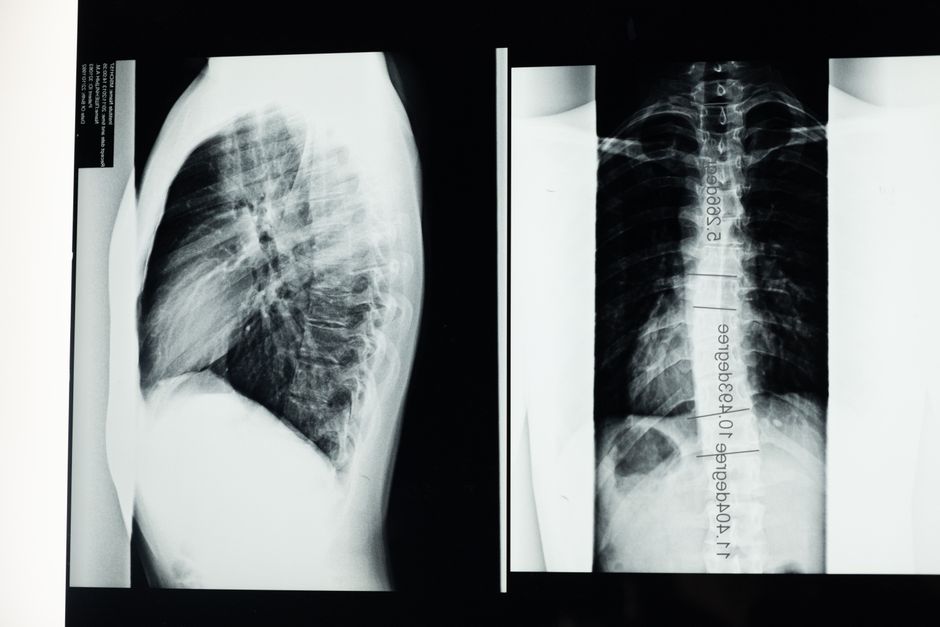
Scoliosis is a sideways curve of the spine that usually develops without pain or obvious warning signs. The most reliable way to tell if you have it is a physical exam by a doctor, often confirmed with an X-ray that measures the curve. At home, you can look for uneven shoulders, one shoulder blade that sticks out more than the other, or a waist that looks asymmetrical. These signs suggest scoliosis, but they cannot confirm it on their own.
How To Tell If You Have Scoliosis: What You Can Check at Home
A home check is a screening tool, not a diagnosis. It can help you decide whether to see a doctor. It cannot measure a curve or tell you whether treatment is needed.
The most studied at-home check is called the Adams forward bend test. You stand with your feet together, knees straight, and bend forward at the waist as if reaching for the floor. Someone standing behind you looks at your back. In a normal spine, both sides of the back look roughly level. In scoliosis, one side of the rib cage or lower back sits higher than the other. This unevenness is sometimes called a rib hump.
Why does this happen? The spine is made of stacked bones called vertebrae. In scoliosis, the column twists as it curves. That twist pushes the ribs on one side outward. When you bend forward, the twist becomes easier to see.
Other things to look for while standing:
- One shoulder sits higher than the other
- One shoulder blade sticks out farther
- The waist looks uneven, with one side more indented
- The head does not sit centered over the body
- One hip appears higher
- Clothing hangs unevenly, or one pant leg seems longer
None of these signs prove scoliosis. Poor posture, muscle imbalance, and leg length differences can create similar looks. A doctor is the only person who can sort out which is which.
Why the Forward Bend Test Matters More Than Just Looking
Standing and looking in a mirror misses many curves. Research consistently shows that the forward bend test catches more possible cases than simply observing someone standing. The bend position reveals the twist that a straight-on view can hide.
This is why school screening programs have used it for decades. Some clinicians also use a scoliometer, a small device that measures the angle of the back’s surface during the bend. A reading above a certain level usually leads to an X-ray referral. The exact cutoff varies by clinician, so do not read too much into any single number you find online.
One clarification worth knowing: a scoliometer measures the surface of the back, not the spine itself. It is a screening signal, not a diagnosis.
When Should You See a Doctor About Scoliosis?
See a doctor if you notice any of the signs above, especially if they are new or getting worse. Also see a doctor if a child or teenager’s clothing fit changes quickly, or if someone else comments on an uneven back.
Adolescence is the most common time for scoliosis to appear. Growth spurts can make a curve worse quickly. This is why timing matters. A curve found during a growth spurt may need closer watching than one found after growth has stopped.
Seek care sooner, rather than waiting, if you notice:
- Back pain that is severe, wakes you at night, or comes with fever
- Weakness, numbness, or tingling in the legs
- Changes in bladder or bowel control
- A curve that seems to be getting worse over weeks or months
- Signs of scoliosis in a young child, before age 10
Those last points are not typical scoliosis symptoms. They point to other problems that need prompt medical attention. Do not wait on them.




How Doctors Diagnose Scoliosis
Diagnosis starts with a medical history and physical exam. The doctor will watch you stand, bend forward, and sometimes walk. They check shoulder height, hip height, and how the spine lines up. They may also test reflexes, muscle strength, and sensation in the legs.
If scoliosis is suspected, the doctor usually orders an X-ray of the spine. This is the only way to confirm the diagnosis and measure the curve. The measurement is called the Cobb angle. It is the standard way doctors describe how severe a curve is.
Doctors also note whether the spine has a normal curve or an unusual one. The most common type is called adolescent idiopathic scoliosis. “Idiopathic” means the cause is unknown. It is not caused by poor posture, backpacks, or sports.
Sometimes an MRI is ordered instead of or in addition to an X-ray. This is usually done when there are unusual findings, such as pain, nerve symptoms, or a curve that does not fit the typical pattern.
What the Curve Measurement Means
The Cobb angle is measured in degrees. It describes how far the spine bends sideways. Doctors use it to decide whether to watch, treat, or refer to a specialist.
The categories below reflect general clinical practice. Exact treatment decisions depend on the person’s age, how much they are still growing, and the curve itself.
| Cobb Angle | General Meaning |
|---|---|
| 10 to 25 degrees | Mild curve; usually monitored with regular checkups |
| 25 to 40 degrees | Moderate curve; may need bracing in growing children |
| Above 40 to 50 degrees | More severe; surgery may be considered in some cases |
These numbers are not a verdict. A mild curve in a child who is still growing may need more attention than a moderate curve in an adult whose growth has stopped. Growth status matters as much as the angle.
Bracing is used to try to keep a curve from getting worse while a child is still growing. It does not reverse an existing curve, and it does not help once growth is finished. Surgery is generally reserved for larger curves or ones that keep worsening. It is not a first-line option for most people.
What Scoliosis Is Not
Scoliosis is not caused by carrying heavy backpacks, slouching, or sleeping in a bad position. These are common beliefs, but research does not support them as causes of the condition.
Most cases have no known cause. Some cases are linked to other conditions, such as certain neuromuscular disorders or birth defects of the spine. These are less common than the typical adolescent form.
Scoliosis also does not usually cause pain in teenagers. If a young person with a curve has significant back pain, that is a reason to look for other explanations, not to assume the curve is the source.
Mild curves often stay mild. Many people have a small curve that never needs treatment and never causes problems. This is one of the more reassuring facts about the condition, and it is accurate for the majority of mild cases.
What to Do If You Are Not Sure
If a home check shows anything uneven, do not try to diagnose yourself. Make an appointment. Bring a note of what you noticed and when. If a child is involved, mention any recent growth spurt.
A doctor can often tell within a single visit whether a curve is present. If it is, they can measure it and explain what, if anything, comes next. If it is not, you have an answer and can stop worrying about it.
The main thing to remember is that early detection gives more options. A curve found early, while a child is still growing, can often be watched or managed before it becomes a bigger issue. A curve found late is not a disaster, but it may leave fewer choices.
Frequently Asked Questions
Can I check myself for scoliosis at home?
You can do a forward bend test and look for uneven shoulders, shoulder blades, or waist. A home check can suggest scoliosis but cannot confirm it or measure the curve.
Does scoliosis always cause back pain?
No, most teenagers with scoliosis do not have back pain. Significant pain in a young person with a curve should be checked for other causes.
At what age does scoliosis usually appear?
Scoliosis most often appears during the growth spurt before puberty, usually between ages 10 and 15. It can also occur in younger children and in adults.
Can poor posture or a heavy backpack cause scoliosis?
No, research does not support posture or backpacks as causes of scoliosis. Most cases have no known cause.
