
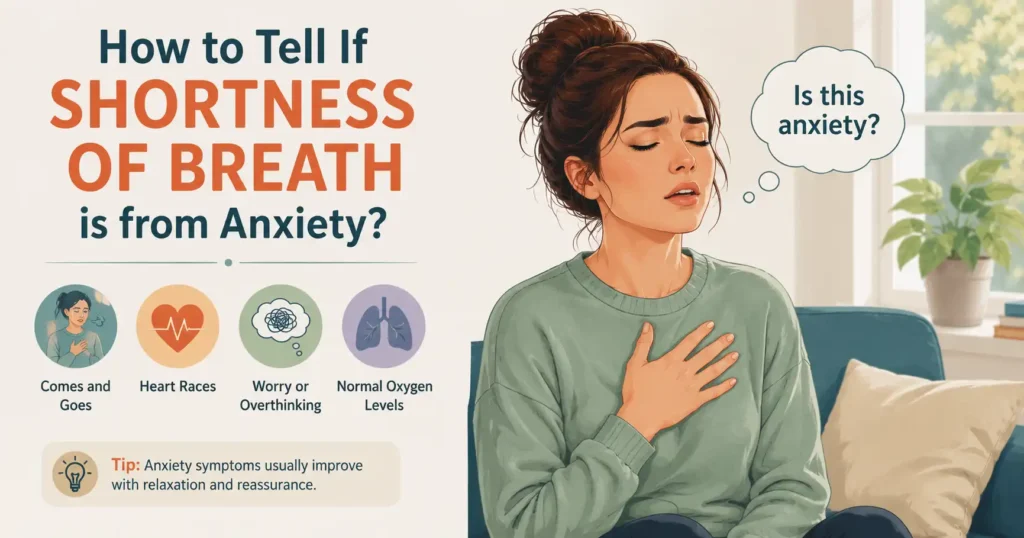
Shortness of breath from anxiety typically comes on suddenly during stress or panic, gets worse when you focus on it, and improves with calm breathing or distraction. Physical causes like heart or lung problems usually produce breathlessness during exertion that does not improve with relaxation, often accompanied by chest pain, dizziness, or blue-tinged lips. The pattern of when it happens and what makes it better or worse is the most reliable way to identify the source.
Anxiety affects approximately 31% of adults at some point in their lives, and shortness of breath ranks among the most frightening symptoms. The sensation can trigger a feedback loop where breathing difficulty causes more anxiety, which worsens the breathing problem. Understanding whether your symptoms stem from anxiety or a medical condition requires looking at specific patterns.
What Does Shortness of Breath from Anxiety Feel Like?
Anxiety-related breathing problems feel like you cannot get enough air, despite your lungs working normally. People describe it as air hunger, a tightness in the chest, or feeling like they are breathing through a straw. The sensation is real, but the cause is not physical obstruction or reduced oxygen.
This happens because anxiety triggers your sympathetic nervous system, the fight-or-flight response that evolved to help you escape danger. Your breathing rate increases automatically, often without you noticing.
Faster breathing can lead to hyperventilation, where you exhale too much carbon dioxide. Low carbon dioxide levels change your blood chemistry and create the sensation of not getting enough air, even though your oxygen levels remain completely normal.
The feeling typically peaks within 10 minutes during a panic attack. Between anxiety episodes, your breathing usually returns to normal. Physical causes of shortness of breath tend to persist or worsen over time rather than coming in discrete episodes.
What Are the Key Differences Between Anxiety and Medical Breathlessness?
Several patterns help distinguish anxiety-related breathing from medical conditions. Timing matters most. Anxiety breathlessness often starts during emotional stress, public speaking, crowded spaces, or when thinking about health concerns. Medical breathlessness typically worsens with physical activity like climbing stairs or walking uphill.
The response to distraction also differs significantly. If watching an engaging movie or having an absorbing conversation makes you forget about your breathing difficulty, anxiety is the likely cause. Medical breathing problems remain noticeable regardless of mental focus. You cannot distract yourself from true lung or heart disease.
| Factor | Anxiety-Related | Medical Cause |
|---|---|---|
| Onset | Sudden, during stress | Gradual or with exertion |
| Duration | Minutes to hours | Persistent or worsening |
| Oxygen levels | Normal (95-100%) | Often reduced |
| Response to calm breathing | Improves noticeably | Little to no change |
| Associated symptoms | Racing thoughts, fear | Chest pain, swelling, cough |
Body position provides another clue. Anxiety breathlessness feels the same whether you are sitting, standing, or lying down. Heart failure characteristically causes worse breathing when lying flat. Lung conditions like asthma often trigger wheezing sounds you can hear, while anxiety-related breathing is typically silent despite feeling severe.
How to Tell If Shortness of Breath is from Anxiety Using Physical Symptoms?
Anxiety produces a cluster of symptoms that rarely appear with medical breathing problems. These accompanying signs help identify anxiety as the source. During anxiety-driven breathlessness, you may notice tingling in your fingers or around your mouth from hyperventilation, changing blood chemistry. Your heart rate increases noticeably, sometimes reaching 120-140 beats per minute at rest.
Muscle tension accompanies anxiety and breathlessness more than medical causes. Your shoulders may creep toward your ears, your jaw clenches, or your chest muscles feel tight. This tension itself can make breathing feel more difficult. Medical breathlessness tends to produce fatigue and weakness rather than muscle tension.
The color of your skin and lips matters. Anxiety does not change your skin color because your oxygen levels remain normal. If your lips or fingernail beds turn blue or gray, this indicates genuine oxygen deprivation and requires immediate medical attention. This never happens from anxiety alone.
A pulse oximeter, available at pharmacies for $20-40, measures your blood oxygen saturation. During an anxiety episode with breathing difficulty, your reading will typically show 95-100%, which is completely normal. Readings consistently below 92% suggest a medical cause. As of 2026, home pulse oximetry has become a standard tool for distinguishing anxiety from medical breathing problems.


What Breathing Techniques Help Identify Anxiety as the Cause?
Testing how your breathing responds to specific techniques reveals whether anxiety is the culprit. Box breathing provides a reliable test. Breathe in for four counts, hold for four, exhale for four, hold for four, then repeat. Do this for two minutes. If your breathing difficulty significantly improves or disappears, anxiety is almost certainly the cause. Medical breathing problems do not respond this dramatically to controlled breathing.
The paper bag technique, once commonly recommended, is no longer advised because it can be dangerous if the breathlessness has a medical cause. If you are actually low on oxygen, rebreathing your exhaled air makes things worse. Controlled breathing techniques are safer and equally effective.
Belly breathing offers another diagnostic approach. Place one hand on your chest and one on your abdomen. Breathe so that only the hand on your belly moves. If you can do this comfortably and it reduces your symptoms within a few minutes, anxiety is likely. People with lung disease or heart failure typically cannot shift to diaphragmatic breathing this easily because their physical breathing capacity is genuinely limited.
The breathing pattern itself provides information. Anxiety often causes you to take frequent shallow breaths using only the upper chest. This chest breathing can continue for hours without you realizing it. Medical conditions that limit breathing capacity typically force you to take slower, deeper breaths to compensate. Watch yourself in a mirror or have someone observe your breathing when it feels difficult.
When Should You Seek Medical Evaluation for Breathing Difficulty?
Certain symptoms accompanying shortness of breath always require medical evaluation. Chest pain that feels like pressure or squeezing, especially if it radiates to your jaw or left arm, may indicate heart problems. Do not wait to see if breathing exercises help. The same applies to sudden severe breathlessness that comes on within seconds to minutes without clear anxiety triggers.
Coughing up blood, significant swelling in your legs or ankles, or feeling faint when standing up, alongside breathing difficulty, point toward medical causes. Wheezing loud enough to hear without a stethoscope suggests airway problems. These symptoms do not appear with anxiety-related breathlessness.
- Breathing difficulty worsens steadily over days or weeks
- You cannot complete a full sentence without stopping to breathe
- Your lips or skin turn blue or gray
- Shortness of breath wakes you from sleep
- Fever accompanies breathing difficulty
- Recent surgery, long travel, or leg injury preceded the symptoms
Even if you believe your symptoms are anxiety-related, persistent breathing difficulty lasting more than a few hours warrants medical attention. The stakes are too high to guess. A healthcare provider can check your oxygen levels, listen to your heart and lungs, and potentially order a chest X-ray or EKG to rule out medical causes. Once medical problems are excluded, you can address the anxiety component with confidence.
A history of panic disorder or generalized anxiety makes anxiety-related breathlessness more likely, but it does not rule out medical causes. People with anxiety can also develop asthma, heart problems, or lung conditions. Past anxiety episodes do not guarantee current symptoms have the same cause.
What Does Research Show About Anxiety-Related Breathing Patterns?
Studies using continuous breathing monitors show that people with panic disorder breathe differently even between anxiety episodes. Research from 2019 found that individuals prone to panic attacks maintain slightly faster breathing rates throughout the day, averaging 14-16 breaths per minute compared to the typical 12-14. This chronic mild hyperventilation may sensitize them to breathing sensations and trigger panic.
The connection between thought patterns and breathing is bidirectional. Worrying about your breathing makes it worse, but changing your breathing also changes your thoughts. A 2021 study had participants with panic disorder practice slow breathing at six breaths per minute for 20 minutes daily. After four weeks, both their panic attack frequency and their fear of physical symptoms decreased significantly. The physical act of controlled breathing appeared to retrain their threat detection system.
Brain imaging studies reveal that anxiety-related breathlessness activates the amygdala and insular cortex, brain regions involved in fear and body sensation awareness. Medical breathlessness from low oxygen activates different regions related to basic survival drives. This distinction exists even though both types feel distressing. The brain knows the difference even when you cannot consciously tell.
Interestingly, research shows that telling someone their breathlessness is “just anxiety” often makes it worse rather than better. The dismissal increases anxiety about not being believed, which perpetuates the symptom. Effective approaches acknowledge the symptom as real and distressing while addressing the anxiety component through specific techniques rather than reassurance alone.
Frequently Asked Questions About How to Tell If Shortness of Breath is from Anxiety
Can anxiety cause shortness of breath all day?
Yes, anxiety can cause breathing difficulty that lasts for hours or even days, especially with generalized anxiety disorder. The intensity typically varies throughout the day rather than remaining constant, and symptoms often improve with distraction or relaxation techniques.
Why does my oxygen level look normal when I cannot breathe?
Anxiety-related breathing difficulty does not actually reduce your oxygen levels because your lungs function normally. The sensation comes from hyperventilation changing your carbon dioxide levels, which affects how breathing feels without lowering oxygen saturation.
Can anxiety make you feel like you are suffocating?
Yes, panic attacks commonly create an overwhelming sensation of suffocation or impending death despite normal breathing function. This feeling peaks within 10 minutes and gradually subsides, unlike medical breathing emergencies which typically worsen without treatment.
How long does anxiety-related shortness of breath last?
During a panic attack, breathing difficulty typically peaks within 10 minutes and resolves within 20-30 minutes. With generalized anxiety, milder breathing difficulty can persist for hours or fluctuate throughout the day, improving with calming activities.
