
You cannot tell whether concrete contains asbestos by looking at it, and no home test can confirm it. The only reliable way is to have a sample analyzed in an accredited laboratory using polarized light microscopy (PLM) or transmission electron microscopy (TEM).
Asbestos was added to some concrete and cement products in the United States mainly between the 1940s and the 1980s. Common products included cement pipe, corrugated roofing, siding shingles, and textured surface coatings. If your home or building was built or renovated before the 1980s, asbestos may be present in cement-based materials.
The safest and most accurate approach is to leave the material undisturbed and hire a licensed asbestos inspector. Disturbing the material to check it yourself can release fibers into the air and create a health hazard that did not exist before.
How To Tell If Concrete Has Asbestos Test It Right?
There is no visual, touch, or smell test that can identify asbestos in concrete. Lab analysis is required.
An accredited lab uses one of two main methods. Polarized light microscopy (PLM) is the standard method for most bulk building samples. It identifies asbestos fibers by their optical properties and can estimate the percentage present. Transmission electron microscopy (TEM) is more sensitive and can detect thinner fibers that PLM might miss. TEM is often used for air samples and for confirming results when PLM findings are unclear.
The correct process looks like this:
- Do not break, drill, sand, or chip the concrete yourself.
- Contact a licensed asbestos inspector. In many states, inspectors must be certified or licensed.
- The inspector will wear protective equipment and use wet methods to reduce dust.
- A small sample is placed in a sealed container and sent to an accredited lab.
- The lab report states whether asbestos is present and, if so, what type and estimated percentage.
Some hardware stores sell do-it-yourself asbestos test kits. These kits still require you to collect the sample yourself, which means disturbing the material. The lab analysis may be valid, but the sampling step carries real risk. For any material that is not already crumbling, professional sampling is the safer choice.
What Does Asbestos in Concrete Actually Look Like?
Asbestos fibers are microscopic. You cannot see individual fibers with the naked eye, and their presence does not change how concrete looks, feels, or performs.
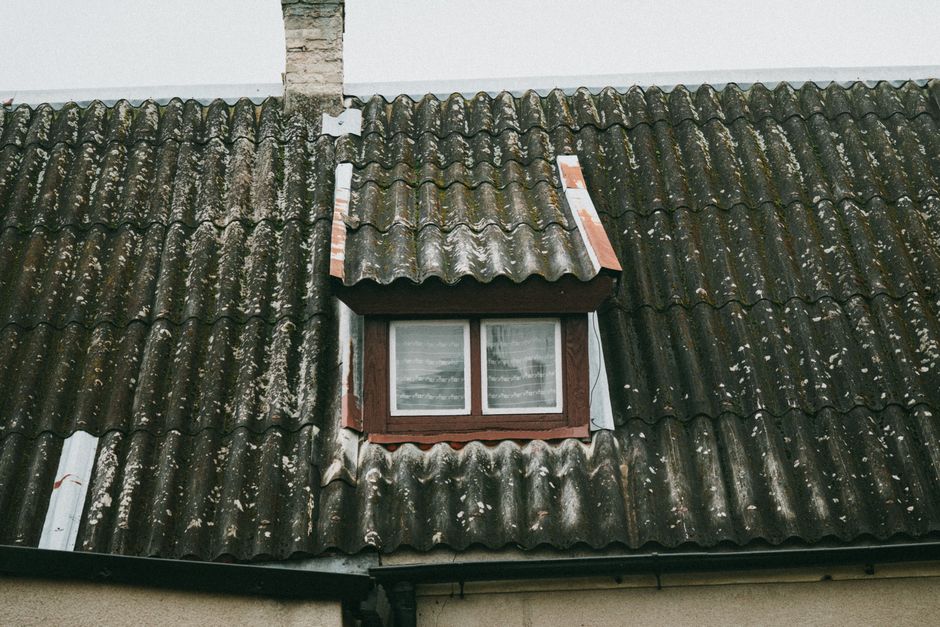
Concrete that contains asbestos looks like concrete that does not. It may be gray, white, or tinted. It may be smooth or rough. There is no color, texture, or surface pattern that signals asbestos.
What you can look for are clues about the material’s age and type. Asbestos was used in cement products most heavily from the 1940s through the 1980s. If a cement product was installed during that period, it should be treated as potentially containing asbestos until lab results say otherwise.
Certain cement products were more likely to contain asbestos than others:
- Corrugated asbestos-cement roofing and siding
- Asbestos-cement pipe used for water and drainage
- Asbestos-cement shingles and cladding
- Textured coatings and some patching compounds
- Some floor tiles and tile adhesives
Not every product from that era contained asbestos. Many did not. That is exactly why testing is the only way to know.
When Is Asbestos in Concrete Dangerous?
Asbestos in intact concrete is generally not considered an immediate health risk. The danger comes when the material is disturbed and fibers become airborne.
Asbestos fibers are most hazardous when they are inhaled. Once inhaled, fibers can lodge in the lungs and remain there for years. Over time, this can lead to serious diseases including asbestosis, lung cancer, and mesothelioma. These conditions typically develop many years after exposure, often decades later.
The risk depends on several factors:
- How much asbestos is in the material
- Whether the material is friable (crumbly and easily broken) or non-friable (solid and intact)
- How much the material is disturbed
- How long and how often someone breathes the fibers
Non-friable asbestos cement, which is the form used in most concrete products, releases fewer fibers when disturbed than friable materials like insulation. But cutting, grinding, or breaking it can still release fibers. The fibers do not break down over time, and they do not stay in one place once airborne.
This is why the standard advice is to leave intact asbestos-containing material alone unless it is damaged or must be removed for renovation. If it is in good condition, the safest action is often to manage it in place rather than remove it.




Can You Test Concrete for Asbestos Yourself?
You can collect a sample yourself and send it to a lab, but this is not the safest approach. Professional sampling is recommended whenever possible.
If you do collect your own sample, the key is to avoid creating dust. The material should be wetted first. The sample should be small, placed in a sealed bag or container, and handled carefully. You should wear a respirator rated for asbestos and disposable protective clothing. After sampling, you should clean the area with wet methods, not dry sweeping or vacuuming with a standard vacuum.
Some important limits to self-testing:
- You may not collect a sample that is representative of the whole material.
- You could disturb fibers and contaminate the area.
- You may not know which parts of the material to sample.
- Some states restrict who can collect asbestos samples for legal or regulatory purposes.
A licensed inspector has training, equipment, and experience to sample safely and accurately. For any material that is already damaged or crumbling, do not attempt to collect a sample yourself. Contact a professional.
What Happens After You Get the Test Results?
The lab report will tell you whether asbestos is present, what type, and roughly what percentage. What you do next depends on the results and the condition of the material.
If asbestos is not detected, the material can generally be handled as normal construction debris, though local rules may still apply.
If asbestos is detected, the response depends on the situation:
- If the material is intact and in good condition, it can often be left in place and managed.
- If the material is damaged or will be disturbed by renovation, it may need to be removed or repaired by a licensed asbestos abatement contractor.
- If the material is in a location where it could be disturbed by normal activity, it should be assessed by a professional.
Removal is not always the best option. In some cases, encapsulation or enclosure is used to contain the material without removing it. The right choice depends on the material’s condition, location, and the likelihood of future disturbance.
Do not attempt to remove asbestos-containing concrete yourself. Abatement is regulated at the federal and state level, and improper removal can spread fibers throughout a building.
Why You Should Not Rely on Visual Clues or Online Tests
No visual clue, home test strip, or online quiz can tell you whether concrete contains asbestos. This is not a matter of opinion. It is a limitation of how asbestos fibers behave and how they are detected.
Asbestos fibers are too small to see. They do not react with common chemicals in a way you could observe. They do not have a distinctive smell. They do not change the color or texture of concrete in a recognizable way.
Some products sold online claim to detect asbestos. No such product has been validated for reliable home use. The only accepted methods are laboratory analysis by PLM or TEM, performed by an accredited lab.
If someone tells you they can identify asbestos by looking at it, they are not giving you reliable information. The same goes for any test that does not involve a laboratory.
How to Find a Qualified Asbestos Inspector
Asbestos inspection is regulated, and requirements vary by state. Some states require inspectors to be licensed or certified. Others have less formal requirements. In all cases, you should look for someone with specific training in asbestos inspection.
Steps to find a qualified inspector:
- Contact your state or local health department for a list of licensed inspectors.
- Ask whether the inspector is accredited or certified.
- Ask which laboratory they use and whether it is accredited for asbestos analysis.
- Ask for a written report that includes the lab results.
- Get more than one quote if possible.
An accredited laboratory should participate in a recognized proficiency testing program for asbestos analysis. You can ask the inspector for the lab’s accreditation details.
Cost varies by region and by the number of samples. A single sample analysis may cost less than a full building inspection. For a renovation project, a full inspection is usually recommended before work begins.
What About Concrete That Was Poured After the 1980s?
Asbestos use in concrete and cement products declined sharply in the United States after the 1980s. By the late 1980s, most asbestos-cement products were no longer manufactured domestically.
That does not mean all newer concrete is asbestos-free. Some imported materials may still contain asbestos. Older stock could have been used in later construction. And some products that look new may have been installed using older materials.
If you are unsure about the age or origin of a material, testing is the only way to know. Age is a clue, not a guarantee.
For any concrete or cement product installed before the 1980s, treat it as potentially containing asbestos until lab results say otherwise. For newer materials, the risk is lower but not zero.
Frequently Asked Questions
Can I tell if concrete has asbestos just by looking at it?
No. Asbestos fibers are microscopic and do not change the appearance, color, or texture of concrete. Laboratory analysis is the only reliable way to know.
What is the best test for asbestos in concrete?
Polarized light microscopy (PLM) is the standard lab method for bulk samples. Transmission electron microscopy (TEM) is more sensitive and may be used when PLM results are unclear.
Is it safe to break up concrete that might have asbestos?
No. Breaking, cutting, or grinding concrete that contains asbestos can release fibers into the air. A licensed professional should handle any disturbance of suspect material.
How long does asbestos testing take?
Most labs return results within a few business days, though turnaround times vary. Rush options may be available for an extra fee.
