
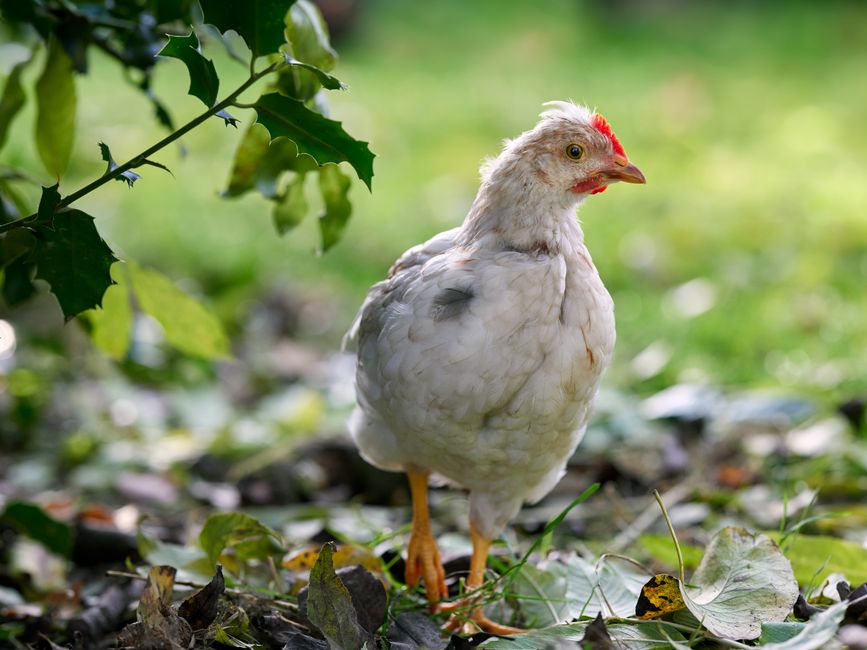
Figuring out whether a young chicken is a female (pullet) or a male (cockerel) can be tricky, especially when they are chicks. The most reliable method is to wait for them to mature, but you can often tell them apart by observing their growth rate, comb and wattle development, feathering patterns, and behavior. While no single sign works at every age, combining several physical and behavioral clues gives you a confident answer long before they start crowing or laying eggs.
How To Tell A Pullet From A Cockerel At Any Age?
Age changes which signs matter most. For chicks under three weeks, feather development is your best clue. For older birds, comb size, leg thickness, and behavior become far more reliable. No single method works at every age, so you need to shift your focus as the bird grows.
In many standard breeds, female chicks grow their wing feathers faster than males. This shows up within the first few days of life. Male chicks often have slower wing feather growth, so their wings may look bare or stubby compared to pullets of the same age. This method works best with purebred standard breeds. It is less reliable with hybrid breeds or fast-feathering varieties.
After six to eight weeks, the differences become more obvious. Cockerels usually grow faster, develop larger combs and wattles earlier, and have thicker legs. Pullets tend to be smaller, with paler combs that stay smaller for longer. By sixteen to twenty weeks, the differences are usually unmistakable, but behavior and feather shape can confirm your guess even earlier.
What Are The Feather Differences Between Pullets And Cockerels?
Feathers offer one of the earliest clues. In many breeds, the wing feathers of female chicks appear earlier and are more uniform in length. Male chicks often have wing feathers that are uneven or delayed. This is called sex-linked feathering in some crosses, but in pure breeds it is a general tendency rather than a guarantee.
As the birds grow, feather shape changes too. Cockerels develop long, pointed saddle feathers at the base of the tail and curved, shiny sickle feathers over the tail. These appear at around eight to twelve weeks. Pullets keep rounded feathers across their backs and necks. They never develop the long, draping saddle feathers that males grow.
Neck feathers also differ. Male chickens grow hackle feathers that are long, pointed, and often more glossy. Female hackle feathers are shorter and rounder. This difference becomes clearer as the bird approaches maturity, usually around twelve weeks or older.
One exception matters. Some breeds, like Silkies or feather-legged varieties, have unusual feathering that makes these clues less useful. If you are raising a feathery or odd-feathered breed, rely more on comb size and behavior than feather shape.
How Do Comb And Wattle Size Help Identify Sex?
Comb and wattle development is one of the most reliable physical signs. Cockerels develop larger, redder combs and wattles earlier than pullets. This difference usually becomes visible by six to eight weeks of age. By twelve weeks, a cockerel’s comb is often noticeably larger and more upright than a pullet’s.
Pullets do develop combs and wattles, but they stay smaller, paler, and more subdued until they approach laying age. A pullet’s comb may remain pale pink for months. A cockerel’s comb turns bright red much earlier, sometimes as young as six weeks.
Comb shape matters less than size and color. Some breeds naturally have single combs, others have pea combs, rose combs, or buttercups. The exact shape depends on the breed, not the sex. Focus on size and color relative to other birds of the same age and breed.
One caution: lighting and temperature affect comb color. A bird in warm, bright conditions may have a redder comb than the same bird in cold or dim conditions. Compare birds kept in the same environment for the most accurate read.





Do Cockerels And Pullets Behave Differently?
Behavior becomes a strong clue as birds approach adolescence. Cockerels often start practicing crowing between six and ten weeks. The first attempts sound like a squeaky, broken crow rather than a full call. This is one of the earliest clear signs of a male.
Cockerels also begin showing assertive behaviors earlier. They may stand taller, stretch their necks, and circle other birds. Some start attempting to mate or tread other chickens by ten to twelve weeks. They may also be more aggressive toward each other or toward people.
Pullets are typically calmer and more food-focused. They spend more time foraging and less time posturing. They may squat when approached, which is a sign of submission and readiness to mate, but this behavior appears closer to laying age, usually around sixteen to twenty weeks.
Behavior is not a perfect test. Some pullets are assertive, and some cockerels are shy. Use behavior as supporting evidence alongside physical signs, not as the sole method.
Are Leg Size And Body Shape Reliable Indicators?
Leg thickness offers a useful clue, especially in older birds. Cockerels generally have thicker, longer legs than pullets of the same breed and age. This difference becomes noticeable around eight weeks and grows more obvious as the bird matures.
Body shape also differs. Cockerels tend to be taller and more upright, with a broader chest and larger frame. Pullets are often more compact, with a rounder, lower-set body. A pullet’s body is built for egg production, with a wider pelvic area that becomes more flexible as she approaches laying age.
You can check pelvic width in older birds. Place two fingers between the pelvic bones just above the vent. A pullet close to laying will have a gap of about two finger-widths. A cockerel will not have this widening. This method only works for birds over sixteen weeks and is not useful for young chicks.
Leg color can help in some breeds, but it is breed-specific rather than sex-specific. Do not rely on leg color alone unless you know your breed’s standards well.
What Is Vent Sexing And Is It Practical?
Vent sexing is a method of identifying sex by examining the chick’s vent area for tiny reproductive organs. It is accurate when done by trained professionals within the first 24 to 48 hours after hatching. The technique requires squeezing the chick gently to expose the vent and looking for a small bump or line that indicates a male.
This method is not practical for most backyard keepers. It takes extensive training to do correctly, and the risk of injuring or killing a chick is real if you press too hard. Professional hatcheries use this method routinely, but they employ people who have practiced for weeks or months.
For a home flock, vent sexing is rarely worth the risk. Feather, comb, and behavior clues are safer and become reliable within a few weeks. If you need an early answer, consider purchasing sexed chicks from a hatchery that uses vent sexing or feather sexing rather than attempting it yourself.
Are There Genetic Or Breed-Specific Ways To Sex Chicks?
Yes, some breeds and crosses allow sexing at hatch based on feather color or feather length. This is called sex-linked inheritance. For example, certain crosses produce female chicks with one color pattern and male chicks with another, visible on the day they hatch.
Feather sexing uses the difference in wing feather growth rate that appears in specific crosses. Female chicks in these crosses grow wing feathers faster than males, making the sex clear within 24 hours. This works reliably only in specific hybrid lines, not in most purebred chickens.
If you buy from a hatchery, ask whether your chicks are sex-linked or feather-sexed. If they are, you get a reliable answer at hatch. If not, you will need to wait and observe the physical and behavioral signs described above.
Some breeds have autosexing traits, where males and females look different at hatch based on color or pattern. These include breeds like the Cream Legbar or the Barred Plymouth Rock in certain crosses. Autosexing is breed-specific and not available across all chickens.
When Can You Be Certain About A Chicken’s Sex?
You can be fully certain when you see a rooster crow and attempt mating, or when a hen lays an egg. These are the only absolute proofs. Everything else is strong evidence, but not perfect certainty.
Most cockerels begin crowing between eight and twelve weeks, though some start earlier and some later. Most pullets lay their first egg between eighteen and twenty-four weeks, depending on the breed. Until one of these events happens, a confident guess is possible, but a guarantee is not.
If you need an answer before maturity, combine as many signs as possible. Fast growth plus large red comb plus early crowing attempts plus thick legs makes a male very likely. Slow growth plus small pale comb plus calm behavior plus rounded feathers makes a female very likely. The more signs point in the same direction, the more confident you can be.
Frequently Asked Questions
Can you tell a pullet from a cockerel at two weeks old?
At two weeks, wing feather development is your best clue, but it is not reliable in all breeds. Cockerels often have slower wing feather growth than pullets, but you cannot be certain until they are older.
Do cockerels always have bigger combs than pullets?
In most breeds, cockerels develop larger, redder combs earlier than pullets, but this is a general tendency, not a rule. Some pullets have naturally large combs, and some cockerels develop slowly.
How early can a chick start crowing?
Some cockerels attempt crowing as early as six weeks, but most start between eight and twelve weeks. The first crows often sound like a squeaky or broken noise rather than a full rooster call.
Is vent sexing safe to do at home?
Vent sexing is accurate only when done by trained professionals within 48 hours of hatching. Attempting it at home carries a real risk of injuring or killing the chick, so it is not recommended for backyard keepers.
