
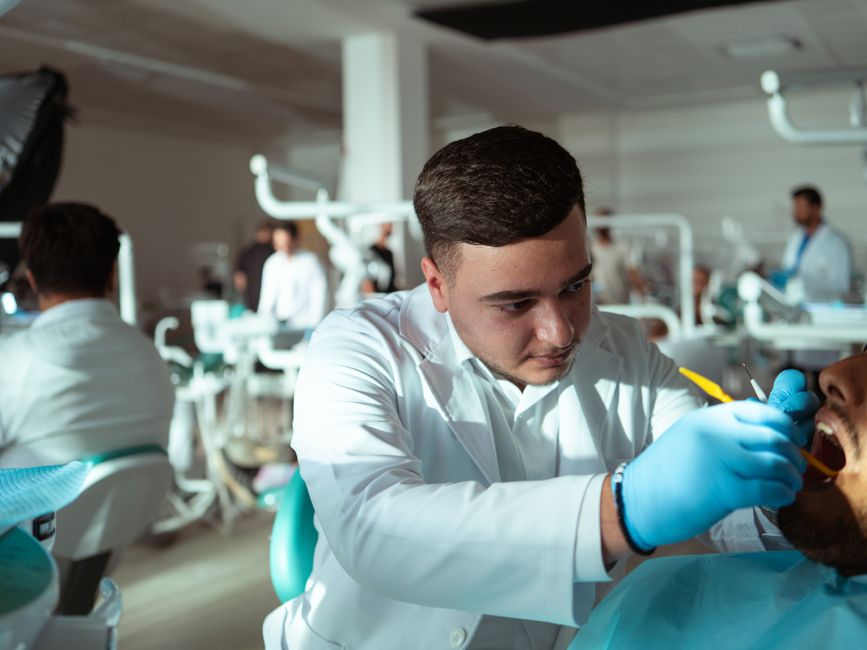
Dental school is less like college and more like a full-time job that happens to require memorizing the blood supply of the face. The core answer is this: successful dental students study in short, frequent blocks, connect basic science facts to clinical procedures, and practice active recall instead of rereading notes. The volume is real. So is the pace. But the students who do well are rarely the ones who study the longest. They are the ones who study with a system.
What Makes Dental School Studying Different From College?
The volume and the integration are different. In college you might take four unrelated courses. In dental school you take anatomy, physiology, biochemistry, histology, and dental materials at the same time — and they all connect to the same patient.
Dental school also splits into two phases that demand different study methods. The first two years are classroom and lab heavy. You are learning the biomedical sciences plus pre-clinical technique on models. The last two years are clinical. You spend most of your day treating patients and studying in the gaps.
That shift catches people off guard. A method that worked in a lecture hall often fails in a clinic. You cannot block out four quiet hours when you have a patient at 9 a.m. and another at 1 p.m.
One non-obvious point: dental students are not just learning facts. They are building a mental library of patterns — what a healthy tooth looks like, what decay looks like, what a margin looks like under a crown. That kind of learning needs repetition over time, not one long cram session.
How To Study In Dental School Using Active Recall
Active recall means testing yourself instead of reviewing. Reading a chapter again feels productive because the material becomes familiar. Familiarity is not the same as knowing it.
Cognitive science research has consistently found that retrieval practice — pulling information out of your memory — produces stronger long-term retention than passive review. This is one of the more reliable findings in the learning literature. It applies directly to dental school.
Here is what it looks like in practice:
- Close the notes and write down everything you remember about a topic.
- Use flashcards for facts that must be instant — cranial nerve branches, tooth eruption timelines, drug interactions.
- Cover the label on anatomy diagrams and name the structures yourself.
- Explain a concept out loud as if teaching a classmate. If you stumble, that is your weak spot.
- Redraw a procedure from memory — the sequence of steps for a Class II restoration, for example.
The struggle is the point. If recall feels easy, you already knew it. If it feels hard and you get it anyway, that is where learning happens.
How Should You Space Your Study Sessions?
Spreading the same total study time across several days beats cramming it into one. This is called spaced repetition, and it is one of the better-supported findings in learning research.
A practical version: review new material the same day, again two or three days later, then again about a week out. Each pass takes less time than the one before.
For dental school specifically, spacing matters because the curriculum keeps stacking. If you truly learn anatomy in the fall, pharmacology in the spring is easier. If you cram anatomy and forget it, you pay for that later — sometimes on board exams.
The spacing does not need to be perfect. Students who review material three times across two weeks generally hold onto it better than students who review it three times in one night. The exact intervals are less important than the fact that the reviews are separated.





How Do You Study Pre-Clinical Technique?
Pre-clinical work is a motor skill, and motor skills are learned differently from facts. You get better by doing, with feedback, in focused bursts.
Repetition alone is not enough. Deliberate practice — working on the specific part you are struggling with, not just repeating the whole procedure — is what moves the needle. If your crown prep margins are inconsistent, practice margins. Do not just prep another full tooth.
Some practical approaches that dental students commonly use:
- Practice in short sessions with full attention rather than long distracted ones.
- Ask faculty or upperclassmen to watch and critique a specific step.
- Watch your own technique on video if your school allows it.
- Compare your work against the standard, not against your last attempt.
Hand skills also need rest. Fine motor control degrades when you are fatigued. A tired hour of practice can build bad habits as easily as good ones.
How Do You Study During Clinical Years?
Clinical years change the game. Your study time shrinks and your patient time grows. The students who adapt treat every patient as a study session.
Before a procedure, review the steps and the anatomy involved. After it, spend five minutes noting what went well and what you would change. That reflection is studying, even though it does not look like it.
Carry a small set of high-yield flashcards for downtime between patients. Use the wait for a patient to numb up. Use the gap while an impression sets. These small blocks add up over a year.
Board exam prep during clinical years usually needs to be scheduled, not squeezed in. Most students find that a consistent 30 to 60 minutes a day works better than trying to find a large block that never appears.
What Study Habits Actually Hurt Dental Students?
Rereading and highlighting are the most common traps. Both feel like studying. Neither forces your brain to retrieve anything.
Studying in long, unfocused marathons is another. Attention fades, and after a certain point you are just moving your eyes across the page. Shorter sessions with real breaks tend to hold up better.
Studying alone all the time is a third. Explaining material to a classmate exposes gaps you did not know you had. Study groups work when they stay on task — and fall apart when they become social hour.
Ignoring sleep is the one that does the most damage. Sleep is when memory consolidation happens. Cutting sleep to study more often backfires, because the material you studied does not get stored as well. This is not a motivational slogan. It reflects how memory formation works.
Comparing yourself to the loudest studier in the class is the last trap. Hours logged is not the same as material learned. Some students need more time than others, and that is normal.
How Do You Manage the Workload Without Burning Out?
The workload is heavy, and pretending otherwise does not help. What helps is treating your schedule like a clinical schedule — with built-in recovery.
Protect sleep first. Then protect a small amount of time that has nothing to do with dentistry. Students who keep one non-dental activity tend to sustain the pace better than those who drop everything.
Learn to triage. Not every lecture deserves equal study time. Figure out what your exams actually emphasize and allocate your hours accordingly.
Ask for help early. Faculty, academic support offices, and upperclassmen are there for a reason. Struggling silently is the slowest path through a hard curriculum.
Frequently Asked Questions
How many hours a day should I study in dental school?
There is no universal number, and it varies by school and by student. Most dental students report studying several hours a day outside of class, with more before exams.
Is dental school harder than medical school?
They are different rather than one being clearly harder. Dental students spend significant time on hand skills and pre-clinical technique in addition to biomedical science.
What is the best way to study for dental school exams?
Active recall and spaced review are the best-supported methods. Testing yourself and spreading review across days beats rereading notes the night before.
Can you work while in dental school?
Most dental programs strongly discourage outside employment because of the schedule demands. Some students take on limited tutoring or flexible work, but it depends on the school and the individual.
