
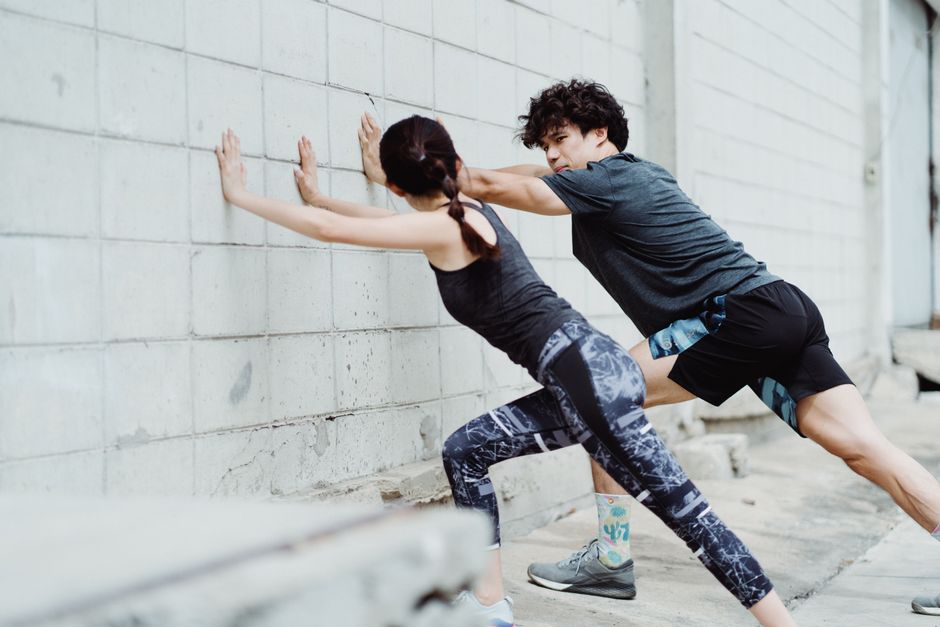
Most people stretch their calves by leaning into a wall with the back leg straight. That stretch mostly targets the inner calf. The outer calf — the lateral head of the gastrocnemius and the lateral portion of the soleus — gets far less attention. To stretch it properly, you need to angle your foot inward and keep the stretch controlled, not bouncy. Here is how the anatomy works, how to do it correctly, and what to avoid.
What Is the Outer Calf Muscle and Why Does It Get Tight?
The calf is not one muscle. It is a group, and the outer portion has a distinct job that makes it prone to tightness in certain people.
The main calf muscle, the gastrocnemius, has two heads. The medial head sits on the inside of your lower leg. The lateral head sits on the outside. Beneath it, the soleus is a broader, flatter muscle that also has a lateral portion. All three merge into the Achilles tendon, which attaches to your heel bone.
The lateral head of the gastrocnemius tends to be smaller and less flexible than the medial head in many people. It also crosses both the knee and the ankle joint, which means its length is affected by what your knee is doing. When your knee is straight, the gastrocnemius is under more tension. When it is bent, the soleus takes more of the load.
Why does the outer calf get tight? Several reasons are well established:
- Prolonged sitting shortens the calf complex over time.
- Running and walking on cambered roads or uneven surfaces loads one side more.
- High-heeled shoes keep the calf in a shortened position for hours.
- Sudden increases in activity — a new running program, more stairs — can leave the calf stiff and sore.
One point worth clarifying: tightness in the outer calf is not always a muscle-length problem. Sometimes what feels tight is actually a strength or control issue, or protective tension after a strain. Stretching a muscle that is guarding after injury can make things worse. If you have sharp pain, swelling, or pain that worsens with stretching, that is a signal to stop and get it assessed rather than push through.
How To Stretch the Outer Calf Muscle Properly
The key to targeting the outer calf is foot position. Angling the toes and foot inward shifts the stretch toward the lateral fibers. Without that rotation, you mostly stretch the inner calf.
Here is a reliable method using a wall or sturdy surface:
- Set up: Stand facing a wall, hands on it at shoulder height.
- Step back: Place the leg you want to stretch behind you, heel flat on the floor, toes pointing slightly inward — toward your other foot.
- Bend the front knee: Keep the back leg straight and the back heel down. You should feel a stretch along the outer back of the lower leg.
- Hold: Hold a steady stretch for 20 to 30 seconds. Breathe normally. Do not bounce.
- Repeat: Two to four repetitions per side is a reasonable starting point.
The inward toe angle is the part most people skip. It is what makes this a lateral calf stretch rather than a general one. Keep the rotation modest — a slight inward turn, not an extreme twist. If your knee or ankle feels uncomfortable with the rotation, reduce it.
To bias the soleus (the deeper muscle), bend the back knee slightly while keeping the heel down. The soleus does not cross the knee, so a bent knee takes tension off the gastrocnemius and puts more load on the soleus. Its lateral portion responds to the same inward foot angle.
Hold the stretch at a point of mild to moderate tension — not pain. Stretching to the point of sharp discomfort tends to trigger a protective contraction, which defeats the purpose. Slow, steady pressure works better than force.
Does It Matter Whether Your Knee Is Straight or Bent?
Yes, and this is one of the most practical things to understand about calf stretching. The position of your knee decides which muscle you are actually stretching.
The gastrocnemius crosses the knee joint. When your knee is straight, it is lengthened at both ends and takes most of the stretch. When your knee is bent, the gastrocnemius is slackened and the soleus — which crosses only the ankle — takes the load.
This means a single stretch position does not cover the whole calf. If your goal is the outer calf as a whole, you benefit from doing both:
- Straight-knee version: targets the lateral head of the gastrocnemius.
- Bent-knee version: targets the lateral portion of the soleus.
Both use the same inward foot angle. Doing both takes only a few extra minutes and gives more complete coverage than one position alone.


Common Mistakes That Reduce the Stretch
Most ineffective calf stretching comes down to a handful of avoidable errors.
Letting the back heel lift. If the heel comes off the floor, the calf shortens and the stretch disappears. Keep it planted.
Skipping the foot rotation. A straight-ahead foot position stretches the calf generally but does little for the outer fibers. The inward angle is the whole point.
Bouncing. Ballistic bouncing triggers a stretch reflex that makes the muscle contract rather than lengthen. Steady holds are more effective and safer.
Stretching cold. A few minutes of easy walking or light activity before stretching makes the tissue more receptive. Stretching a completely cold muscle is not dangerous, but it is less comfortable and often less effective.
Pushing into pain. Discomfort is expected. Sharp pain is not. Pain means stop.
Stretching only. If the outer calf is tight because it is weak or poorly controlled, stretching alone will not fix it. Loading the calf through strength work — heel raises, for example — addresses the underlying capacity. Some clinicians emphasize strengthening over stretching for persistent tightness, though the evidence on which approach works best for calf tightness specifically is limited.
When Stretching Is Not the Answer
Stretching is not appropriate for every kind of calf tightness, and pushing through the wrong symptoms can delay recovery.
Do not stretch aggressively if you have:
- Sharp or shooting pain in the calf
- Swelling, warmth, or redness in the leg
- Pain that gets worse the more you stretch
- A recent strain or tear
- Calf pain with shortness of breath or leg swelling — this needs urgent medical assessment, not stretching
Calf pain that comes with swelling, warmth, or redness in one leg can be a sign of a blood clot. That is a medical emergency. Do not stretch it, massage it, or wait to see if it improves. Seek care right away.
If tightness has persisted for weeks despite consistent stretching, or if it limits how you walk or move, a physical therapist can assess whether the issue is muscle length, joint mobility, nerve tension, or strength. What feels like a tight outer calf is sometimes referred tension from the ankle or a control problem higher up the leg. Stretching in that case treats the symptom, not the cause.
How Often Should You Stretch the Outer Calf?
Consistency matters more than duration. A few short sessions spread through the week tend to work better than one long session.
General flexibility guidance from exercise science suggests holding stretches for around 20 to 30 seconds and repeating two to four times per muscle, several days per week. This is a widely used range, not a strict prescription. The exact best dose for the outer calf specifically has not been established by high-quality trials, so treat these numbers as reasonable general guidance rather than a proven formula.
Stretching after activity, when the muscle is warm, is a practical habit. Some people also stretch in the morning to counter overnight stiffness. Both are fine. The main thing is to do it regularly enough that the muscle is exposed to a lengthened position often.
Frequently Asked Questions
How do I stretch the outer calf muscle?
Stand facing a wall, step the target leg back with the heel flat, and turn the toes slightly inward. Keep the back knee straight and lean forward until you feel a stretch along the outer calf.
Should I bend my knee to stretch the outer calf?
Both positions are useful. A straight knee targets the gastrocnemius, while a slightly bent knee shifts the stretch to the soleus.
How long should I hold an outer calf stretch?
Hold for about 20 to 30 seconds and repeat two to four times per side. General flexibility guidance supports this range, though the ideal dose for the outer calf specifically has not been firmly established.
Why does my outer calf feel tight even after stretching?
Persistent tightness can come from weakness, joint stiffness, or nerve tension rather than short muscle fibers. If stretching does not help over several weeks, a physical therapist can identify the actual cause.
