
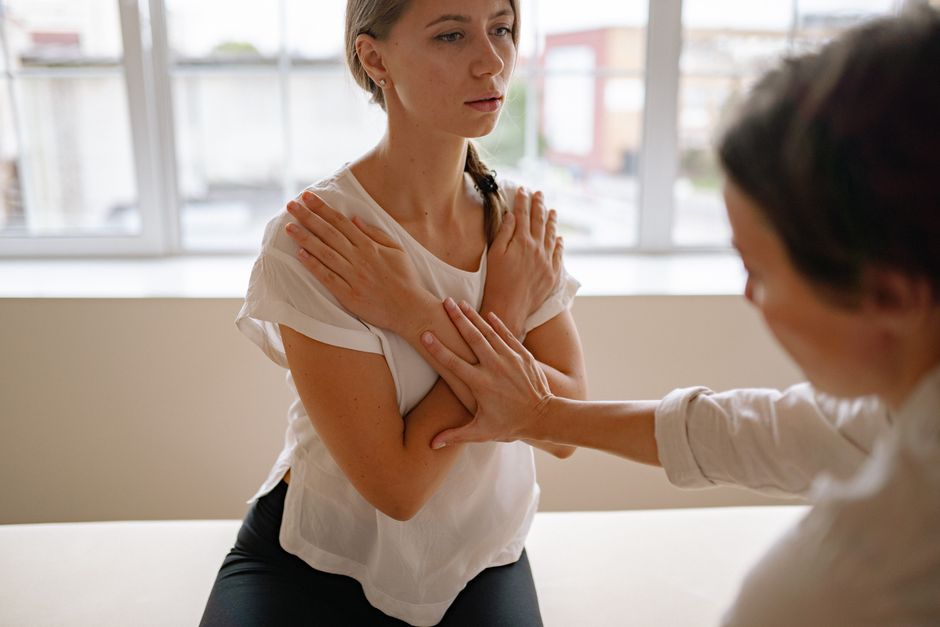
Shoulder blade tightness is one of the most common complaints in adults, and it usually comes from the same place: hours of sitting with your shoulders rolled forward. When your shoulder blades sit in this rounded position for long periods, the muscles around them — especially the rhomboids and the lower trapezius — get stretched out and weak, while the muscles in the front of your chest get short and tight. The result is a dull ache between the shoulder blades that can spread up the neck or into the arms.
The good news is that targeted stretching can relieve this tightness quickly. The most effective approach combines stretches that open the chest with exercises that strengthen the muscles that pull your shoulder blades back and down. Stretching alone helps, but pairing it with activation exercises gives longer-lasting relief. Below are the specific stretches and movements that work best, along with the reasons they help.
Why Do My Shoulder Blades Feel So Tight?
Your shoulder blades are not attached to your rib cage by a bone. They float on a network of muscles that hold them in place. This design gives your arms a huge range of motion, but it also means your posture directly controls where your shoulder blades sit.
When you sit at a desk, drive, or look at your phone, your shoulders naturally roll forward. This position pulls your shoulder blades away from your spine and tilts them forward. The muscles between your shoulder blades — the rhomboids and middle trapezius — get overstretched and have to work constantly to try to hold your posture. That constant low-level effort is what feels like tightness.
Meanwhile, the chest muscles in the front of your body shorten. A short chest muscle pulls your shoulders forward even more, creating a loop. You stretch the back, it tightens again, because the front is still pulling. This is why the most effective stretching routine always addresses both the front and the back of the shoulder girdle.
How To Stretch Shoulder Blades And Ease Tightness?
The single most effective stretch for shoulder blade tightness is the doorway chest stretch. Stand in a doorway and place your forearm on the door frame with your elbow bent at 90 degrees. Step forward with the same-side foot until you feel a gentle pull across the front of your chest and shoulder. Hold for 30 seconds, then switch sides.
This stretch works because it directly targets the pectoral muscles — the ones that pull your shoulders forward. When those muscles release, your shoulder blades can naturally slide back into a more neutral position. Do this stretch twice per side, twice daily, especially after long periods of sitting.
The second most important movement is the wall slide. Stand with your back against a wall, your arms bent at 90 degrees, and the backs of your hands against the wall. Slowly slide your arms up the wall as high as you can while keeping your lower back flat against the wall. Then slide them back down. This movement activates the lower trapezius muscles, which pull your shoulder blades down and together.
Perform 10 to 15 wall slides slowly, focusing on the feeling of your shoulder blades moving down your back as your arms go up. This is not a stretch — it is an activation exercise. It teaches your muscles to hold your shoulder blades in a better position, which is what prevents tightness from returning.
Simple Stretches You Can Do At Your Desk
You do not need a gym or a yoga mat to relieve shoulder blade tightness. Several effective stretches require nothing but a chair and a few minutes.
The seated twist is one of the best. Sit tall in a chair, place your right hand on your left knee, and gently twist your torso to the left. Place your left hand on the back of the chair and look over your left shoulder. Hold for 30 seconds, then repeat on the other side. This stretch targets the muscles between your shoulder blades and along your spine.
The chin tuck is another essential movement. Sit up straight, look straight ahead, and gently pull your chin straight back as if you are making a double chin. Hold for 5 seconds, then release. Repeat 10 times. This movement strengthens the deep neck flexors and helps correct the forward-head posture that often accompanies shoulder blade tightness.
For a deeper stretch between the shoulder blades, clasp your hands in front of you and round your upper back, pushing your hands away from your body. You should feel a strong stretch between your shoulder blades. Hold for 20 to 30 seconds. This stretch directly targets the rhomboids — the muscles that connect your shoulder blades to your spine.





Strengthening Exercises That Prevent Tightness
Stretching provides temporary relief. Strengthening prevents the tightness from coming back. The key muscles to strengthen are the ones that pull your shoulder blades back and down: the rhomboids, the middle trapezius, and the lower trapezius.
Prone Y-T-W exercises are the gold standard for this. Lie face down on a mat or bed. Raise your arms off the floor into a Y shape with your thumbs pointing up. Squeeze your shoulder blades together and hold for 5 seconds. Lower and repeat 10 times. Then do the same with your arms in a T shape, and finally in a W shape with your elbows bent. These exercises directly target the muscles that hold your shoulder blades in a healthy position.
The band pull-apart is another effective option. Hold a resistance band in front of you with straight arms at shoulder height. Pull the band apart by squeezing your shoulder blades together. Control the movement back to the start. Perform 15 repetitions. This exercise works the same muscles as the prone exercises but can be done standing at your desk.
Research consistently shows that a combination of stretching and strengthening is more effective for reducing shoulder pain than stretching alone. The strengthening component is what retrains your muscles to hold a better position long after the session ends.
When To See A Doctor About Shoulder Blade Pain
Most shoulder blade tightness is muscular and improves with stretching and movement. But shoulder blade pain can occasionally signal something more serious. You should seek medical attention if the pain is severe, if it came on suddenly, or if it is accompanied by chest pain, shortness of breath, or pain down your left arm.
Shoulder blade pain can sometimes be referred pain from the heart, gallbladder, or lungs. This is rare, but it happens. If your pain does not improve after two weeks of regular stretching, or if it gets worse despite stretching, see a healthcare provider for an evaluation.
Also seek care if you notice weakness in your arm, numbness or tingling in your fingers, or if the pain wakes you from sleep. These symptoms suggest nerve involvement that requires professional assessment rather than self-treatment.
Common Mistakes That Worsen Tightness
One of the most common mistakes people make is stretching the back when the real problem is the front. If your chest muscles are short and tight, they will keep pulling your shoulders forward no matter how much you stretch your back. This is why the doorway chest stretch is so important — it addresses the root cause.
Another mistake is bouncing or forcing a stretch. Stretches should be held steady and gentle. A sharp, painful stretch triggers a protective reflex in the muscle that causes it to tighten rather than relax. You should feel a mild to moderate pull, never sharp pain.
Finally, many people stretch but never strengthen. Stretching a weak muscle does not make it stronger. If your rhomboids are weak, they will continue to feel tight no matter how much you stretch them. The tightness is partly the sensation of a muscle working too hard to hold a poor position. Strengthening that muscle reduces its workload and resolves the tightness.
Frequently Asked Questions
How long does it take for shoulder blade tightness to improve?
Most people notice improvement within one to two weeks of consistent daily stretching and strengthening. Chronic tightness that has built up over years may take four to six weeks of regular work to fully resolve.
Can shoulder blade tightness cause headaches?
Yes, tight muscles in the upper back and neck can refer pain into the head, particularly at the base of the skull. These are called cervicogenic headaches, and they often improve when the underlying muscle tension is treated.
Is it better to use heat or ice for shoulder blade tightness?
Heat is generally more helpful for chronic muscle tightness because it increases blood flow and relaxes muscle tissue. Ice is better for acute injuries with inflammation, such as a sudden strain or injury.
What is the fastest way to relieve shoulder blade tightness?
The fastest relief comes from a combination of a doorway chest stretch followed by wall slides. The chest stretch releases the pull on the front, and the wall slides activate the muscles that hold your shoulder blades in a better position.
