
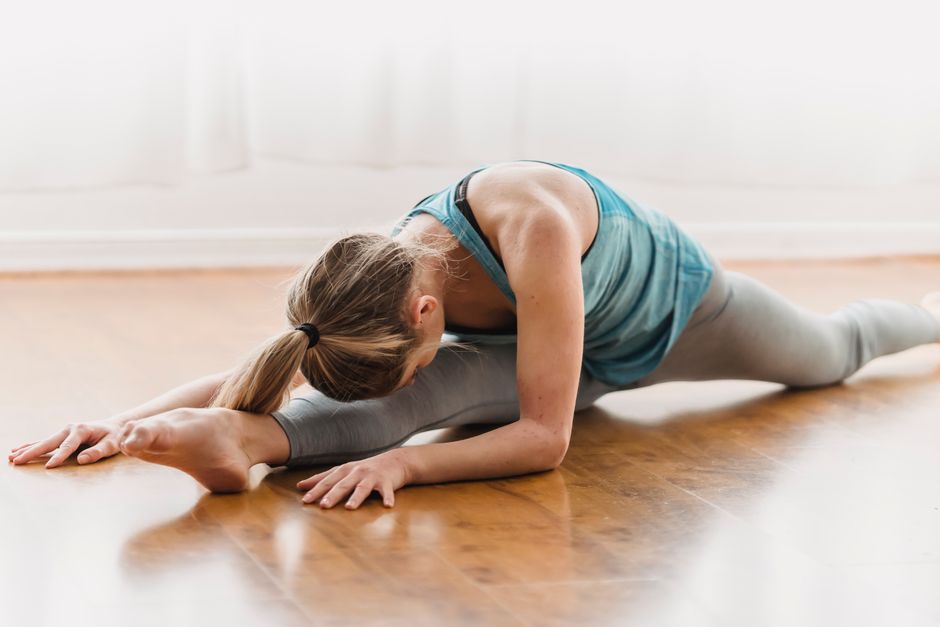
Tight legs rarely mean short muscles. They usually mean a nervous system that has decided your current range of motion is far enough, thank you. To stretch legs fully and loosen tight muscles, you need three things: warmth before you pull, a hold long enough for the muscle to stop resisting (roughly 30 seconds or more), and a stretch that targets the specific muscle group that is actually tight — not just the one that feels tight. Most people skip the first two and guess at the third.
Muscles do not lengthen like elastic bands. They lengthen because the nervous system allows them to. A stretch held for a few seconds triggers a protective reflex that makes the muscle resist. Hold it longer and that reflex fades, which is why patience matters more than force. Below is how to work each major leg muscle properly, plus the reasons your hamstrings may feel tight even when they are not.
How To Stretch Legs Fully And Loosen Tight Muscles?
You stretch legs fully by working every major muscle group in the leg — calves, hamstrings, quadriceps, hip flexors, and glutes — with slow, sustained holds rather than quick bounces. You loosen tight muscles by stretching when they are warm, breathing steadily, and holding each position long enough for the muscle’s protective reflex to settle.
The order matters less than people think. What matters more is consistency and not forcing range your body is not ready to give.
Here is the basic approach that works for most healthy adults:
- Warm up first. Five to ten minutes of walking, cycling, or any light activity that raises your body temperature makes muscle tissue more pliable and stretching more comfortable.
- Hold, don’t bounce. Bouncing triggers the stretch reflex — a rapid contraction that fights the lengthening. A steady hold lets the muscle relax into the position.
- Hold for at least 30 seconds. This is the commonly cited threshold in exercise physiology for a sustained static stretch. Shorter holds still help, but the muscle’s resistance tends to ease with time under tension.
- Breathe out as you settle in. Holding your breath increases muscle tension. Slow exhales help the nervous system permit more range.
- Stretch to mild tension, not pain. Sharp pain is a signal to back off, not push through.
One clarification worth knowing: static stretching before explosive activity like sprinting or jumping can temporarily reduce power output. Save long static holds for after exercise or as a separate session, and use dynamic movement as your warm-up.
Why Do My Legs Feel Tight Even When I Stretch?
Feeling tight is not the same as being short. This is the single most useful thing to understand about leg tightness, and most people never hear it.
Muscle “tightness” is a sensation, not a measurement. It can come from several places:
- Genuine muscle shortening from prolonged sitting or inactivity — the muscle really has adapted to a shorter resting length.
- Nervous system guarding — the brain keeps a muscle tense because it perceives instability or past injury risk.
- Nerve tension — the sciatic nerve running down the back of the leg can create a pulling sensation in the hamstrings that feels exactly like a tight muscle but is not one.
- Weakness elsewhere — weak glutes or core can make the hamstrings and hip flexors work harder and feel chronically tight.
If you have stretched your hamstrings diligently for weeks with no change, nerve tension or weakness may be the real issue. A hamstring stretch will not fix a nerve that needs to glide, and it will not fix a glute that needs to strengthen. This is why some people stretch for months and feel no different.
How Do You Stretch Each Major Leg Muscle?
Each muscle group needs a different position because each one crosses different joints. Working them all takes about ten to fifteen minutes.
Calves
Stand facing a wall with hands on it. Step one foot back, keep that heel flat on the floor, and lean forward until you feel a stretch in the calf. Keep the back knee straight to target the gastrocnemius (the larger upper calf muscle). Then bend the back knee slightly to shift the stretch to the soleus, the deeper muscle below it. Hold each for 30 seconds.
Hamstrings
Sit on the edge of a chair and extend one leg straight in front of you, heel on the floor, toes pointing up. Keep your back straight and hinge forward from the hips until you feel tension behind the thigh. Do not round your spine to reach further — that moves the stretch to your back, not your hamstring. Hold 30 seconds per leg.
Quadriceps
Stand and hold a wall for balance. Bend one knee and bring your heel toward your buttocks, grasping your ankle if you can reach it comfortably. Keep your knees close together and your hips pushed slightly forward. You should feel the stretch along the front of the thigh. Hold 30 seconds per side.
Hip Flexors
Kneel on one knee in a lunge position, back knee on the floor, front foot flat. Tuck your pelvis under (think of tilting your tailbone toward the floor) and gently shift your weight forward until you feel a stretch at the front of the hip of the kneeling leg. The pelvic tuck is the part most people miss — without it, the lower back arches and the hip flexor never fully lengthens. Hold 30 seconds per side.
Glutes
Lie on your back with both knees bent. Cross one ankle over the opposite knee, then reach through and pull the uncrossed thigh toward your chest until you feel a stretch in the buttock of the crossed leg. Hold 30 seconds per side.





Static or Dynamic Stretching — Which Should You Do?
Both have a place, and they serve different purposes. The choice depends on when you are stretching, not which one is better.
| Type | What it is | Best timing |
|---|---|---|
| Dynamic | Controlled movement through range, like leg swings or walking lunges | Before exercise, as a warm-up |
| Static | Holding a position still for 30 seconds or more | After exercise or as a separate session |
| PNF (contract-relax) | Contract the muscle against resistance, then relax into a deeper stretch | For improving range of motion; often done with a partner or therapist |
Dynamic stretching before activity primes the muscles without reducing power. Static stretching is better suited to improving flexibility and cooling down. Research on flexibility consistently shows that static stretching done regularly does increase range of motion — the debate is mostly about timing relative to performance, not whether it works.
PNF, or contract-relax stretching, involves tightening the muscle being stretched for a few seconds before relaxing deeper into the stretch. Some studies suggest it produces larger gains in range of motion than static stretching alone, though the evidence is not uniform across all muscle groups. It is widely used in physical therapy.
How Long Does It Take to Loosen Tight Leg Muscles?
Most people notice some improvement in comfort within a few weeks of consistent stretching, but meaningful, lasting changes in flexibility typically take longer — often several weeks to a few months of regular practice.
This timeline is not precise, and it varies widely. Age, activity level, how long the tightness has been present, and whether there are underlying causes like nerve tension all affect how quickly you see change. Someone who has sat at a desk for a decade will likely need more time than someone who is generally active.
The bigger factor is frequency. Stretching once a week produces little change. Stretching most days, even briefly, produces more. Consistency beats intensity every time.
When Should You Not Stretch a Tight Leg?
Not all tightness should be stretched. Some sensations that feel like tightness are warning signs, and pulling on them can make things worse.
- Sharp or shooting pain during a stretch — stop. This is different from mild tension.
- Numbness, tingling, or electric sensations down the leg — this suggests nerve involvement, and stretching may aggravate it. A clinician should assess it.
- Recent injury — a strained or torn muscle should not be stretched during early healing. Follow the guidance of whoever is treating you.
- Joint pain rather than muscle tension — stretching a muscle will not fix a joint problem.
If tightness comes with swelling, heat, or pain that wakes you at night, see a healthcare provider. Those are not flexibility issues.
What Else Helps Loosen Tight Legs?
Stretching is one tool, not the only one. For many people, the tightness has more to do with what happens during the other 23 hours of the day than with the ten minutes they spend stretching.
Breaking up long periods of sitting helps more than most people expect. Standing and moving every 30 to 45 minutes interrupts the pattern that lets muscles adapt to a shortened position. Strengthening the opposing muscle groups — glutes for hamstrings, for example — can reduce the load that makes a muscle feel tight in the first place.
Some people find foam rolling or massage temporarily reduces the sensation of tightness. The evidence for lasting flexibility gains from these methods is limited and mixed. They may feel good and can be a reasonable addition, but they are not a substitute for stretching and strengthening.
Hydration and sleep are frequently mentioned in this context. The evidence linking either directly to muscle flexibility is not strong. Adequate sleep supports general recovery, which is reasonable to prioritize, but it is not a proven fix for tight hamstrings.
The most reliable approach remains unglamorous: warm up, stretch each major leg muscle with sustained holds several times a week, strengthen what is weak, and move more throughout the day. If tightness persists despite months of consistent effort, or comes with nerve symptoms, it is worth having a clinician or physical therapist look at it.
Frequently Asked Questions
How long should you hold a stretch to loosen tight muscles?
Hold a static stretch for at least 30 seconds to give the muscle’s protective reflex time to settle. Longer holds of up to 60 seconds are also used and are generally well tolerated by healthy adults.
Should you stretch before or after exercise?
Use dynamic movement before exercise and save static holds for after. Long static stretches right before explosive activity can temporarily reduce power output.
Why are my hamstrings always tight no matter how much I stretch?
Nerve tension, weak glutes, or nervous system guarding can all create a feeling of hamstring tightness that stretching will not resolve. If weeks of consistent stretching produce no change, a clinician or physical therapist can help identify the cause.
Can stretching alone fix tight legs?
Stretching helps, but it works best combined with strengthening and reducing long periods of sitting. Tightness often has more to do with daily movement patterns than with a lack of stretching.
