
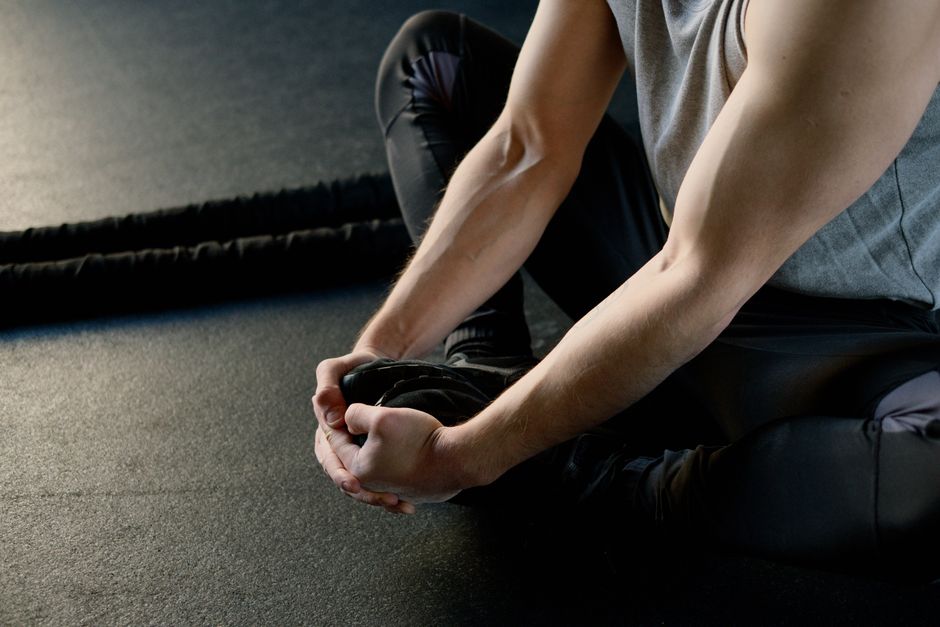
Stretching your whole body head to toe does not require a long routine or special equipment. You work through the major muscle groups in order, holding each stretch long enough for the muscle to actually relax. A full-body sequence takes about 10 to 15 minutes and can be done on a floor mat or even standing in a doorway.
The key is to move from top to bottom so you do not miss anything, and to hold each position rather than bouncing. Static stretching, where you hold a position still, is the most studied approach and the one most physical therapists recommend for general flexibility.
How To Stretch Every Muscle In Your Body Head To Toe?
You go in one direction and do not skip around. Start at your neck and finish at your ankles and feet. This order matters less than covering each area, but a fixed sequence makes it easier to remember and repeat.
Here is a simple head-to-toe order that covers the major muscle groups:
- Neck — gentle side tilt and slow rotation
- Shoulders and upper back — cross-body arm stretch and shoulder rolls
- Chest — doorway or corner stretch
- Triceps and lats — overhead reach and side bend
- Lower back — knees-to-chest and gentle spinal twist
- Hips and hip flexors — kneeling lunge and figure-four stretch
- Quadriceps — standing or side-lying thigh stretch
- Hamstrings — seated or standing forward fold
- Calves — wall push and standing heel drop
- Ankles and feet — ankle circles and toe stretch
That list covers the large muscles people usually mean when they say “every muscle.” It does not reach every small muscle in the body, and no routine does. You cannot isolate each of the roughly 600 muscles in the human body. What you can do is stretch the major groups that affect how you move and feel.
How Long Should You Hold Each Stretch?
Hold each stretch for about 30 seconds. That is the most commonly cited target in flexibility research and clinical practice.
Some studies suggest that holding a stretch for 30 to 60 seconds produces better gains in range of motion than shorter holds of 10 to 15 seconds. The evidence is not perfectly consistent, but 30 seconds per muscle group is a reasonable, widely used standard. Doing two to four repetitions per stretch is common in clinical settings.
Do not bounce. Ballistic stretching, where you bounce in and out of a position, can trigger a reflex that makes the muscle tighten instead of relax. For most people doing general flexibility work, a slow, steady hold is safer and more effective.
Breathe normally. Holding your breath increases tension. If a stretch hurts, you have gone too far — back off to the point of mild pulling, not pain.
Should You Stretch Before or After Exercise?
Static stretching works best after activity, or as its own session. This is one of the clearer findings in exercise science.
Long static stretches held right before strength or power activities — like sprinting or heavy lifting — can temporarily reduce muscle power output. The effect is usually small and short-lived, but it is real enough that many coaches now avoid long static holds in a pre-workout warm-up.
For a warm-up, dynamic movements are the better choice. These are controlled movements that take a joint through its full range, such as leg swings, arm circles, and walking lunges. They raise muscle temperature and prepare the tissue for activity without the temporary power dip.
If your goal is general flexibility rather than performance, the timing matters less. Stretching after a workout, when muscles are warm, is often more comfortable and may allow a slightly greater range.





Does Stretching Actually Make You More Flexible?
Yes, regular stretching increases range of motion. This is well established.
What is less clear is why. For years people assumed stretching physically lengthened the muscle. Current evidence suggests the change is mostly about tolerance — your nervous system learns to allow a greater range before it signals the muscle to resist. The tissue itself may change a little over time, but the nervous system plays a large role.
This matters because it explains why flexibility gains fade if you stop. If the change were purely structural, it would stick around longer. Because it involves the nervous system, consistency is what maintains it.
It also explains why you can often gain range quickly at first. That early improvement is largely your nervous system adjusting, not your muscle getting longer.
What Stretching Can and Cannot Do
Stretching improves flexibility and range of motion. That part is solid.
Other claims are weaker. Stretching has not been clearly shown to prevent injury on its own, despite being widely promoted for that purpose. The evidence is mixed, and some reviews find little or no injury-prevention benefit from stretching alone.
Stretching also does not reliably prevent soreness after exercise. Delayed onset muscle soreness, the ache that shows up a day or two after a hard workout, is not consistently reduced by stretching.
What stretching can reasonably do:
- Increase range of motion at a joint
- Improve how easily you can move through daily tasks
- Support relaxation and reduce feelings of stiffness
- Pair well with strength training for overall function
What it is not proven to do on its own:
- Prevent all injuries
- Prevent muscle soreness
- Fix chronic pain by itself
- Replace strength or cardiovascular training
Flexibility is one part of fitness, not the whole picture. Strength, balance, and aerobic capacity matter just as much for how you function day to day.
How Often Should You Stretch?
Most days of the week is a reasonable target for meaningful flexibility gains. Some research suggests that stretching a muscle group several times per week, and holding for a total of about a minute per muscle group per session, produces measurable improvement.
Daily stretching is generally fine for healthy people. The muscles adapt to regular demand, and there is no strong evidence that daily static stretching of normal intensity is harmful. Soreness or sharp pain is a signal to ease off.
If you are short on time, a few focused stretches for your tightest areas done consistently will do more than an occasional long session. Consistency beats intensity here.
When Should You Be Careful With Stretching?
Stretching is low risk for most healthy people, but there are situations where you should get medical guidance first.
Talk to a doctor or physical therapist before stretching if you:
- Have had a recent injury, fracture, or surgery
- Have a joint replacement or unstable joint
- Have osteoporosis or a condition that weakens bone
- Have nerve pain, numbness, or tingling
- Are pregnant — some positions, like deep backbends or lying flat on your back for long periods, may need adjusting
Stop immediately if a stretch causes sharp pain, numbness, or a joint feels like it is being pushed past its limit. Muscle stretching should feel like a mild pull, not a sharp or electric sensation. Pain that shoots down a limb can be a sign of nerve involvement and is worth having checked.
No clinical guidelines set a single safe stretching dose for pregnant women or people with specific medical conditions. If you fall into either group, individual guidance from a clinician is the right approach rather than a general routine.
Do You Need to Stretch Every Single Muscle?
No. The goal is to cover the major muscle groups, not every individual muscle.
A head-to-toe routine that hits your neck, shoulders, chest, back, hips, thighs, calves, and feet covers what most people need for general flexibility. Small muscles get worked along the way as you move through these larger positions.
If you have a specific sport or activity you do, you might add targeted stretches for the muscles that activity stresses most. A runner might focus more on calves, hamstrings, and hip flexors. Someone who sits at a desk all day might focus more on chest, hip flexors, and upper back.
The general head-to-toe sequence is a solid default. Adjust it to your body and your goals rather than chasing a perfect list.
Frequently Asked Questions
How long should I hold a stretch to see results?
Hold each stretch for about 30 seconds, and repeat two to four times per muscle group. Stretching most days of the week is what produces lasting gains in range of motion.
Is it better to stretch before or after a workout?
Static stretching is generally better after a workout or as its own session. Before activity, dynamic movements like leg swings and arm circles are the better warm-up because long static holds can briefly reduce muscle power.
Can stretching prevent injuries?
The evidence that stretching alone prevents injury is mixed, and some reviews find little benefit. Stretching improves flexibility, but strength, balance, and proper training technique also play major roles in injury prevention.
How often should I stretch my whole body?
Most days of the week is a reasonable target for meaningful flexibility gains. Even a few focused stretches done consistently will help more than an occasional long session.
