
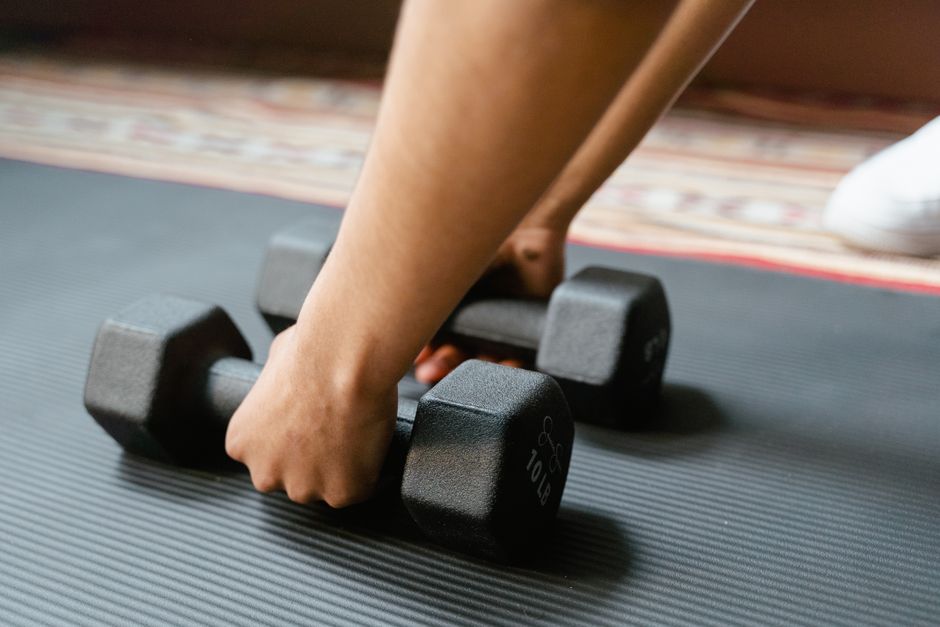
Wrist pain in yoga rarely means your wrists are weak in a general sense. It usually means the tissues in the wrist are being asked to handle more load, more extension, or more time under pressure than they are currently conditioned for. Strengthening the wrists for yoga means building tolerance gradually in the positions yoga actually uses — hands on the mat, weight shifting forward, and the wrist bent back into extension. That is a trainable skill, and most people can improve it with consistent, progressive loading.
Why Do My Wrists Hurt During Yoga?
The wrist is a small joint doing a big job. In poses like downward dog, plank, and chaturanga, the entire body weight passes through two hands. The wrist is not designed to bear load in a straight, locked line the way the ankle is. It relies on a stack of small bones, cartilage, ligaments, and tendons to distribute force.
When you place your palm flat and lean forward, the wrist bends backward into a position called extension. Most people can only reach about 70 to 90 degrees of wrist extension. If your forearms and shoulders are stiff, the wrist has to make up the difference. That extra bend concentrates pressure on the back of the wrist joint.
Several things commonly contribute:
- Limited shoulder and thoracic mobility, which forces the wrist to compensate
- Weak or untrained forearm and grip muscles
- Sudden increases in how often or how long you practice
- Repeating loaded poses without enough recovery
- Existing conditions such as old injuries, ganglion cysts, or early arthritis
Pain at the base of the thumb side of the wrist deserves specific attention. It can involve the scapholunate ligament or the tendons that control thumb movement. These are structures that do not always heal well on their own. If pain is sharp, localized, and persists, that is a reason to see a clinician rather than push through it.
How To Strengthen Your Wrists For Yoga No More Pain
The core principle is progressive load. You start with positions that place light stress on the wrist and gradually increase the demand. This is the same principle used in physical therapy for tendon and ligament conditioning. The wrist responds to load by adapting, but it adapts slowly compared to larger muscle groups.
Start with these building blocks:
- Wrist extension and flexion holds. Place your palm on a table, fingers pointing away, and gently lean forward until you feel a stretch or mild load in the wrist. Hold briefly, then switch to the other side.
- Fist and finger loading. Make a fist and press the knuckles into the mat or a wall. This shifts load away from full palm extension and trains the hand in a different position.
- Grip work. Squeezing a soft ball or towel trains the flexor muscles of the forearm, which support the wrist from the front.
- Forearm rotations. Turning the palm up and down against light resistance builds the muscles that control rotation, which matters for hand placement.
Two to three sessions per week is a reasonable starting point for most healthy adults. Sessions do not need to be long. A few minutes of targeted work before or after practice is often enough to create an adaptation over weeks.
If you feel sharp pain, tingling, or numbness, stop. Numbness in the fingers can point to nerve compression, and that is a different problem than muscle weakness. It needs a proper assessment.
Should You Modify Poses While Your Wrists Get Stronger?
Yes, and this is where many people go wrong. They try to strengthen the wrist while continuing to load it heavily in the same painful positions. That is a recipe for a stalled recovery.
Modifying does not mean giving up your practice. It means changing how the load reaches the wrist while you build capacity.
Practical adjustments include:
- Use a wedge or rolled mat. Raising the heel of the hand reduces how far the wrist has to bend into extension.
- Make fists. In poses like plank or downward dog, pressing through fists keeps the wrist in a more neutral position.
- Forearm variations. Forearm plank and forearm-supported poses remove wrist extension entirely.
- Spread the fingers and press through the knuckles. This distributes force across the whole hand instead of concentrating it at the wrist.
- Reduce time in weight-bearing poses. Shorter holds with more rest let the tissue recover between efforts.
The wedge point is worth emphasizing. A small lift under the heel of the hand can meaningfully reduce the angle the wrist must reach. Many people find this alone reduces discomfort enough to keep practicing while they build strength.





What Role Do Shoulders And Forearms Play?
A large share of wrist pain in yoga is not really a wrist problem. It is a load distribution problem.
When the shoulders are tight or the upper back does not extend well, the arm cannot reach a straight line from hand to shoulder. The wrist then has to absorb the extra angle. Improving shoulder flexion and thoracic extension takes pressure off the wrist without touching the wrist directly.
The forearm muscles are the other half of the picture. The muscles that bend and straighten the fingers and wrist live in the forearm. When they are weak, the passive structures of the wrist — ligaments and cartilage — take more of the load. Strengthening the forearm muscles gives the wrist active support.
This is why a program that only stretches the wrist tends to disappoint. Stretching may feel good in the moment, but it does not build the capacity to tolerate load. You need both mobility and strength.
How Long Does It Take To See Improvement?
Timelines vary widely, and no responsible source can promise a specific number of weeks. What is well established is the general pattern: tendons and ligaments adapt more slowly than muscle. Muscle strength can change noticeably within a few weeks of consistent training. Connective tissue remodeling takes longer, often measured in months.
What tends to predict success is consistency and gradual progression rather than intensity. Short, frequent sessions usually work better than occasional hard ones. If you are still in pain after several weeks of sensible loading and modification, that is a signal to get evaluated rather than to push harder.
Persistent wrist pain that does not improve, wakes you at night, or comes with swelling or loss of grip strength is not something to train through. Those features warrant a clinical assessment.
When Should You Not Push Through Wrist Pain?
Some discomfort during loading is normal and expected when you are building strength. Pain that is sharp, sudden, or located in one small spot is different. So is pain that lingers well after practice or gets worse over time.
Warning signs that call for evaluation include:
- Sharp pain at a single point, especially the thumb side of the wrist
- Numbness, tingling, or weakness in the hand or fingers
- Visible swelling or a new lump
- Pain that persists at rest or at night
- Loss of grip strength or dropping objects
These can point to ligament injury, nerve compression, tendon problems, or joint conditions. None of them are diagnosed by how they feel alone. A clinician can examine the wrist, and imaging may be needed.
Yoga is generally adaptable. Almost every weight-bearing pose has a variation that spares the wrist. Working with a teacher who understands wrist mechanics, or a physical therapist if pain is significant, is often the fastest route back to a full practice.
Frequently Asked Questions
Can weak wrists be strengthened for yoga?
Yes. The wrist and forearm respond to progressive loading the same way other tissues do. Consistent, gradual training over weeks to months typically improves tolerance for weight-bearing poses.
Why do my wrists hurt in downward dog but not other poses?
Downward dog places a large share of body weight through the hands with the wrist bent back. If shoulder or upper back mobility is limited, the wrist has to bend further, which concentrates load on the joint.
Is it better to use a wedge or make fists for wrist pain?
Both reduce how far the wrist bends into extension. A wedge lifts the heel of the hand, while fists keep the wrist closer to neutral. The better choice depends on which feels more comfortable for you.
How often should I train my wrists?
Two to three short sessions per week is a reasonable starting point for most healthy adults. More frequent, lighter work often suits connective tissue better than occasional heavy loading.
